Showing posts with label Japanese author. Show all posts

23 August 2024

Review: BUTTER, Asako Yuzuki

  • This edition from Amazon on Kindle
  • ASIN ‏ : ‎ B0CBYJNKTT
  • Publisher ‏ : ‎ Fourth Estate (29 February 2024)
  • Language ‏ : ‎ English
  • Print length ‏ : ‎ 448 pages
  • Page numbers source ISBN ‏ : ‎ 0063236419
  • Translated from Japanese into English by Polly Barton

Synopsis (Amazon) 

The cult Japanese bestseller about a female gourmet cook and serial killer and the journalist intent on cracking her case, inspired by a true story.

There are two things that I can simply not tolerate: feminists and margarine.

Gourmet cook Manako Kajii sits in Tokyo Detention Centre convicted of the serial murders of lonely businessmen, who she is said to have seduced with her delicious home cooking. The case has captured the nation’s imagination but Kajii refuses to speak with the press, entertaining no visitors. That is, until journalist Rika Machida writes a letter asking for her recipe for beef stew and Kajii can’t resist writing back.

Rika, the only woman in her news office, works late each night, rarely cooking more than ramen. As the visits unfold between her and the steely Kajii, they are closer to a masterclass in food than journalistic research. Rika hopes this gastronomic exchange will help her soften Kajii but it seems that she might be the one changing. With each meal she eats, something is awakening in her body, might she and Kaji have more in common than she once thought?

Inspired by the real case of the convicted con woman and serial killer, "The Konkatsu Killer", Asako Yuzuki’s Butter is a vivid, unsettling exploration of misogyny, obsession, romance and the transgressive pleasures of food in Japan.

My Take

This novel really isn't crime fiction, despite the fact that the elephant in the room is a person who has been convicted of the serial murders of lonely businessmen. Manako Kajii is in the Tokyo Detention Centre awaiting the court's confirmation of her guilt. The problem is that each of the 3 businessmen seem to have died from natural causes, nor is there any obvious motives for their deaths, if they were murdered. 

Her mentor suggests that journalist Rika Machida try to write a definitive piece explaining what Kajii's motives were. The problem is that Kajii is refusing all interviews. Eventually Rika, after writing several letters, gets an interview, but then the novel takes a direction which the reader does not expect.

Rika finds that Kajii will only agree to continuing interviews if they talk about food, and in particular, about butter in cooking. Not only that, Rika has to agree to cook the food that Kajii wants her to cook, and then report on how she felt about that experience.  The prime ingredient that Kajii wants Rika to use is butter, currently in short supply in shops and supermarkets in Japan. Kajii determines the recipes and the circumstances under which Rika produces and eats the food.

The novel wears on, and Rika's whole lifestyle changes. And the issue of whether Kajii can be fairly convicted of murder persists.

‘You really didn’t kill them, then? You never actually laid hands on them?’ Kajii shook her head. In that moment, Rika believed her entirely. This is the truth, she thought. This is what I’ve been coming here all this time for – this moment. ‘Did you have the intention to kill them, though? That will be what the trial hinges on.’

My rating: 4.4

About the author 

Polly Barton is a translator based in Bristol. A winner of the Japanese Agency of Cultural Affairs's International Translation Competition, she has received the Kyoko Selden Memorial Translation Prize and the Fitzcarraldo Editions Essay Prize.

Asako Yuzuki was born in Tokyo in 1981. She won the All Yomimono Award for New Writers for her story "Forget Me, Not Blue," which appeared in her debut novel, published in 2010. She won the Yamamoto Shugoro Award in 2015. She has been nominated multiple times for the Naoki Prize, and her novels have been adapted for television, radio, and film. Butter is her first novel published in English.

12 June 2021

review: THE GINZA GHOST, Keikichi Osaka

  •  Format: Kindle (Amazon)
  • ASIN : B0714J93TC
  • Translated by Ho-Ling Wong
  • Publisher : Locked Room International (May 29, 2017)
  • Stories published originally between 1932 and 1947
  • Language : English
  • Print length : 206 pages
  • Page numbers source ISBN : 154305742X

Synopsis (Amazon)

Although the Japanese form of Golden Age detective fiction was re-launched in the early 1980s as shin honkaku by Soji Shimada and Yukito Ajatsuji, the original honkaku dates from the 1930s and one of its pioneers was Keikichi Osaka. The Ginza Ghost is a collection of twelve of his best stories, almost all impossible crimes. Although the solutions are strictly fair-play, there is an unreal, almost hallucinatory quality to them.
Osaka, who died tragically young, was an early pioneer and master of the genre, whose work is only now starting to be re-discovered.

My take

This collection of stories was recently brought to my attention by a fellow blogger at A Crime is Afoot. The stories are essentially mysteries, not necessarily murders. Most of them present "impossible" scenarios, with unusual/unpredictable solutions, some featuring illusions or ghosts.

  • THE HANGMAN OF THE DEPARTMENT STORE, 1932, debut work featuring detective Kyosuke Aoyama
  • THE PHANTASM OF THE STONE WALL, 1935, Kyosuke Aoyama
  • THE MOURNING LOCOMOTIVE, 1934
  • THE MONSTER OF THE LIGHTHOUSE, 1935
  • THE PHANTOM WIFE, 1947, published posthumously
  • THE MESMERISING LIGHT, 1936
  • THE COLD NIGHT'S CLEARING, 1936
  • THE THREE MADMEN, 1936
  • THE GUARDIAN OF THE LIGHTHOUSE, 1936
  • THE DEMON IN THE MINE, 1937
  • THE HUNGRY LETTER-BOX, 1939
  • THE GINZA GHOST, 1936

These stories could have been written in any language, but at the same time you are aware that the settings are a "different" culture, and notes are provided to explain Japanese weights and measures, as well as cultural terms. The ones that stick with me are THE HANGMAN OF THE DEPARTMENT STORE, where a thief is "hoist on his own petard", THE MOURNING LOCOMOTIVE, about a train that keeps killing people, and THE THREE MADMEN, which is truly horrific.

My rating: 4.3

25 July 2012

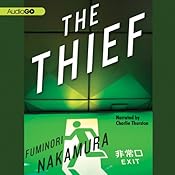
Review: THE THIEF, Fuminori Nakamura - audio book

Synopsis

The Thief is a seasoned pickpocket. Anonymous in his tailored suit, he weaves in and out of Tokyo crowds, stealing wallets from strangers so smoothly sometimes he doesn’t even remember the snatch. Most people are just a blur to him, nameless faces from whom he chooses his victims. He has no family, no friends, no connections....

But he does have a past, which finally catches up with him when Ishikawa, his first partner, reappears in his life, and offers him a job he can’t refuse. It’s an easy job: tie up an old rich man, steal the contents of the safe. No one gets hurt. Only the day after the job does he learn that the old man was a prominent politician, and that he was brutally killed after the robbery. And now the Thief is caught in a tangle even he might not be able to escape.

My take

From a Western point of view, this is an unusual story told from the thief's point of view.
The first signs that things may not be well are the things that appear in his pockets that he doesn't remember lifting.  Has he in his turn been the victim of a skilled pickpocket?

He has been a thief all his life, always coveting the treasures other children had, and gradually perfecting his techniques as a pickpocket. He specialises in replacing the wallets after he has removed what he wants, so the victim does not immediately realise his cash has been taken.

He is alarmed when he meets a boy who shoplifts with his mother and who is setting his sights on life as a pickpocket. He tries to divert the boy, at first refusing to show him any techniques, and then by giving him money to adopt a better life.

The murder of the old man in the house robbery leaves The Thief ensnared in a trap where he is required to steal to order. Failure to carry out the thefts will result in his own death and each task gets harder than the last. He realises he may not be around much longer.

Many other reviewers have commented on the gritty view the novel gives of the underbelly of Tokyo life.

It is a surprisingly short audio book, but is apparently unabridged although Amazon says the hard back version is 304 pages. At first I was put off by the narrator's American accent, but then became used to it.

My rating: 4.5

See another review on Reactions to Reading

LinkWithin

Blog Widget by LinkWithin