Showing posts with label true crime. Show all posts

21 August 2015

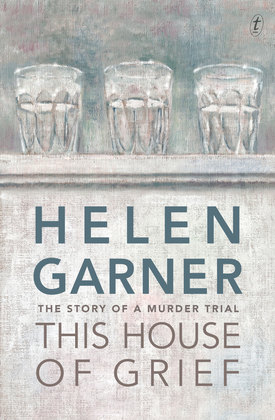
Review: THIS HOUSE OF GRIEF, Helen Garner

Synopsis (Text publishing)

Anyone can see the place where the children died. You take the Princes Highway past Geelong, and keep going west in the direction of Colac. Late in August 2006, soon after I had watched a magistrate commit Robert Farquharson to stand trial before a jury on three charges of murder, I headed out that way on a Sunday morning, across the great volcanic plain.

On the evening of 4 September 2005, Father’s Day, Robert Farquharson, a separated husband, was driving his three sons home to their mother, Cindy, when his car left the road and plunged into a dam. The boys, aged ten, seven and two, drowned. Was this an act of revenge or a tragic accident? The court case became Helen Garner’s obsession. She followed it on its protracted course until the final verdict.

In this utterly compelling book, Helen Garner tells the story of a man and his broken life. She presents the theatre of the courtroom with its actors and audience, all gathered for the purpose of bearing witness to the truth, players in the extraordinary and unpredictable drama of the quest for justice.

My Take

I have been aware of Helen Garner as a writer for many years, but not actually read anything by her during the life of this blog. While you may not see it as much of a movement to go from crime fiction to true crime, reading this book was part of my attempt to read a little more widely than usual.

Ten months after his car left the main road and veered into a dam, drowning his three young sons, Robert Farquharson was committed for trial on three counts of murder. A year passed between the committal hearing and the trial.  Farquharson spent that time on bail, a free man.

Helen Garner and a close friend's daughter, a sixteen year old taking a gap year, squeezed into the press seats with the journalists. The trial would take over five months and Garner was there every day. She takes the reader through the highs and lows of the court room, the mind-numbingness of evidence and expert opinions, and shows us clearly how difficult it is to get to the truth. Her account is detailed, but at the same time she struggles to keep an open mind, and we watch as she swings like a pendulum. By the time the jury goes out to consider its verdict we still don't know which way they will jump.

Garner takes us further than the original trial, into the second trial after the verdict of the first is declared invalid. She shows us clearly the effects not only on Farquharson, but on his former wife, and on the family and friends. 

There is nothing dry about this book. It reads as well as any crime fiction. Garner pays a lot of attention to character study, and she also tells us how what she is witnessing affects her personally.
 
My rating: 4.3


  • Shortlisted, Indie Book Awards, 2015
  • Longlisted, Stella Prize, 2015
  • Shortlisted, Nielsen BookData Booksellers Choice Award, 2015
  • Shortlisted, Kibble Literary Award, 2015
  • Shortlisted, Australian Book Industry General Non-Fiction Award, 2015
  • Shortlisted, NSW Premier's Literary Awards, 2015
  • Shortlisted, Colin Roderick Literary Award, 2015 
  • Shortlisted, Ned Kelly Awards Best True Crime, 2015
  • A Times Literary Supplement Book of the Year, 2014

  • About Helen Garner
    Helen Garner was born in 1942 in Geelong, and was educated there and at Melbourne University. She taught in Victorian secondary schools until 1972, when she was dismissed for answering her students’ questions about sex, and had to start writing journalism for a living.

    Her first novel, Monkey Grip, came out in 1977, won the 1978 National Book Council Award, and was adapted for film in 1981. Since then she has published novels, short stories, essays, and feature journalism. Her screenplay The Last Days of Chez Nous was filmed in 1990. Garner has won many prizes, among them a Walkley Award for her 1993 article about the murder of two-year-old Daniel Valerio. In 1995 she published The First Stone, a controversial account of a Melbourne University sexual harassment case. Joe Cinque’s Consolation (2004) was a non-fiction study of two murder trials in Canberra.

    In 2006 Helen Garner received the inaugural Melbourne Prize for Literature. Her most recent novel, The Spare Room (2008), won the Victorian Premier’s Literary Award for Fiction, the Queensland Premier’s Award for Fiction and the Barbara Jefferis Award, and has been translated into many languages.
    Helen Garner lives in Melbourne.

    21 October 2014

    Review: MOTHERS WHO MURDER, Xanthe Mallett

    • source: Net Galley review copy
    • File Size: 3100 KB
    • Print Length: 265 pages
    • Publisher: Random House Australia (July 30, 2014)
    • Sold by: Amazon Digital Services, Inc.
    • Language: English
    • ASIN: B00IY5QK8O
    Synopsis (Net Galley)

    Child murder: A social taboo and one of the most abhorrent acts most of us can imagine. Meet the women found guilty of murdering their own children. They represent some of the most hated women in Australia. The infamous list includes psychologically damaged, sometimes deranged, women on the edge.

    But, as we will see, accused doesn't always mean guilty. Among the cases covered is that of Kathleen Folbigg, accused and found guilty of killing four of her children, even with a lack of any forensic evidence proving her guilt; Rachel Pfitzner, who strangled her 2-year-old son and dumped his body in a duck pond; as well as Keli Lane, found guilty of child murder though no body has ever been found.

    Dr Mallett goes back to the beginning of each case; death's ground zero. That might be the accused's childhood, were they abused? Or was their motivation greed, or fear of losing a partner? Were they just simply evil? Or did the media paint them as such, against the evidence and leading to a travesty of justice. Each case will be re-opened, the alternative suspects assessed, the possible motives reviewed.

    Informed by her background as a forensic scientist, Xanthe will offer insight into aspects of the cases that may not have been explored previously. Taking you on her journey through the facts, and reaching her own conclusion as to whether she believes the evidence points to the women's guilt.

    Hear their stories.

    My Take

    Those who follow my blog will know that true crime is not really my cup of tea, but each year I set myself a target to read a little outside the genre of crime fiction.

    MOTHERS WHO MURDER looks at a number of Australian cases where the author feels there has been the possibility of a miscarriage of justice. She begins with the case of Lindy Chamberlain, where Lindy claimed a dingo had taken her baby when the family were camping at Uluru. The Northern Territory police decided that Lindy's story could not possibly be true and she was eventually convicted of the murder and disposal of baby Azaria although no body has ever been found. Then the conviction was quashed and an apology issued. But nothing can compensate for the thirty years of anguish suffered by Lindy and her family. For me this chapter acted as a sort of benchmark as I was familiar with the trial.

    Seven individual cases are given individual chapters: mainly of mothers who appear to have been responsible for the deaths of multiple children over a number of years. In most cases there were two or even three children who were thought originally to have died of SIDS. The death of the fourth child raised a flag and sparked an investigation because authorities felt that the fourth death raised questions about the earlier three.

    While the author began with these multiple death cases she also investigated the deaths of individual children, mainly interested in why they happened. These cases are dealt with in less detail, and include cases where a father has taken the life of his children, and sometimes his spouse.

    The chapter on Lindy Chamberlain sets the pattern for those to follow: the background to the case, a description of the main events, why an investigation was conducted and how it panned out, the alternative who (who else might have committed the crime), the how (how the prosecutors behaved and why- their agenda), the role and influence of the expert witnesses, the inquests, the media influence, comparative cases, and the closure of the case. Each time the author identifies how expert witnesses had an influence outside their own area of expertise, often in response to the agenda of the prosecutors who were trying to make the facts fit the case they wanted to prove.

    The author tried hard to be objective and detached in her descriptions and conclusions but she says she recognizes that she became emotionally involved, so horrified was she by what she saw that some children had suffered. She says too that "beyond the children who have been killed, there are many more victims": the police who have to investigate the cases, the social workers, neighbours and community. She does point out times where the responsible authorities, whether because of work overload, inexperience, or lack of follow up, did not take action that might have prevented the death of a child. 
    She also considers the role of the media in raising community awareness, helping to identify perpetrators, or searching for missing children. She believes that in most cases, while some of the media has been sensational and wrong in their opinions, the media has acted responsibly.

    The author sees herself as a "seasoned forensic scientist", with experience first of all in the UK and then in Australia, and draws on cases from both countries, believing there is much to be learnt by comparisons. She points out how some cases and their outcomes in the UK have actually led to precedents being set in legal procedures.

    I found this book well presented, engrossing reading, guaranteed to make the reader think.

    My rating: 4.5

    28 June 2008

    It's True - Well, Almost

    I'm not a great fan of the "true crime" genre and that is probably reflected in the ratings I have given the books I've listed here. However I also concede that many crime fiction authors get their ideas and even a considerable part of their content from true crime files. What I generally dislike about the true crime accounts that I have read is what seems to me the unacknowledged fictionalisation that occurs as the content is padded out and interpreted. The lines between fiction and fact become blurred to the point where the reader is likely to accept everything as "the truth."

    This posting is prompted by the fact I am currently half way through THE TIN ROOF BLOWDOWN by James Lee Burke which is crime fiction based on the crime wave caused in Louisiana by Hurricanes Katrina and Rita. This posting will give me some reflective background for my eventual review.

    The author at whose door the blurred line accusation can be laid is Truman Capote and so my first mini-review is about IN COLD BLOOD, which is generally recognised as founding a new style of writing.

    IN COLD BLOOD, Truman Capote, published 1966
    This reconstructs the murder in 1959 of a Kansas farmer, his wife and their two children by 2 amoral young killers. The book presents the true-fact story almost as if it were fiction with descriptive passages where truth and journalism are inextricably intertwined. The structure that Capote chose for the book gave him the leeway to use the facts to explore the circumstances surrounding the murders, and to consider why they happened, and what the effects were on those who not only remained but investigated the crime.
    My Rating: 4.2

    THE FACE WITHOUT A NAME: FINDING JANE DOE, Norm Lipson & Adam Walters
    True crime story that traces the case of a young woman murdered in Sydney late in 1991. Her body remained unidentified for a number of months and was referred to in the press and publicity as Jane Doe. It was to be a case crucial to the career of a young detective senior constable handling his first homicide investigation. The book recounts the story of the discovery of the body, the steps taken to identify it, the final break-through, and then the eventual tracing of the murderer and his extradition back to Australia. Written by two Sydney journalists, the book also contains an epilogue by the detective, now a detective superintendent. The final chapter is the judge's summing up as he delivered his verdict. A rather "no-frills" account, it will be popular with those who look for something that is easy to read and yet factually accurate.
    My rating: 4.2

    THE RESTLESS SLEEP, Stacy Horn
    Author Stacy Horn spent two years working with New York City’s Cold Case Squad. THE RESTLESS SLEEP in written in the true crime genre pioneered by Truman Capote. It follows four main cases that began as far ago as 1951, and brings them through to the present day. Horn focuses on the methodology of cold case investigations, reconstructing investigations and interviews from dusty archival boxes and public record. In each of the cases Horn had access to the Cold Case Squad detective who worked the case, the commanding officer of their unit, and commanding officer of the Cold Case Squad.
    My rating: 3.2

    KILLING FOR PLEASURE, Debi Marshall
    Do you really know your neighbours? What happens in their house? In their backyard? Would you be living next door to people like this anyway? In 'Killing for Pleasure' Australian journalist Debi Marshall tells the stories behind the grisly Snowtown "bodies-in-the barrels" serial killings, carried out over seven years in South Australia by three killers and their accomplices, both knowing and unwitting. The book took Marshall five years to write, synthesising thousands of hours of interviews with the families of the victims, with neighbours, and with close members of the families of the murderers. What she describes pushes the boundaries of credibility, both in relation to the nature of the murders, and in the slowness of the South Australian police system to begin an investigation into the disappearance of the victims.
    My rating: 4.5

    DONE LIKE A DINNER, Jennifer Cooke & Sandra Harvey.
    The authors tell us in the preface that DONE LIKE A DINNER “is the result of ten years of eating at bistros, brasseries, cafes, pizzerias, coffee shops, clubs, pubs and restaurants, all in the name of research.” The focus of these stories is particularly on gangland wars in Sydney and Melbourne from the 1980s to the first decade of the twenty first century. The ten stories are pieced together from newspaper reports, trial proceedings and through talking to family and other people who remember the incidents. Each chapter begins with an identification of the restaurant, night club or bar and includes in the first pages a recipe that might once have been served there. A Very Fishy Murder, the first story, describes how Andrew Kalajzich of K’s Snapper Inn at Manly came to put a price on his wife’s head and eventually to kill her. In Chapter 2 Ducky O’Connor is killed in a crowded Sydney restaurant by mobster Lennie McPherson. McPherson re-appears in later stories. Chapter 3, Siege at the Spaghetti Speak-Easy, recounts how aboriginal juvenile delinquent Amos Atkinson, panics and holds thirty people hostage at Melbourne’s Italian Waiters’ Club. Finally in the last two stories we see Melbourne at the mercy of extended gangland wars culminating in the cold-blooded murder of Lewis Moran in 2004, and the impact of two decades of bikie gang vendettas in Sydney.
    My rating: 3.8

    29 April 2008

    Gruesome stories

    Sometimes fact is just so much worse than fiction.

    How about this story?: source; A variation here

    At the turn of the last century, Belle Gunness was in the market for a third husband. And many suitors visited from Wisconsin, from Missouri, from South Dakota, some from as far as Norway. They met her at her farm house and many never left. What happened after she courted some of these gentlemen was revealed after a fire ravaged the house one hundred years ago today. The flames consumed Gunness and her three young children, leaving nothing but charred remains. But this is just where the tragic story begins. As police sifted through the ruins they found eleven butchered bodies buried beneath the farm’s hog pen. Reports estimate Belle Gunness may have killed up to 33 people in her lifetime. But did her death end her killing spree? The body thought to be Gunness’s had no head, and that fueled rumors that she’d faked her death, and escaped. Now a new investigation into this century-old mystery has begun. Andrea Simmons is a forensic anthropologist who grew up in LaPorte, Indiana. She says that like all the children there, she was very familiar with the grisly legend of Belle Gunness.

    This past Saturday, Simmons and several decedents of Gunness’s victims got together to commemorate the hundred year anniversary of the fire. They placed headstones on the victims’ graves that have been unmarked since 1908

    Or what about the Smiley Face murder mystery?

    Chris Jenkins was a popular student at the University of Minnesota who disappeared one night in 2003. Four months later, he was found dead in the Mississippi River. At first police thought Jenkins was just a drunk college kid who accidentally fell into the river and drowned after a night on the town.

    But for two retired New York City Police detectives, Jenkins' death became the link that connected the drowning deaths of 40 young men — usually high-achieving college students — in 25 cities in 11 different states.

    More on the site

    LinkWithin

    Blog Widget by LinkWithin