 One of the good friends that I have made through my blogging network is American author Margot Kinberg.
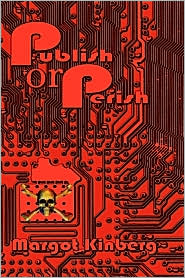
I have also reviewed both Margot's books on this blog
PUBLISH OR PERISH
B - VERY FLAT
Margot's blog Confessions of a Mystery Novelist.... was the featured blog in a recent Agatha Christie Reading Challenge Blog Carnival
It is very clear to me that not only does Margot have an incredible knowledge of crime fiction, particularly of Agatha Christie, she also has all the hallmarks of someone who has studied the genre for a long time.
Margot has been conducting a blog tour for some weeks now and today she is visiting with me.
I asked Margot to talk about who her 10 favourite authors are.
~~~~~~~~~~~~~~~~~~
 Thanks so much, Kerrie for inviting me to guest blog. I’m honored – very honored – to be here. Kerrie’s asked me to blog about my top ten favorite crime fiction authors, and that’s an interesting question, actually. I think people who write can’t help but be influenced by other writers, especially writers whose work they admire. That’s as true of me as it is of anyone else who writes. I’ve learned a great deal from the crime fiction authors I’ve read, and I hope to make my own work better as I keep learning. That’s one reason for which I think it’s so important for writers to also be avid readers; what a rich resource of inspiration, lessons and good ideas other books are!
My only challenge was to narrow down my list to ten authors. There are so many authors whose writing I admire. There are also several authors whose work I think I’d like very much, but haven’t been introduced to yet. That said, here, in no particular order (except for the first entry on the list), is my list of ten authors whose work has really influenced me.
Agatha Christie
I daresay that it won’t come as a shock to anyone that Agatha Christie is my favorite author. Over the course of over fifty years, she wrote novels, short stories and plays that are still read and admired all over the world. I’ve learned so many lessons from reading her work that it’s hard to just focus on a few; she was immensely talented in so many aspects of crime fiction writing.
Dame Christie was a genius at plot twists. The surprise character, the secret identity, the unexpected revelation, and other twists are so deftly done in her novels that I am left in awe. Things are often not as they seem to be in a Christie story, and that’s part of the joy of reading her work.
Christie’s novels also feature finely-drawn characters with whom readers can identify. I try to do that, too, as I think it’s so important. We relate to those characters as the suspense in a Christie story builds, and that’s part of what keeps readers turning pages.
And then there’s the fact that Christie never “talks down” to the reader. Her novels are intellectual challenges, too, and I admire that. There’s much, much more that I admire about Christie’s work, but I’ve been asked to mention nine other authors. So suffice it to say that even at its weakest, Christie’s work is better than that of many others at their best.
Dorothy Sayers
I’m also a great admirer of the writing of Dorothy Sayers. Her Lord Peter Wimsey and Harriet Vane characters still resonate more than eighty years after the publication of Whose Body?. The plots are engaging and sound, the dialogue well-written and the characters memorable.
Dorothy Sayers’ work was, in many ways, ahead of its time, and I’ve always admired her characterization. She allowed her main characters to develop over time, too. In fact, it’s that quality about her work that inspired me to think in terms of writing a series. If you look at the way Wimsey and Harriet Vane, as well as the other characters, grow and change over time, you see well-rounded characters whom you’re glad to see in the next novel.
Ellery Queen
In the Ellery Queen novels, Frederic Dannay and Manfred Bennington Lee created a series of absolutely fascinating intellectual puzzles. That’s what I think I admire most about the Ellery Queen stories. I can often forgive the occasional dated stereotype (and there are several of them) and weak characterization because the Ellery Queen novels challenge the reader’s mind.
In the course of the Queen novels, we encounter “locked room” mysteries, codes, and much more to get the reader thinking. I think it’s the puzzles in these mysteries that have my real admiration. The Ellery Queen mysteries have reminded me that readers want to be challenged. They don’t want to be given everything “up front.”
Tony Hillerman
I’ve seldom had a better sense of place and community than in Tony Hillerman’s novels. There are, of course, other authors such as Martin Edwards, Deon Meyer, Ann Cleeves and Donna Leon who give us a real sense of place. But Hillerman was a master at “taking the reader” to the Southwest United States. The land very often becomes a character, so to speak, in his novels.
Besides that, Hillerman created truly unique sleuths in Jim Chee and Joe Leaphorn. They’re not just cops, and I admire the way that Hillerman added depth and originality to his characters. Hillerman’s work has taught me much about culture, too, and for me, that’s a good reminder that readers often want to learn as well as solve the mystery at hand.
Ruth Rendell
Ruth Rendell is so skilled as a writer that it’s hard to mention just one or two things that she’s taught me. One of the things I admire most about Rendell’s writing is her ability to delve into the psychology of crime. Both under her own name and as Barbara Vine, she’s written memorable studies of what really drives people to crime, and how they react once the crime has been committed. Those characters stay with one after one’s finished reading, and perhaps that’s the greatest compliment I could pay her. Each Rendell novel offers an interesting twist or sub-plot, too, so it’s impossible for the reader to lose interest.
Michael Connelly
Michael Connelly’s Harry Bosch is one of the most memorable sleuths in crime fiction. He’s got a fascinating backstory, he’s complex and he’s certainly flawed. But he is a fascinating character, and he’s far more interested in doing the right thing than he is in promotion, job security, or just about anything else. I admire him for that.
I admire Connelly for the rich way in which he’s developed Bosch over the years. I would like to do the same thing with my own Joel Williams as time goes by, as I think that allowing characters to evolve is part of what makes a series appealing, even after several novels.
I also admire Connelly for his willingness to take on new subjects, try new approaches to plotting, and take other risks. Innovation is an important part, I think, of good writing over time, and Connelly certainly does that.
Arthur Conan Doyle
Conan Doyle created one of the most enduring characters in fiction, Sherlock Holmes. For me, the Holmes stories were really my first introduction, ever, to crime fiction. I started reading Holmes stories as a young girl, and haven’t looked back. They’re full of interesting adventures and the Holmes character is unique.
One of the things I admire about these stories is the fascinating puzzles they offer. I think a well-written mystery should keep the reader guessing. Even “cat-and-mouse” mysteries, where one knows who the killer is, can give the reader intellectual “food,” and that keeps the reader turning pages. In a sense, Conan Doyle’s work pushed me to write by making me wonder if perhaps I could give readers something to guess at, too – sort of challenge the reader.
P.D. James
There is so much to admire, I think, in P.D. James’ work that again, it’s difficult for me to keep myself to just one or a few things. I’ll try, though. I’ve always admired (and I think it’s obvious from just this short list of some of my favorite authors) the intellectual kind of mystery. I like murder mysteries where there’s a challenge for the reader (even if I don’t figure out whodunit before the novel ends). James has done this through the years quite well, whether or not the story has featured her most famous sleuth, Adam Dalgliesh.
James’ work pushed me to do more, though, than just write to keep the reader guessing. Readers also want rich and interesting characters, and she’s always done this well, too. I think well-developed characters that we care about and that we believe are critical to a good story. James gets readers interested in the people in the story, and that’s a real skill. P.D. James has pushed me to create stories where everything – characters, plot, events, and more – falls out naturally and logically from the main point of the story.
Like Connelly, too, James is not afraid to take risks and try different kinds of writing and plots. I admire that, too.
Alexander McCall Smith
McCall Smith’s No. 1 Ladies’ Detective Agency is deeply evocative of place, and I admire that very, very much. We know right away in these novels that we’re in a special place – Botswana – and it’s easy for the reader to “get lost” in a McCall Smith novel for that reason. Even in subtle ways, McCall Smith shows readers what Botswana is like. This series has pushed me to create a place in my own writing, and give readers a real sense of what that place (in my case, a college campus) is like.
More than that, though, McCall Smith has created a sleuth, Mma. Precious Ramotswe, who’s got quiet good sense, a compassionate heart and a sense of humor. I admire her (and McCall Smith, for creating her). I wanted some of the same kinds of qualities for my own sleuth, so although they’re quite different, I must say that Precious Ramotswe has pushed me to make sure my own sleuth is likable.
Colin Dexter
Colin Dexter’s Inspector Morse is an old friend of mine : ). I’ve always admired the Dexter mysteries for several reasons. One of them is that they aren’t “givens.” Some of them are actually quite complex, and they’ve been criticized on that point. But I respect authors who respect readers enough to challenge them. It was Dexter, too, who taught me that university/college towns can be very effective settings for mystery novels. When I decided to write, I learned a lot about integrating the campus setting from the Inspector Morse series.

And then there’s Morse’s character itself. He’s brilliant (which I respect), flawed (which makes him human) and fully aware of it (which makes him more likable). I admire sleuths who aren’t perfect, but whose flaws make them all the more interesting. Morse uses his brain, too, not brawn, and I admire that. Maybe it’s because I was never as much good at games as I was at learning : ).
So there you have it: ten crime fiction authors who have had a profound influence on my writing. I’d also like, if I may, to mention some other authors whose work I admire very much: Martin Edwards, Donna Leon, Caroline Graham, Peter Temple, Michael Robotham, and Yrsa Sigurðardóttir. There are many other authors, too, whose work I’ve read and liked. I’m very fortunate that there’s so much to love in crime fiction. Thanks, Kerrie, for the opportunity to “talk” about it!
~~~~~~~~~~~~~~~~~~~~~~~~~~~
Margot blogs at Confessions of a Mystery Novelist....


