Showing posts with label Andrew Taylor. Show all posts

14 April 2017

Review: THE ASHES OF LONDON, Andrew Taylor

  • format: Kindle (Amazon)
  • File Size: 3680 KB
  • Print Length: 497 pages
  • Publisher: HarperCollins (April 7, 2016)
  • Publication Date: April 7, 2016
  • Sold by: HarperCollins Publishers
  • Language: English
  • ASIN: B015DLTMXG
Synopsis (Amazon)

From the No.1 bestselling author of The American Boy and The Silent Boy comes a brand new historical thriller set during the time of the Great Fire of London. The first of an exciting new series of novels.

A CITY IN FLAMES
London, 1666. As the Great Fire consumes everything in its path, the body of a man is found in the ruins of St Paul’s Cathedral – stabbed in the neck, thumbs tied behind his back.

A WOMAN ON THE RUN
The son of a traitor, James Marwood is forced to hunt the killer through the city’s devastated streets. There he encounters a determined young woman, who will stop at nothing to secure her freedom.

A KILLER SEEKING REVENGE
When a second murder victim is discovered in the Fleet Ditch, Marwood is drawn into the political and religious intrigue of Westminster – and across the path of a killer with nothing to lose…

My Take

It is a while since I have read anything by Andrew Taylor (although there is plenty to choose from)

The Stuart Monarchy was restored in 1660 but things were far from easy for Charles II. There were plenty of opponents to the Restoration. Bubonic plague struck in 1665 and now in 1666 came a devastating fire. The King played a decisive role in fighting the fire, giving instructions to firefighters about blowing up buildings to slow the path of the fire, but there are other things to worry about too.
There is a plot to finish the work begun by the execution of Charles I, to prepare the way for King Jesus.

James Marwood's father, a Regicide himself, and a Fifth Monarchist, took his young son to the Banqueting House to witness the beheading of the king in 1649, and he has never forgotten what he saw. Marwood's father, now suffering dementia and in poor health, has been allowed to live in seclusion but there is always the threat of the past taking its retribution.

The story is told from two points of view: the first person narrative of James Marwood, working for a newspaper publisher, and a third person narrative which follows the story of Cat Lovett, also the child of a Fifth Monarchist.  Her father is thought to be abroad having fled when the new King was crowned. The reader has the advantage of being able to meld the two stories.

The historical detail in the story is entrancing. Both James Marwood and Cat Lovett become connected with Master Hakesby, an elderly draughtsman who is working with Dr Wren, the architect and mathematician whom the King has appointed one of his Commissioners for the rebuilding of London. It is inevitable that their paths will cross.

My rating: 4.5

I've also read
THE BARRED WINDOW
4.5, THE FOUR LAST THINGS
4.4, THE JUDGEMENT OF STRANGERS
4.2, THE ANATOMY OF GHOSTS
4.5, THE OFFICE OF THE DEAD 

18 July 2013

Crime Fiction Alphabet 2013: O is for THE OFFICE OF THE DEAD, Andrew Taylor


Following a pattern established in 2012, my contributions to the Crime Fiction Alphabet in 2013 will mainly feature authors or books that I have read recently.

My choice this week is THE OFFICE OF THE DEAD by Andrew Taylor

Synopsis

It's 1958, and the party's over for Wendy Appleyard: she finds herself penniless, jobless and on the brink of divorce. Who better to come to her rescue than her oldest friend, Janet Byfield?

So Wendy goes to stay with Janet, who seems to have everything Wendy lacks: a handsome husband, a lovely little daughter, Rosie, and a beautiful home in the Cathedral Close of Rosington. David Byfield is on the verge of promotion, and Janet is the perfect wife for an ambitious young clergyman. But perfection has always been dangerous, and gradually the idyll sours.

Old sins come to haunt the present and breed new sins in their place. The shadow of death seeps through the Close, and with it comes the double mystery stretching back to turn-of-the-century Rosington, to a doomed poet-priest called Francis Youlgreave.

Only Wendy, the outsider looking in, glimpses the truth. But can she grasp its dark and twisted logic in time to prevent the coming tragedy. The Office of the Dead is a chilling novel of crime and retribution, and is the third volume of Andrew Taylor's stunning and acclaimed Roth Trilogy.

See my review

See what others have chosen for the letter O.

20 January 2013

Review: THE OFFICE OF THE DEAD, Andrew Taylor - audio

Synopsis (Fantastic Fiction)

It's 1958, and the party's over for Wendy Appleyard: she finds herself penniless, jobless and on the brink of divorce. Who better to come to her rescue than her oldest friend, Janet Byfield?

So Wendy goes to stay with Janet, who seems to have everything Wendy lacks: a handsome husband, a lovely little daughter, Rosie, and a beautiful home in the Cathedral Close of Rosington. David Byfield is on the verge of promotion, and Janet is the perfect wife for an ambitious young clergyman. But perfection has always been dangerous, and gradually the idyll sours.

Old sins come to haunt the present and breed new sins in their place. The shadow of death seeps through the Close, and with it comes the double mystery stretching back to turn-of-the-century Rosington, to a doomed poet-priest called Francis Youlgreave.

Only Wendy, the outsider looking in, glimpses the truth. But can she grasp its dark and twisted logic in time to prevent the coming tragedy. The Office of the Dead is a chilling novel of crime and retribution, and is the third volume of Andrew Taylor's stunning and acclaimed Roth Trilogy.

My Take


With The Roth Trilogy of which THE OFFICE OF THE DEAD is the last published, but the first in strict chronological order of events, Andrew Taylor attempted to do something alarmingly strange.
Now I've finished reading all three, I feel like I should go back and read them all again. The author says I can read them in any order, but I suspect that is not really so. I think also it will help if you read them all within a short time frame, not, as I have done, over an extended period.

It is not just the linked histories of the Appleyards and the Byfields that bind the novels together as one, but the presence throughout of the rather sinister (or was he, as some characters insist, a "good" man, ?), Canon Francis Youlgreave.


The Roth Trilogy

Previously reviewed
THE BARRED WINDOW
4.5, THE FOUR LAST THINGS
4.4, THE JUDGEMENT OF STRANGERS
4.2, THE ANATOMY OF GHOSTS

Top marks to Andrew Taylor for a thoroughly intriguing series in which more than one crime, more than one murder, is committed. The characters are strong, red herrings abound.

My rating: 4.5

Read more for yourself about the Roth Trilogy on Andrew Taylor's site.

18 January 2012

Review: THE ANATOMY OF GHOSTS, Andrew Taylor


  • published by Penguin 2010
  • 469 pages
  • ISBN 978-0-718-15659-6
  • source: local library
Synopsis (Fantastic Fiction)

1786, Jerusalem College Cambridge. The ghost of Sylvia Whichcote is rumoured to be haunting Jerusalem since disturbed fellow-commoner, Frank Oldershaw, claims to have seen the dead woman prowling the grounds. Desperate to salvage her son's reputation, Lady Anne Oldershaw employs John Holdsworth to investigate.

Subtitled: An Inquiry into the distressing circumstances surrounding an alleged apparition lately recorded in Cambridge. Set Down for the Curious in the Form of a Novel.

My take:

The novel is set against background of a fictional college, the Jerusalem College, in Cambridge. In an author's note Andrew Taylor admits "remarkable similarities [that extend only to its layout and aspects of its early history] between the fictional Jerusalem College and the entirely real Emmanuel College".

The novel opens with a meeting of the Holy Ghost Club in Jerusalem College. The club is part of the social fabric of the college, designed to introduce a group of select members to the rather more dissolute habits. The club is a focal point in John Holdsworth's investigation into the derangement of College fellow Frank Oldershaw.

The original The Anatomy of Ghosts is a pamphlet that Holdsworth wrote to help him come to terms with the deaths of his son and then his wife by drowning and his feeling that they are haunting him. While she was still alive his wife had been preyed upon by some unscrupulous people. Holdsworth was keen to show that they had been instrumental in bringing about the suicide of his wife who had been convinced she was being visited by their son's ghost. His book brings him to the notice of Lady Anne Oldershaw who commissions him to investigate the madness of her son which has apparently been caused by the appearance of a ghost.

Jerusalem College is a close knit and closed community with the usual power rivalries at the top and distinct social strata. Lady Anne Oldershaw is a patron of the college and so Holdsworth will be staying in the Master's house under the pretext of organising the college library. He is also charged with trying to bring Frank Oldershaw back to health.

At the same time as being a detective story that follows a trail of clues to a final denouement THE ANATOMY OF GHOSTS provides an interesting insight into academic and social life in a Cambridge university college in the late eighteenth century. The novel won't be everybody's cup of tea, but it has the feeling of a scholarly work, with attention to authentic historical detail.

My rating: 4.2

Other reviews to check:
Other reviews of Andrew Taylor titles on MiP:
THE BARRED WINDOW
4.5, THE FOUR LAST THINGS
4.4, THE JUDGEMENT OF STRANGERS

9 November 2011

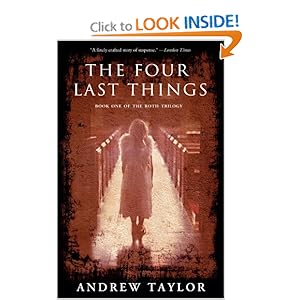
Review; THE FOUR LAST THINGS, Andrew Taylor - audio book

  • Published 1997
  • This audio book version published by AudioGO Ltd.
  • Available from Audible.com 
  • Narrator by Ric Jerrom 
  • Unabridged
  • Length: 11 hours
  • Source: I bought it
  • First book in the Roth Trilogy
Synopsis

Little Lucy Appleyard is snatched from her child minder's on a cold winter afternoon, and the nightmare begins. It is as if the child had disappeared into a black hole with no clues to her whereabouts...until the first grisly discovery in a London graveyard. More such finds are to follow, all at religious sites. In a city haunted by religion, what do these offerings signify?

My take

Like all Andrew Taylor's books THE FOUR LAST THINGS is complex with great attention to detail.

The storyline sounds so simple if you just go by the synopsis but there is a multiplicity of themes and threads: should women be priests? Whose job is more important: husband or wife? Paedophilia and child abduction.

The novel is tightly structured. Each chapter is prefaced with a quotation from Thomas Browne's Religio Medici. The first quotation in the book defines what "the four last things" are.

Click on the image of the cover to the right to access the abstract of the printed version on Amazon. You can also access a sample of the audio version by clicking on the link to Audible.com.

The complexity of THE FOUR LAST THINGS extends from the plotlines into character descriptions including deep consideration of what drives those characters.

I reviewed #2 in the Roth Trilogy earlier this year: THE JUDGEMENT OF STRANGERS
Andrew Taylor explains what he is attempting to do in the Roth Trilogy as
    Each book discreetly modifies the others, and each is written in a different style. Taken as a whole, they make one large novel, which should keep readers occupied for the longest transcontinental flights.
The structure of the trilogy is made all the more complex by the fact that as you move from #1 to #2 you actually move back in time. If you click on the link on Andrew Taylor's name you can visit his website and investigate more about the trilogy for yourself.

The narration in the audio version of the novel is very well done.

My rating: 4.5

21 April 2011

Review: THE JUDGEMENT OF STRANGERS, Andrew Taylor - audio

Available from Audible.com
Narrated by Ric Jerrom 
Length: 10 hours 8 mins
Publisher: BBC WW
Originally published: 1998

Publishers blurb:
David Byfield, a widowed parish priest, brings home a new wife. Soon the murders and blasphemies begin. But does the responsibility lie in the present or the past? And can Byfield break through to the truth before the final tragedy destroys what he most cherishes?

My take:
Once I started listening to this, from somewhere the vague knowledge surfaced that it was part of Taylor's Roth trilogy. In fact, I know I had intended to read the trilogy once and here I was listening to #2 in the series.

It is ten years since his first wife died and David Byfield has been celibate all that time, focussing his attention on bringing up his daughter Rosemary, who is now getting ready for her university entrance exams. Rosemary is resentful of her new step-mother Vanessa, and Vanessa has no intention of being simply a vicar's wife. She has a successful career in publishing and has no intention of abandoning it.

Roth Park, the manor house near the vicarage, has recently been bought by Toby Clifford and his sister Joanna. They have hopes of turning it into a classy hotel.

The village of Roth, on the outskirts of London, and being brought closer to the city by a motorway, is about to have the church fete and on night of the fete everything comes to a climax.

THE JUDGEMENT OF OTHERS is a deceptive mixture of saga, village cozy, romance, and crime novel with a slight touch of the paranormal.
Sometimes you feel sorry for David Byfield, at other times you feel like shaking him.

My rating: 4.4

I remember hearing Andrew Taylor talking at a Writers Festival (perhaps Adelaide some years back) talking about the Roth trilogy.
There are 3 books in the trilogy:
1. The Four Last Things (1997)
2. The Judgement of Strangers (1998)
3. The Office of the Dead (2000)
and then they were published as Requiem for an Angel (omnibus) (2002)  aka Fallen Angel
The blurb for the latter gives a clue about the structure of the trilogy:
Beginning, in "The Four Last Things", with the abduction of little Lucy Appleyard and a grisly discovery in a London graveyard, the layers of the past are gradually peeled away through "The Judgement of Strangers" and "The Office of the Dead" to unearth the roots of a very immediate horror.

Well, it has me hooked. I'm going to listen to THE FOUR LAST THINGS next.

12 November 2009

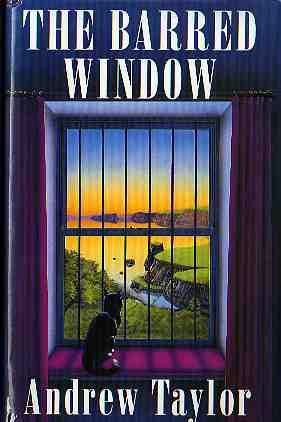
Review: THE BARRED WINDOW, Andrew Taylor

I listened to this as a download from Audible.com
According to Fantastic Fiction it was published in 1993, the same year in which the book is set.

Quite a long book, and I spent much of the time wondering if it was actually crime fiction, although in my heart of hearts I knew it was.

You know, for example, that nasty things have happened in Finisterre, the house Thomas inherited from his mother. People have died, including his father, his baby cousin Lizzie, and his wife Lillian. The room his father and Lizzie died in is referred to as the Death Room. It is not an accident either than Finisterre rhymes with Sinister.

The tension mounted in the last hour or so of the book, and I really began to question who was telling the truth. The eventual truth is horrifying, but you are still left wondering about which version to believe.

On his site Andrew Taylor says
"THE RAVEN ON THE WATER and THE BARRED WINDOW both explore the relationship between now and then: as a writer I'm fascinated by the fact that if you want to understand the present, you have to go back to the past. Both novels use a double narrative technique, in which the distant past and the recent past unfold together until they converge in the present. Both deal with the long shadows cast by old crimes.

THE BARRED WINDOW was widely reviewed as mainstream fiction. It is set in Cornwall and uses many of the conventions of the Gothic novel. One of its themes is the blurred dividing line which sometimes exists between predators and victims."


Read a few pages of THE BARRED WINDOW here. Listen to a sample here.

My rating 4.5

I haven't read as many of Andrew Taylor's books as I would like.
He was the winner of the CWA Cartier Diamond Dagger in 2009 for "sustained excellence in crime writing."
His blog site. Books listed on Fantastic Fiction.

Here are some mini-reviews from my database.

CAROLINE MINUSCULE (1982), my rating 4.2
William Dougal has had a nasty shock. When he went to see his lecturer in medieval languages Doctor Gumper, there he was lying inconsiderately on the floor of his study, not only dead but garrotted! William decided not to become involved in any way and removed any evidence of himself from the scene, and then departed, leaving it to the next person to discover the body to report the murder. Imagine his surprise when, as he leaves the college by the side entrance, a stranger joins him from the shadows, saying "I've been waiting for you. I'd like to have a chat". CAROLINE MINISCULE is the beginning of the Dougal series.

AN AIR THAT KILLS (1994), my rating 4.3
The bones of a baby are discovered in a disused privy as workmen demolish an old inn in a small market town on the England/Wales border in the 1950s. Newly arrived Detective Inspector Thornhill is called in to investigate what appears to be an old Victorian murder case. This is the first of Taylor's Lymouth series. It reminds me of Dorothy Simpson's Inpector Thanet series. Thornhill and Thanet have a lot in common. A fairly placid cozy.

DEATH'S OWN DOOR (2001), my rating 4.5
#6 in Taylor's Lydmouth series. Edith, wife of D. I. Richard Thornhill of Lydmouth, returns to nearby Trenalt for the funeral of Rufus Moorcroft, someone she knew when she was much younger. The funeral draws a number of her 'old crowd' back together, first to the funeral, and then as part of the investigation surrounding Moorcroft's death. The plot thickens when the elderly and decidely odd Cicely Caswell is found dead on the railway line, and events that occurred decades before become important. Edith has a little fling with a former flame, set against the larger backdrop of her husband's much more serious affair with Jill Francis, editor of the Lydmouth Gazette. (I wish I'd read this series in order though)

CALL THE DYING (2004), my rating 4.4
Love and need make unexpected bedfellows, and both are blind. As the grip of a long hard winter tightens on Lydmouth, a dead voice calls the dying in a séance behind net curtains. Two provincial newspapers are in the throes of a bitter circulation war. A doctor finds his Nemesis and an office boy loses his heart. In Lydmouth, it is the year when the fog is particularly bad - and when the rats are fed on bread and milk, a gentleman's yellow kid glove is mislaid, and something disgusting is happening at Mr Prout's toyshop. It's also the year when Jill Francis returns to Lydmouth as editor of the Gazette. There's no pleasure left in the life of DCI Richard Thornhill. Only a corpse, a television set and the promise of trouble to come. 7th in the Lydmouth series. Quite tightly written.

2 August 2008

Riding on the coat-tails, or plagiarism?

This is a question of continuing interest to me. Let me assure you it occurs in crime fiction, and murder mystery fiction, as in all other forms of writing.

Here is the Wikipedia definition, although I think this states the case rather more crudely than I am thinking of: Riding coattails is a metaphor that refers to the way in which lower level or uninspiring celebrities can often reach stardom through their ties to another, more popular and successful celebrity. This can often be used as a generic phrase for anyone that hangs onto another person as they forge ahead, without effort from the hanger-on.

Let me explain.

Last year I read A GENTLE AXE by R.N. Morris. ( I gave it 4.2)
Here is what I wrote:
St. Petersburg December 1866. An old woman foraging for whatever she can find discovers two frozen bodies in Petrovsky Park. One swings from the branch of a tree. In a large leather suitcase at his feet she finds the curled up body of a dwarf, his head split open as if with an axe. In his pockets she finds a pack of pornographic cards, a small key, and a bulging envelope of bank notes. Russia in 1866 is transforming itself into an industrial society, and the creation of a specialist department to investigate serious crimes is part of the transformation. Enter Porfiry Petrovich, newly appointed investigating magistrate for the Department of the Investigation of Criminal Causes. Author R. N. Morris has attempted to write not only a richly textured and authentic crime novel, but to do it in a style seen in writers like Dostoevsky, and more recently in the success of Boris Akunin. This is a world dominated by squalor, crowded tenements, poverty stricken students, and people who need to make a living however they can.
Morris has written A GENTLE AXE as a sequel to Dostoevsky’s CRIME AND PUNISHMENT. The clues are all there – the references to the earlier axe murders, to Raskolnikov, the detective is Porfiry Petrovich, the location in St. Petersburg, quotes from Dostoevsky and even a limited amount of direct acknowledgement. I missed realizing this because CRIME AND PUNISHMENT is not where I am coming from (40 years since I read it). The novel has caused quite a lot of comment in relation to plagiarism and identity theft, and Morris has joined quite a chain of writers who are continuing the work of the more famous. Recently he has published a sequel: A VENGEFUL LONGING.

Let's take a second, more recent case.
Recently Reginald Hill published A CURE FOR ALL DISEASES and I reviewed it (my rating 5.0).
Reginald Hill dedicated this novel "To Janeites everywhere". He says this novel has been ten years in the making, from seeds sown when he visited the Jane Austen Society's of North America's AGM. Reginald Hill wrote this novel not only for crime fiction readers, for those eagerly awaiting the next Dalziel & Pascoe, but also for those who know their Jane Austen.
My advice to you, dear reader, read everything.
You might like to check what he has done. Here is an earlier posting.
See also
http://en.wikipedia.org/wiki/Sanditon
http://www.pemberley.com/janeinfo/janewrit.html
http://tinyurl.com/4lenec
So is this taking the ideas of another, or a tribute to a master?
I would strenuously argue that what Hill has done is much harder than plagiarism.
Someone on the 4MA list has asked whether you need to check the Jane Austen connection to appreciate the book. My answer: if you understand what he has done in writing this book, then your appreciation of the book is heightened.

Just recently though, a fellow reader on the oz_mystery_readers list recommended Laurie King as a much under-rated, under-read author. The recommended book was THE BEEKEEPER'S APPRENTICE. Here is the blurb:
Set in 1914, a young woman, Mary Russell meets a retired beekeeper. His name is Sherlock Holmes, and he sees a fellow intellect in 15-year-old Mary, so takes her as his apprentice. Together, they tackle crimes and investigations, as Sherlock becomes Mary's mentor and friend.
Now I haven't read this yet, so can't really express an opinion, but it does seem to be me to be a bit like coat-tails riding.

But look, Laurie King is not on her own! Here are a couple that I know of:

ENTOMBED by Linda Fairstein My rating 5.0
Workers demolishing a nineteenth-century brownstone where Edgar Allan Poe once lived discover a human skeleton entombed -- standing -- behind a brick wall. When sex crimes prosecutor Alexandra Cooper hears about the case, it strikes her as a classic Poe scene...except that forensic evidence shows that this young woman died within the last twenty-five years. Meanwhile, Alex's old nemesis the Silk Stocking Rapist is once again terrorizing Manhattan's Upper East Side. The attacks soon escalate to murder, and the search leads Alex and detectives Mercer Wallace and Mike Chapman to the city's stunning Bronx Botanical Gardens. There, an enigmatic librarian presides over the Raven Society, a group devoted to the work of Poe.
This was an engrossing read. There's a lot of detail about Poe (and who knows if it is correct) but certainly we have all read some Poe at some time. I can believe too the claim made in the book that Poe was the originator of the detective novel. There were parts of the novel which were very Poe-ish in their macabre-ness and suspense.

THE AMERICAN BOY by Andrew Taylor
Blurb from Fantastic Fiction
Interweaving real and fictional elements, The American Boy is a major new literary historical crime novel in the tradition of An Instance of the Fingerpost and Possession. Edgar Allan Poe is the American boy, a child standing on the edge of mysteries. In 1819 two Americans arrive in London, and soon afterwards a bank collapses. A man is found dead and horribly mutilated on a building site. A heiress flirts with her inferiors. A poor schoolmaster struggles to understand what is happening before it destroys him and those he loves. But the truth, like the youthful Poe himself, has its origins in the new world as well as the old. The American Boy is a 21st-century novel with a 19th-century voice. It is both a multi-layered literary murder mystery and a love story, its setting ranging from the coal-scented urban jungle of late Regency London to the stark winter landscapes of rural Gloucestershire. And at its centre is the boy who does not really belong anywhere, an actor who never learns the significance of his part.

And there are many more. What do you know of? How do you feel about novels that are sequels to, or use the characters of, novels of already famous authors, or include fictitious renditions of famous people long dead? Am I being too picky? Does this practice muddy our knowledge of history - my guess is that is where I am coming from. Not a moral question at all, but rather how we will recognise the original ideas from the stuff that comes afterwards in the tributes and emulations. It is probably the same question as- if we take a historical setting and create a historical fiction, how we distinguish the real facts from the fiction. Or doesn't it matter?

LinkWithin

Blog Widget by LinkWithin