Showing posts with label Barbara Vine. Show all posts

22 December 2021

Review: THE BLOOD DOCTOR, Barbara Vine

  • this large print edition published by Chivers Press 2002
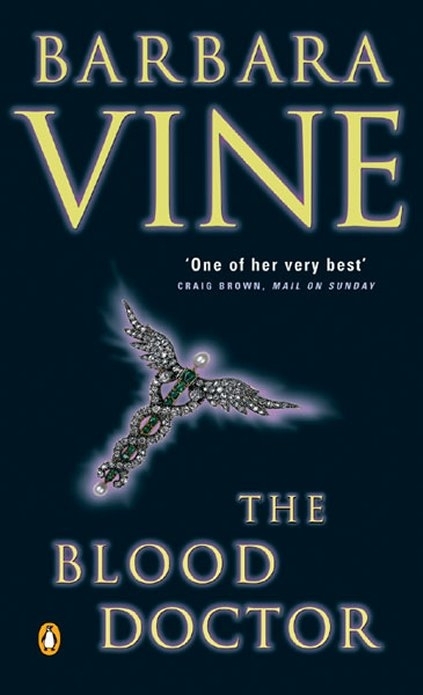
  • ISBN 0-7540-1786-9
  • 507 pages

Synopsis (publisher)

Barbara Vine's new novel is about blood - blood in its metaphysical sense as the conductor of an inherited title and blood in its physical sense as the transmitter of disease.

The current Lord Nanther, experiencing the reform of the House of Lords, embarks on a biography of his great-grandfather, the first Lord Nanther, favoured physician to Queen Victoria, expert on blood diseases and particularly the royal disease of haemophilia. What he uncovers begins to horrify him as he realizes that Nanther died a guilty man - carrying a horrific secret to the grave.

The Blood Doctor weaves effortlessly between past and present, public life and private life. The result is a superbly satisfying novel about ambition, obsession and bad blood.

My Take

As she often did, Barbara Vine (Ruth Rendell) took circumstances that were prompted by her position and work in the House of Lords as a springboard for this stand-lone novel. She was appointed a Commander of the Order of the British Empire (CBE) in the 1996 Birthday Honours and a life peer as Baroness Rendell of Babergh, of Aldeburgh in the County of Suffolk, on 24 October 1997. She sat in the House of Lords for the Labour Party. In 1998 Rendell was named in a list of the party's biggest private financial donors. 

The reform of the House of Lords took place in 1998 just after she had been made a life peer so what is happening to Martin Nanther is essentially what was happening there, although of course she was a life peer, not an hereditary one like Nanther.

By the time of the reform, the House of Lords was being overwhelmed by an excess of hereditary peers and had become unsustainable and unwieldy in its present form. The idea that the blood of the hereditary peers was somehow "special" had lost favour. They wouldn't lose their titles or their estates, simply their right to sit in the House of Lords.

Martin Nanther has begun amassing memorabilia about his great grandfather Henry Nanther, given a hereditary peerage at the end of the nineteenth century by Queen Victoria for his work on diseases of the blood, particularly of haemophilia of which she was a carrier (which she refused to recognise), and which her own sons and grandsons were afflicted by.

Martin is transfixed by a letter written by one of his great-aunts in which she says Henry Nanther had done terrible things. Martin aims to eventually write a biography of his great-grandfather, and his research takes him to meet cousins and distant relatives whom he has never met, and to become aware of the presence of "tainted" blood in his own family.

Running alongside the main plot is the sub-plot of Martin and his second wife Jude attempting to have a baby, and the revelation that it is a genetic problem that is causing her frequent miscarriages.

This wasn't a book I could read quickly. There was quite a lot of history to absorb, and though I read it in large print, or perhaps because I did, it was also quite weighty.

However, a fascinating read.

My rating:  4.7

I've also read 

Vine, Barbara:
THE BIRTHDAY PRESENT
4.8, A DARK ADAPTED EYE
4.3, THE CHILD'S CHILD

Rendell, Ruth:
FROM DOON WITH DEATH - Wexford #1
4.5, A NEW LEASE OF DEATH- Wexford #2
4.6, THE BEST MAN TO DIE - Wexford #4
4.3, A SLEEPING LIFE, Ruth Rendell  - Wexford #10 
4.7, PUT ON BY CUNNING - Wexford #11
4.6, THE VAULT- Wexford #23
4.5, NO MAN'S NIGHTINGALE- Wexford #24
PORTOBELLO
4.7, THE MONSTER IN THE BOX
4.5, A SIGHT FOR SORE EYES
4.5, THE SAINT ZITA SOCIETY
4.6, THE MASTER OF THE MOOR
4.4, DARK CORNERS
4.6, A SPOT OF FOLLY  

31 October 2019

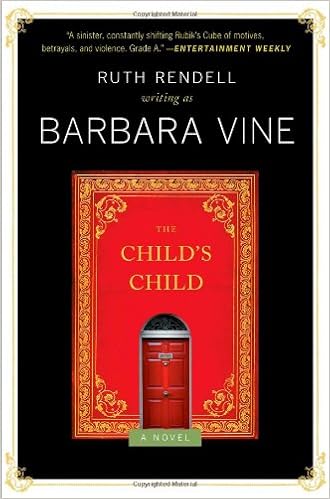
Review: THE CHILD'S CHILD, Barbara Vine

  • this edition published by Scribner 2012
  • ISBN 978-1-4516-9489-5
  • 302 pages
  • source: my local library
Synopsis (Amazon)

From three-time Edgar Award–winning mystery writer Ruth Rendell, writing here under her Barbara Vine pseudonym, an ingenious novel-within-a-novel about brothers and sisters and the violence lurking behind our society’s taboos.

When their grandmother dies, Grace and Andrew Easton inherit her sprawling, book-filled London home, Dinmont House. Rather than sell it, the adult siblings move in together, splitting the numerous bedrooms and studies. The arrangement is unusual, but ideal for the affectionate pair—until the day Andrew brings home a new boyfriend. A devilishly handsome novelist, James Derain resembles Cary Grant, but his strident comments about Grace’s doctoral thesis soon puncture the house’s idyllic atmosphere. When he and Andrew witness their friend’s murder outside a London nightclub, James begins to unravel, and what happens next will change the lives of everyone in the house. Just as turmoil sets in at Dinmont House, Grace escapes into reading a manuscript—a long-lost novel from 1951 called The Child’s Child—never published because of its frank depictions of an unwed mother and a homosexual relationship. The book is the story of two siblings born a few years after World War One. This brother and sister, John and Maud, mirror the present-day Andrew and Grace: a homosexual brother and a sister carrying an illegitimate child. Acts of violence and sex will reverberate through their stories.

The Child’s Child is an enormously clever, brilliantly constructed novel-within-a-novel about family, betrayal, and disgrace. A master of psychological suspense, Ruth Rendell, in her newest work under the pseudonym Barbara Vine, takes us where violence and social taboos collide. She shows how society’s treatment of those it once considered undesirable has changed—and how sometimes it hasn’t.

My take

Two fairly parallel stories, history repeating itself. Also a novel about how social conventions have changed over a century. For example our attitudes to homosexuality have changed, as they have to unmarried mothers. There is a suggestion made that the attitudes changed around the same time.

The structure is a book within a book, a challenge for any author. We begin in the modern day and are then transported to a plot within the plot. In my opinion the "inner book", the manuscript that Grace is reading, is just a bit long, and almost turns into a family saga. But just in time we emerge back into the modern day.

Is it crime fiction? Well yes, there is a murder: the culprit is brought to trial and executed. But, by the laws of the day, there are other crimes for which penalties are not applied.

It wasn't my favourite Barbara Vine book, and I don't seem to have found it as fascinating as other reviewers but it is certainly clever.

My rating: 4.3

I've also read
THE BIRTHDAY PRESENT
4.8, A DARK ADAPTED EYE

12 September 2013

Review: A DARK ADAPTED EYE, Barbara Vine - audio book

Just over a month ago I wrote a post for Friday's Forgotten Books about A DARK ADAPTED EYE which apparently I originally read 20 years ago. As is the way of things, I could remember almost nothing about it and decided to re-read it. I settled on an audio version read by Harriet Walter available from Audible.

The book was first published in 1986.
The audio version is 11 hours and 46 minutes of enthralling listening.

Synopsis

When Faith Severn's aunt was hanged for murder, the reason behind her dark deed died with her. For 30 years, the family hid the truth--until a journalist prompts Faith to peer back to the day when her aunt took knife in hand and entered a child's nursery.

The novel won an Edgar Award and then was made into a BBC film for TV in 1994.

The title: A dark-adapted eye is one that has adjusted to darkness so that it is able to discern objects. In the context of the novel, the title refers to Faith's ability, after many years, to examine and analyze her family's history and its tragedy.

Publisher's Summary

Like most families, they had their secrets...
...and they hid them under a genteelly respectable veneer. No onlooker would guess that prim Vera Hillyard and her beautiful, adored younger sister, Eden, were locked in a dark and bitter combat over one of those secrets. England in the '50s was not kind to women who erred, so they had to use every means necessary to keep the truth hidden behind closed doors - even murder.

 My Take

This is one of those books that clearly show how Ruth Rendell becomes a different writer when she uses the Barbara Vine pseudonym, at least in the early days. I think later Rendell novels actually have Vine overtones; the police procedurals have more psychological explorations, more description of why characters have acted as they did.  A DARK ADAPTED EYE was the first of the novels written as Barbara Vine and was very different to the Wexford novels, although it showed many similarities in style to the stand alone novels she had already published.

So why did Rendell write as Barbara Vine? I believe she was just too prolific as a writer, writing at least two novels every 3 years, perhaps leading buyers to believe that she was writing pot boilers. Quite simply the extra pseudonym gave her more publication opportunities, and many of her readers did not realise the two writers were the same person.

A DARK ADAPTED EYE explores family relationships. During the bombing of London in 1940 Faith, not yet a teenager, is sent to stay in the country with her father's half-sisters Vera and Eden. In the following years Faith periodically spends extended periods of time with Vera. The setting of England in the 1940s and early 1950s helps us reflect on the impact of events like war on society's values as well as their impacts on individuals.

The novel explores family jealousies that eventually lead to murder. Faith gets an opportunity to look back over events, and to consider what happened with an older eye, when a journalist contacts family members because he wants to write a book about Vera. What is interesting about how Vine has handled this plot is that even in the last pages of the novel there are a number of questions that are not finally resolved, where the reader is required to make their own judgement.

An excellent read and a good Barbara Vine to start with if you've never read one.

My rating: 4.8

26 July 2013

Forgotten Book: A DARK ADAPTED EYE, Barbara Vine (Ruth Rendell)

My plan this year for my contributions to Friday's Forgotten Books hosted by Pattinase is to feature books I read 20 years ago - in 1993- from the records I have in my "little green book", which I started in 1975.
In 1993 I read 111 books and was pretty well addicted to crime fiction by then.

I can see from my records that I had begun to explore the works of Barbara Vine. I am not sure whether at that stage I knew that this was Ruth Rendell writing under another name. I suspect I didn't.
I have found a reference that says that at first both names were shown on covers, but I don't think that was the case in Australian editions. That link also explains how as a child Rendell was often called by both names, and the differences she sees between them.

A DARK ADAPTED EYE  was published in 1986 and was the first of Rendell's novels under the Vine pseudonym. (there are now 15 of them). I read it just over 20 years ago.

Synopsis
When Faith Severn's aunt was hanged for murder, the reason behind her dark deed died with her. For 30 years, the family hid the truth--until a journalist prompts Faith to peer back to the day when her aunt took knife in hand and entered a child's nursery.

The novel won an Edgar Award and then was made into a BBC film for TV in 1994.

The title: A dark-adapted eye is one that has adjusted to darkness so that it is able to discern objects. In the context of the novel, the title refers to Faith's ability, after many years, to examine and analyze her family's history and its tragedy.

Review at BooksPlease

I'm very tempted to re-read the book. It sounds wonderful and I remember almost nothing of it.

9 October 2009

Don't Always Hit the Mark #2

This is a series that I began last week.
The general idea behind it is that even the best authors, or your favourite ones, don't always achieve the same rating with the reader.
There are of course many reasons for this - some of them lie with the author, some with the reader. You probably already recognise the factors that affect how you feel about a book - sometimes it is the plot, sometimes plot lines that don't quite come off, sometimes unconvincing characters, but sometimes too it is your mood when you are reading, factors in your life that the author could not have predicted.

Any way each of these posts will deal with an author or two, and the titles stored on my database as well as those I have reviewed on my blog. Last week I looked at Agatha Christie.

This week I am looking at Ruth Rendell/Barbara Vine.

Here are my records in rating order:

Ruth Rendell

  1. NOT IN THE FLESH (2007) my rating 4.8
  2. END IN TEARS (2005) my rating 4.8
  3. THE FEVER TREE AND OTHER STORIES (1982) my rating 4.8
  4. THE WATER'S LOVELY (2006) my rating 4.7
  5. COLLECTED STORIES (2007) my rating 4.6
  6. FROM DOON WITH DEATH (1964) my rating 4.2
  7. PORTOBELLO (2008) my rating 4.2
My average rating of Ruth Rendell titles is 4.5 which makes them a safe pick for me.

Barbara Vine:
  1. THE MINOTAUR (2005) my rating 5
  2. THE BIRTHDAY PRESENT (2008) my rating 4.1
  3. NO NIGHT IS TOO LONG (1994) my rating 4.0
You can see that the Barbara Vine titles, admittedly there are only 3 of them on my list, although I've actually read many more, don't fare so well.

My general benchmarks are
    5.0 Excellent
    4.0 Very Good
    3.0 Average
    2.0 Poor
    1.0 Did Not Like
    0 Did Not Finish
Reviews on my blog:

Rendell, Ruth:
Vine, Barbara: THE BIRTHDAY PRESENT

All my posts relating to and

19 December 2008

Review: THE BIRTHDAY PRESENT, Barbara Vine

Penguin Books, 2008, ISBN 978-0-67090176-1-7, 274 pages.

MP Ivor Tesham's secret affair with stunningly beautiful housewife Hebe Furnal comes to an abrupt end when she is killed in a car accident. Hebe was only in that car because Ivor had her snatched from the streets in a mock kidnapping, designed to spice up their encounter later that night. The kidnapping/adventure is Hebe's birthday present.

The police investigation after the accident comes to the conclusion that Hebe is the victim of mistaken identity. There is no linking at the time between Ivor and Hebe although there are those who know bits of the truth. For the moment Ivor's meteoric rise in Parliament is unchecked, even when his next girlfriend is the the former lover of the other passenger in the car, who was also killed. But five years later things start to unravel.

The main narrator of THE BIRTHDAY PRESENT is Rob, Ivor's brother in law. I actually found him a very annoying narrator, taking far too long to spill the beans, parsimonious with the truth. He is telling the story retrospectively, there is no doubt that the whole story is all over, but he goes about it in an exasperatingly long winded fashion.
There is a secondary narrator, Jane, Hebe's girlfriend, the source of her alibis when Hebe, a married woman with one child, has an assignation with Ivor. Jane has a sense of foreboding and keeps records on sheets of paper which she keeps in a shoebox in her flat.

There was a point about 70 pages from the end when I wondered why I was still reading THE BIRTHDAY PRESENT. There is a lot of minutiae that feels like the basic story is being padded out. I think perhaps it would have made a good short story or even a novella, and I understand that Barbara Vine wanted to explore the intertwining of relationships between the characters, but I think she really milked this scenario for all it was worth. There's a lot of detail supplied by Rob, in keeping with his pedantic longwindedness, about his family, his children, and how he and his wife Iris are devoted to Ivor. The second narrator Jane, a rather unstable character, similarly supplies details about her relationship with Hebe, and then later with Hebe's widowed husband.

My rating: 4.1

Fantastic Fiction lists the following books for Barbara Vine
A Dark Adapted Eye (1986)
A Fatal Inversion (1987)
The House of Stairs (1988)
Gallowglass (1990)
King Solomon's Carpet (1991)
Asta's Book (1993)
aka Anna's Book
No Night Is Too Long (1994)
In the Time of His Prosperity (1995)
The Brimstone Wedding (1995)
The Chimney Sweeper's Boy (1998)
Grasshopper (2000)
The Blood Doctor (2002)
The Minotaur (2005)
The Birthday Present (2008)
King Soloman's Carpet (2009) - this appears to be a reprint of a similar title published in 2001.

Barbara Vine won an Edgar Award for Best Novel in 1987 for A DARK ADAPTED EYE.

Barabra Vine is a pseudonym for Ruth Rendell.

LinkWithin

Blog Widget by LinkWithin