Remembering World War One through crime fiction
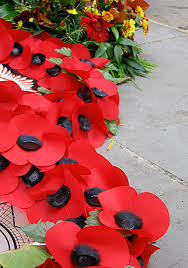
November 11 is Remembrance Day.
At 11 am on that day (whose 11 am? I always wondered as a child ) in 1918 the Armistice was signed officially ending World War One.
The subsequent Treaty of Versailles contained within it the seeds of World War Two, so that it was destined not to be "the war to end all wars" as was hoped at the time.
World War One saw destruction on a scale that no-one could have imagined, an incredible loss of life for all countries involved, changes to create military technology almost beyond recognition, and it had an economic impact that lasted for decades, as well as being instrumental in re-drawing the geographic outline of Europe and the Middle East with reverberations that we are still feeling today.
At the end of this list you will find links to a number of Agatha Christie novels reviewed on this blog. I have come to appreciate Agatha Christie as a largely under-estimated and under-valued, but excellent, social observer of how World War One changed the world forever.
Here are some other novels to look for too.
THE FIRST CASUALTY by Ben Elton. My rating 4.6
The setting is 1917 and the Great War grinds on, with the youth of the British Empire and Germany being sacrificed on the Somme. Douglas Kingsley, an inspector in His Majesty's Metropolitan Police in London, finds himself in gaol when he declares that the war offends his sense of logic. Rejected by his wife and condemned as a conscientious objector, Kingsley is sent to Flanders to investigate the murder of a British officer, also renowned as a poet. The setting in the war allows the author to ask questions about the importance of investigating the murder of one man when so much bloodshed is occurring all the time.
MURDER IN MONTPARNASSE by Kerry Greenwood. My rating 4.6
A Phryne Fisher Mystery read by Julia Davis. At the end of World War 1 in Paris, Bert, Cec and 5 other Australian soldiers witness a murder when a man is pushed under a Paris train. Now, in Australia in 1928, two are very recently dead and Bert and Cec believe they are being targetted. Phryne was in Paris in 1918 and remembers the train incident. It also brings back memories of the man she was infatuated with then. Now she learns that he has recently arrived in Melbourne.
THE SHIFTING FOG (aka THE HOUSE AT RIVERTON) by Kate Morton. My rating 4.7
Set mainly during World War I and immediately after it. Six months before the war starts young Grace Bradley, 14, takes up a position as a housemaid at Riverton Manor. Eighty four years on, she is contacted by a young female filmmaker who is making a romance film about the death of Robbie Harrison, a young poet, who suicided at the house during a mid summer's eve party in 1924. Many will argue this is not a murder mystery, but you'll have to decide for yourself.
BIRDS OF A FEATHER by Jacqueline Winspear. My rating 4.6
This novel is set some time after the first in the Maisie Dobbs series. Maisie is now an established detective with rooms of her own and an assistant. It's now the early Spring of 1930. Her friend Detective Inspector Stratton of Scotland Yard's Murder Squad is investigating a murder case in Coulsden, while Maisie has been summoned to Dulwich to find a runaway heiress. The woman is the daughter of Joseph Waite, a wealthy self-made man who has lavished her with privilege but kept her in a gilded cage. His domineering ways have driven her off before, and now she∂'s bolted again. Waite's instructions are to find his daughter and bring her home. When Maisie looks into the disappearance she finds a chilling link to Stratton's murder case, and to the terrible legacy of The Great War.
PARDONABLE LIES by Jacqueline Winspear. My rating 4.6
A deathbed plea from his wife leads Sir Cecil Lawton to seek the aid of Maisie Dobbs to confirm that his son, an aviator in the Great War, did actually die when his plane crashed in France. It was something his wife never accepted and it was a torment that drove her mad. Lawton believes his son is dead and is expecting Maisie to confirm just that. Maisie was in France during the War herself as a nurse and it is where her friend Simon was wounded and brain-damaged, so going back to France is no easy thing for Maisie. She takes on an extra mission - to find out for her friend Priscilla Evernden what happened to one of her three brothers who were also killed there. I would call this book a comfortable, rather old-fashioned read, which are the qualities that I liked in the first book in the series, and which led others to dislike the book.
DEPTHS by Henning Mankell, my rating 4.4
This is not a Kurt Wallender. The main character is Lars Tobiasson-Svartman a naval depths sounder who is re-charting channels for Sweden's ships at the beginning of World War 1 using a plumb line. He comes across a woman living alone on a skerry, one of the outlying isolated islands, and he can't get her out of his mind. He presents at the beginning of the book as a fairly normal person, if a little too focussed on the power of his plumb line. As the book progresses however you become less and less certain of his normality.
TOUCHSTONE by Laurie R. King, my rating 4.7
Bennett Grey survived being blown up at the end of World War 1. In fact he believes he was blown to pieces and somehow miraculously re-assembled. With the experience came the new ability to see into people, to "feel" accurately whether they are telling the truth. When his ability is noticed he becomes a "touchstone" for British intelligence, useful in prisoner interrogation, and in the development of lie detection technology. Upset by the brutality of the interrogations he participates in, he withdraws from the project and becomes a recluse, abandoning the woman he was to marry, and going to live in Cornwall.
He emerges to help an American agent attached the Bureau of Investigation who is looking for an anarchist, a bomber, thought to be British, already responsible for a number of deaths in the USA.
A TEST OF WILLS by Charles Todd, my rating 4.8
The Great War is over, and Ian Rutledge has survived. He's come back to London Yard to pick up the brilliant career he left in late 1914. But though he's survived he hasn't come through unscathed. He's suffering from shell shock, the legacy of the Somme where he was buried alive, subsequently spending time in a psychiatric hospital. And he carries with him memories that he can't escape.
Rutledge is turning out to be a problem for Superintendent Bowles, his superior at Scotland Yard. Bowles dislikes Rutledge, his education, his reputation as a war hero, and his pre-war history as an intuitive clever detective.
So the request from Warwickshire for help in managing the investigation into the murder of Colonel Harris seems as if heaven sent. The most obvious suspect is a much decorated pilot, a favourite of the Queen's no less, and so the policeman who brings him to trial will be very unpopular.
A TEST OF WILLS is the first in the Ian Rutledge series, written by mother and son team Caroline and Charles Todd.
Agatha Christie titles:
- 1920, THE MYSTERIOUS AFFAIR AT STYLES
- 1922, THE SECRET ADVERSARY
- 1923, THE MURDER ON THE LINKS
- 1924, THE MAN IN THE BROWN SUIT
1924, Poirot Investigates (short stories: eleven in the UK, fourteen in the US)
- 1925, THE SECRET OF CHIMNEYS
- 1926, THE MURDER OF ROGER ACKROYD
- 1927, THE BIG FOUR
- 1928, THE MYSTERY OF THE BLUE TRAIN
- 1929, THE SEVEN DIALS MYSTERY
1929, Partners in Crime (fifteen short stories; featuring Tommy and Tuppence)
- 1930, THE MURDER AT THE VICARAGE
1930, The Mysterious Mr. Quin (twelve short stories; introducing Mr. Harley Quin)
- 1931, THE SITTAFORD MYSTERY (aka MURDER AT HAZELMOOR)
- 1932, PERIL AT END HOUSE


