Showing posts with label Fred Vargas. Show all posts

7 August 2014

Review: DOG WILL HAVE HIS DAY, Fred Vargas

  • published by Harvill Secker 2014
  • ISBN 978-1-846-55820-7
  • translated from French by Sian Reynolds
  • source: my local library
  • The Three Evangelists #2
Synopsis (Random House Australia)

HOW DO YOU SOLVE A MURDER WITHOUT A BODY?

Keeping watch under the windows of the Paris flat belonging to a politician's nephew, ex-special investigator Louis Kehlweiler catches sight of something odd on the pavement. A tiny piece of bone. Human bone, in fact.

When Kehlweiler takes his find to the nearest police station, he faces ridicule. Obsessed by the fragment, he follows the trail to the tiny Breton fishing village of Port-Nicolas – in search of a dog. But when he recruits ‘evangelists' Marc and Mathias to help, they find themselves facing even bigger game.

My Take

I really did find this Fred Vargas novel a most peculiar read. That was probably I have never read the first in The Three Evangelists series and kept expecting her usual sleuth, Inspector Adamsberg, to make an appearance.

The little piece of human bone that Louis Kehlweiler finds convinces him that a murder has taken place. But his contacts tell him that no murder of an elderly woman has been reported. After a week he decides the murder has not taken place in Paris but in the country. By watching the dogs that visit a particular tree in Paris, he identifies one that has come from the country and that leads him to a fishing village in Breton.

A review in The Independent called it a "bizarre tale" with "surreal touches" and it certainly is, but at the same time as stretching the bounds of credibility, there is something compelling about reading it.
Keihlweiler ends up not only identifying a multiple murderer, and tracking down a former lover, but also solving a puzzle related to his own family history. Throw in too an Incredible Machine that performs the role of a modern oracle, with the whole story delivered with patches of quirky humour.

My rating: 4.4

I've also reviewed
SEEKING WHOM HE MAY DEVOUR
THE CHALK CIRCLE MAN
THIS NIGHT'S FOUL WORK
WASH THIS BLOOD CLEAN FROM MY HAND
4.8, AN UNCERTAIN PLACE
5.0, THE GHOST RIDERS OF ORDEBEC 

5 September 2013

What I read in August 2013

Crime Fiction Pick of the Month 2013

A good reading month with a great variety, including a couple that were not crime fiction.
I used my Kindle a lot, and I am convinced it speeds my reading up.

I got a lot closer to completing the 2013 Global Reading Challenge too.

I had 3 books I couldn't pick between for Pick of the Month:
DEADLY HARVEST by  Michael Stanley
THE LAST POLICEMAN by Ben H. Winters
THE GHOST RIDERS OF ORDEBEC by Fred Vargas

Crime Fiction Alphabet 2013: V is for Fred Vargas


Following a pattern established in 2012, my contributions to the Crime Fiction Alphabet in 2013 will mainly feature authors or books that I have read recently.

This week's choice is Fred Vargas, whose  THE GHOST RIDERS OF ORDEBEC was recently named the joint winner of the 2013 CWA International Dagger.

Synopsis

'People will die,' says the panic-stricken woman outside police headquarters. She has been standing in blazing sunshine for more than an hour, and refuses to speak to anyone besides Commissaire Adamsberg. Her daughter has seen a vision: ghostly horsemen who target the most nefarious characters in Normandy. Since the middle ages there have been stories of murderers, rapists, those with serious crimes on their conscience, meeting a grizzly end following a visitation by the riders.

Soon after the young woman's vision a notoriously cruel man disappears, and the local police dismiss the matter as superstition. Although the case is far outside his jurisdiction, Adamsberg agrees to investigate the strange happenings in a village terrorised by wild rumours and ancient feuds.

My review 

See what others chose for the letter V.

2 August 2013

Review: THE GHOST RIDERS OF ORDEBEC, Fred Vargas

  • published: Hardback: 368 pages (Mar. 2013) Publisher: Harvill Secker ISBN: 1846557364
  • Kindle version available Amazon
  • #8 in the Commissaire Adamsberg series
  • translated by Sian Reynolds.
Synopsis

'People will die,' says the panic-stricken woman outside police headquarters. She has been standing in blazing sunshine for more than an hour, and refuses to speak to anyone besides Commissaire Adamsberg. Her daughter has seen a vision: ghostly horsemen who target the most nefarious characters in Normandy. Since the middle ages there have been stories of murderers, rapists, those with serious crimes on their conscience, meeting a grizzly end following a visitation by the riders.

Soon after the young woman's vision a notoriously cruel man disappears, and the local police dismiss the matter as superstition. Although the case is far outside his jurisdiction, Adamsberg agrees to investigate the strange happenings in a village terrorised by wild rumours and ancient feuds.

My Take

THE GHOST RIDERS OF ORDEBEC was recently named the joint winner of the 2013 CWA International Dagger.
The other novel to share the award was ALEX by Paul Lemaitre.
This is the 4th time that Fred Vargas has won the International Dagger.

The judges of the award said
    “for all the differences between these brilliant novels, they share—among their other qualities—an original and absorbing ability to leash incredulity in the name of the fictional contract between author and reader. 
    From the strange presuppositions of their opening pages, these stylish writers – one newly translated, the other long established, give us crime novels with superb plotting, interesting actors old and new, good dialogue in the service of characterisation, leavened by humour (sometimes of the gallows), and always an ability to upset our preconceptions. 
    From the sometimes outlandish imagination which is Fred Vargas to the painfully explicit, but never gratuitous, violence of Pierre Lemaitre, these novels demonstrate the variety and quality of international crime writing.”
I think what struck me about THE GHOST RIDERS is Vargas' "outlandish imagination" - the story begins with a visitation of riders from hell, who point to deaths that will take place soon in a remote Normandy village. Here the author has begun with a grisly legend, and then jumped into a modern day murder or two.

Do people really believe in these hellhounds? Adamsberg is pretty sure he doesn't but others in his team are not sure whether they do or not.

Adamsberg goes off to Normandy and his team in Paris continue to investigate a case where an elderly industrialist has been burnt to death in his car. The culprit seems obvious but Adamsberg is convinced it is out of character for the young man.

This tale is totally captivating. I have this image of Vargas in times gone by, holding an audience spellbound around a camp fire, telling a story that makes you look over your shoulder. The story twists and turns towards its conclusion.

My Rating: 5.0

See another review on Euro Crime.

Other reviews of Vargas titles on this blog
SEEKING WHOM HE MAY DEVOUR
THE CHALK CIRCLE MAN
THIS NIGHT'S FOUL WORK
WASH THIS BLOOD CLEAN FROM MY HAND
4.8, AN UNCERTAIN PLACE

12 May 2013

On the doorstep, waiting to be read

Currently I have many more books in the "waiting to be read" pile than I really have any hope of reading in the near future. Several of them seem to arrive each week at present, and sit on the shelves making me feel guilty.

So I have decided to feature some of them, (mainly review copies forwarded to me by publishers), in a more or less weekly feature, so you get to consider whether you want to read them.
My postings won't be reviews, just titles with publisher's blurbs.
Some I may actually read in the near future and then do a proper review.

I'd like to also stress that there is no rhyme or reason to my selections.

Please note that this listing is in no way a recommendation for you to read a title, simply a chance for you to assess for yourself whether you would like to read it. I will also try to discover whether the book is available on Kindle, particularly for Australian authors which are not necessarily available overseas.
My focus this week is on some e-books, which I have on my Kindle. Some of these are review copies, others books I have recently purchased.

THE LAST POLICEMAN, Ben H. Winters

Recently the winner of Best Paperback Original in the 2013 MWA Edgar Awards.
Published by Quirk 2012
Available on Amazon

Blurb (Amazon)

What’s the point in solving murders if we’re all going to die soon, anyway?

Detective Hank Palace has faced this question ever since asteroid 2011GV1 hovered into view. There’s no chance left. No hope. Just six precious months until impact.
 
The Last Policeman presents a fascinating portrait of a pre-apocalyptic United States. The economy spirals downward while crops rot in the fields. Churches and synagogues are packed. People all over the world are walking off the job—but not Hank Palace. He’s investigating a death by hanging in a city that sees a dozen suicides every week—except this one feels suspicious, and Palace is the only cop who cares.
 
The first in a trilogy, The Last Policeman offers a mystery set on the brink of an apocalypse. As Palace’s investigation plays out under the shadow of 2011GV1, we’re confronted by hard questions way beyond “whodunit.” What basis does civilization rest upon? What is life worth? What would any of us do, what would we really do, if our days were numbered?

PRIMAL, D.A. Serra

Published 2012
Available on Amazon

Blurb (Amazon)

The writer who made you laugh with Punky Brewster, who made you cry with Just Ask My Children, will now make you cringe with PRIMAL. This story was originally purchased by one of America's most prestigious storytellers James Cameron.

What if the worst happens and you are not a cop, or a spy with weapons training and an iron heart? What if you're a schoolteacher - a mother? In this gritty crime thriller a family vacation takes a vicious turn when a fishing camp is invaded by four armed men. With nothing except her brains, her will, and the element of surprise on her side, Alison must kill or watch her family die. And then - things get worse.

THE CELTIC DAGGER, Jill Paterson (Australian author)

Published 2012
Available on Amazon

Blurb (Amazon)

University professor Alex Wearing is found murdered in his study by the Post Graduate Co-coordinator, Vera Trenbath, a nosey interfering busybody. Assigned to the case is Detective Chief Inspector Alistair Fitzjohn. Fitzjohn is a detective from the old guard, whose methodical, painstaking methods are viewed by some as archaic. His relentless pursuit for the killer zeros in on Alex’s brother, James, as a key suspect in his investigation.

Compelled to clear himself of suspicion, James starts his own investigation and finds himself immersed in a web of intrigue, ultimately uncovering long hidden secrets about his brother’s life that could easily be the very reasons he was murdered.

This gripping tale of murder and suspense winds its way through the university’s hallowed halls to emerge into the beautiful, yet unpredictable, Blue Mountain region where more challenges and obstacles await James in his quest to clear himself of suspicion and uncover the truth about his brother.

I reviewed MURDER AT THE ROCKS

THE GHOST RIDERS OF ORDEBEC, Fred Vargas

Published 2013
Available on Amazon

Blurb (Amazon)

'People will die,' says the panic-stricken woman outside police headquarters. She has been standing in blazing sunshine for more than an hour, and refuses to speak to anyone besides Commissaire Adamsberg.

Her daughter has seen a vision: ghostly horsemen who target the most nefarious characters in Normandy. Since the middle ages there have been stories of murderers, rapists, those with serious crimes on their conscience, meeting a grizzly end following a visitation by the riders.

Soon after the young woman's vision a notoriously cruel man disappears, and the local police dismiss the matter as superstition. Although the case is far outside his jurisdiction, Adamsberg agrees to investigate the strange happenings in a village terrorised by wild rumours and ancient feuds.

I've reviewed other novel in this series.

22 June 2011

Review: AN UNCERTAIN PLACE, Fred Vargas

  • Paperback: 416 pages
  • Publisher: Harvill Secker (May 2, 2011)
  • Language: English. Translated from French by Sian Reynolds.
  • ISBN-10: 9781846554452
  • ISBN-13: 978-1846554452
  • ASIN: 1846554454
  • Source: my local library
Note AN UNCERTAIN PLACE is also available for Kindle.


Product Description (Amazon)

Adamsberg travels to London, where a routine conference draws him into a disturbing investigation.

Commissaire Adamsberg leaves Paris for a three-day conference in London. With him are a young sergeant, Estalère, and Commandant Danglard, who is terrified at the idea of travelling beneath the Channel. It is the break they all need, until a macabre and brutal case comes to the attention of their colleague Radstock from New Scotland Yard.

Just outside the baroque and romantic old Highgate cemetery a pile of shoes is found. Not so strange in itself, but the shoes contain severed feet. As Scotland Yard's investigation begins, Adamsberg and his colleagues return home and are confronted with a massacre in a suburban home. Adamsberg and Danglard are drawn in to a trail of vampires and vampire-hunters that leads them all the way to Serbia, a place where the old certainties no longer apply.

My take:

As Chief of the Serious Crimes Squad in Paris, Commissaire Adamsberg is obliged to attend the 3 day conference in London about controlling migratory flows in Europe. As he doesn't speak English, he is rather hoping to be able to tune out of most of the discussion. He knows his deputy Commandant Danglard, who has an excellent grasp of English, will tell him the most important bits anyway.

Danglard makes several friends at the conference and through one of them, DCI Radstock of New Scotland Yard, he and Adamsberg are treated to the amazing sight of a collection of pairs of shoes (containing feet) at the entrance to Highgate Cemetery. Some of the shoes are ancient, while others more modern, and to his dismay Danglard thinks he recognises one of the pairs. It certainly seems as if most of the shoes may be of European origin.

When Adamsberg and his team return to Paris they are confronted with the very grisly case in which a body has been
    "chopped up, pulverised, scattered. Wherever you look, you see parts of it, and when you see it all, you can't see any of it. There's nothing but the body, but the body isn't there.
    ...This old man wasn't just killed, he was reduced to nothingness. He didn't have his life taken, he was literally demolished, wiped out."
Adamsberg's team's hunt for the killer sends them looking for relatives of the victim, to trying to understand why the victim did not leave his estate to his own son but to his part-time gardener, and then by chance, to the discovery that a distant relative has been killed in a similar fashion. Adamsberg himself eventually ends up in Serbia, in a village, where nearly 3 centuries before, at least two families were thought to be vampires. And there too he unearths the connection with Highgate Cemetery.

But there is something else going on too. Someone in high places is calling in favours, and a member of his own team is subverted in an attempt to have Adamsberg discredited and dismissed, and his investigation cancelled. So Adamsberg know he is getting too close to the truth. But which truth and just who is it that is pulling the strings?

One of the tricks in a Vargas novel is to work out what is the really important information and to retain that so that eventually your brain will make the connections. I wondered several times where AN UNCERTAIN PLACE was headed, and whether either I or Vargas had "lost the plot".
As Norman says on Crime Scraps
    this novel is designed to be read slowly because you won't want it to end; the literary equivalent of slow cooking, or sipping a fine whisky or wine. A tasty French bouillabaisse of a novel to be enjoyed and savoured by gourmets of crime fiction.
Not everybody will enjoy AN UNCERTAIN PLACE. I did find myself wondering what had been the trigger for Vargas in writing this novel.
For some Adamsberg and his team will be just too peculiar, the idea that events in London, Paris and Serbia could be connected will be just too much of a stretch, and the murders themselves will be just too grisly.

But for me, in the end, Vargas pulled it off. It is a novel that just can't be finished and put aside. The reader needs to reflect to see how finely Vargas connected the threads.

My rating: 4.8

About the author
Fred Vargas is the pen name of Frederique Audoin-Rouzeau, a medieval historian and archaeologist, who has along with translator Sian Reynolds won the CWA International Dagger three times.

At CrimeFest on May 20 AN UNCERTAIN PLACE by Fred Vargas, translated by Siân Reynolds (Harvill Secker) was announced as one of the nominations for the shortlist for the Crime Writers’ Association’s International Dagger. (The winner of the CWA International Dagger will be announced at the CWA Daggers awards ceremony at the Theakston’s Old Peculier Crime Writing Festival, Harrogate on Friday, 22 July.)

Fred Vargas has won this particular award in 2006, 2007, and 2009, and must be a hot favourite again.
AN UNCERTAIN PLACE is a clear leader in the unofficial poll being held on EuroCrime. 

Check the links between Highgate Cemetery and vampires on Wikipedia.

Other Reviews to check

Other Vargas novels reviewed on this blog:
SEEKING WHOM HE MAY DEVOUR
THE CHALK CIRCLE MAN
THIS NIGHT'S FOUL WORK
WASH THIS BLOOD CLEAN FROM MY HAND

14 June 2011

Crime Fiction Alphabet - V is for Vargas

At CrimeFest on May 20 AN UNCERTAIN PLACE by Fred Vargas, translated by Siân Reynolds (Harvill Secker) was announced as one of the nominations for the shortlist for the Crime Writers’ Association’s International Dagger. (The winner of the CWA International Dagger will be announced at the CWA Daggers awards ceremony at the Theakston’s Old Peculier Crime Writing Festival, Harrogate on Friday, 22 July.)

Fred Vargas has won this particular award in 2006, 2007, and 2009, and must be a hot favourite again.
AN UNCERTAIN PLACE is a clear leader in the unofficial poll being held on EuroCrime.

Fred Vargas is the pseudonym of Frédérique Audouin-Rouzeau, who was born in 1957 in Paris (Fred is not unusual in France as an abbreviation of this feminine name). As well as being a best-selling author in France, she is by training a mediaeval archaeologist. Her books have been translated into thirty-two languages.

Synopsis: Commissaire Adamsberg leaves Paris for a three-day conference in London. With him are a young sergeant, Estalère, and Commandant Danglard, who is terrified at the idea of travelling beneath the Channel. It is the break they all need, until a macabre and brutal case comes to the attention of their colleague Radstock from New Scotland Yard. Just outside the baroque and romantic old Highgate cemetery a pile of shoes is found. Not so strange in itself, but the shoes contain severed feet. As Scotland Yard's investigation begins, Adamsberg and his colleagues return home and are confronted with a massacre in a suburban home. Adamsberg and Danglard are drawn in to a trail of vampires and vampire-hunters that leads them all the way to Serbia, a place where the old certainties no longer apply.

Check the review on the EuroCrime website by Karen Meeks.

I have reviewed other Fred Vargas novels on MiP:
SEEKING WHOM HE MAY DEVOUR
THE CHALK CIRCLE MAN
THIS NIGHT'S FOUL WORK
WASH THIS BLOOD CLEAN FROM MY HAND

15 March 2010

Crime Fiction Alphabet: V is Vargas

This week's Crime Fiction Alphabet is the letter V.

So much to choose from - but I have decided to feature reviews I've written of Fred Vargas novels.

Fred Vargas is a French crime fiction author. Her novels have been translated into English out of order (see the list from Euro Crime below) but if you've never read any then I really suggest you read them in order.

I've read and reviewed 4, and have just realised that I've still got one to go.

THE CHALK CIRCLE MAN (4.5)
SEEKING WHOM HE MAY DEVOUR (4.9)
WASH THIS BLOOD CLEAN FROM MY HAND (4.8)
THIS NIGHT'S FOUL WORK (4.6)


List of titles from Euro Crime- the second date is that of an English translation:
The Chalk Circle Man ( L'Homme aux Cercles Bleus 1996)20091
Seeking Whom He May Devour (L'homme a L'envers 1999)20042
Have Mercy on Us All (Paris Vite et Reviens Tard 2001)20033
Wash This Blood Clean From My Hand (Sous les Vents de Neptune 2004)20075
This Night's Foul Work ( Dans les Bois Éternels 2006)20086

Her central character is Jean-Baptiste Adamsberg, Commissaire of the police headquarters in the 5th Arrondissement of Paris. He solves crimes by flashes of intuition rather than logic.

Vargas has garnered a number of awards including CWA Dagger shortlists, and the Duncan Lawrie International Award. Fred Vargas is the pseudonym of French historian, archaeologist and writer Frédérique Audoin-Rouzeau, born in 1957. There are 6 of her novels that have not been translated into English yet. She does not appear to have published anything since 2008.

7 February 2009

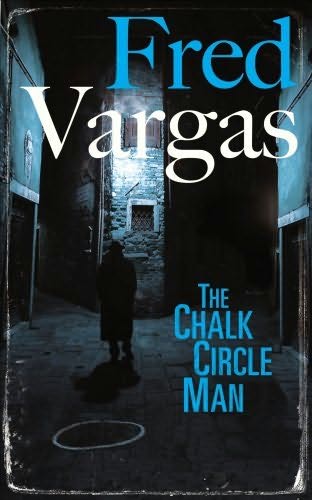
Review: THE CHALK CIRCLE MAN, Fred Vargas

Random House, 2009, ISBN 978-1-843-43272-2, 246 pages
Australian release date 2 Feb 2009
Translated from the French by Sian Reynolds

Jean-Baptiste Adamsberg has just been appointed Commissaire of the police headquarters in the 5th Arrondissement of Paris. His reputation as a solver of crimes has preceded him, but eleven days after his arrival, his new team does not quite know what to make of him. For Adamsberg does not solve crimes by logic. He is also an outsider from the Pyrenees.

Adamsberg is the first to admit that he is not a thinker, that he works mainly by instinct and hunches. He tells Adrien Danglard, his second in command and a person who believes in logic, that he himself is a slow inarticulate man who can sense guilt in a suspect. Most of all Adamsberg believes people commit murder because underneath they enjoy inflicting pain: cruelty oozes from them.

The strange overnight appearance of blue chalk circles on the pavements of Paris is regarded by most, including the newspapers, as a harmless prank. The circles generally contain some strange object, but it is difficult to see any connections. However Adamsberg asks Danglard to see that photographic records are made of each, predicting that the thing in the middle of the circles will get bigger, and saying that the circles ooze cruelty. Eventually he is right and the body of a young woman, her throat cut, is discovered inside one of the circles. Adamsberg believes there will be more, but he is not sure whether there are two people or just one responsible for both the chalk circles and the murder.

Here at last is the first of Vargas' Adamsberg series, for they have been translated into English out of order. THE CHALK CIRCLE provides the beginning of some of the threads that run through subsequent novels: Adamsberg's unusual methods of solving crimes, his love for Camille, and his relationship with Danglard.

My rating: 4.5

SEEKING WHOM HE MAY DEVOUR was a finalist for a Dagger Award in 2005. Vargas went on to win the Duncan Lawrie International Dagger twice with THE THREE EVANGELISTS (2006) and WASH THIS BLOOD CLEAN FROM MY HAND (2007). In 2008 THE NIGHT'S FOUL WORK was shortlisted for the International Dagger.

My other Vargas reviews
List of titles from Euro Crime- the second date is that of an English translation:
The Chalk Circle Man ( L'Homme aux Cercles Bleus 1996)20091
Seeking Whom He May Devour (L'homme a L'envers 1999)20042
Have Mercy on Us All (Paris Vite et Reviens Tard 2001)20033
Wash This Blood Clean From My Hand (Sous les Vents de Neptune 2004)20075
This Night's Foul Work ( Dans les Bois Éternels 2006)20086

Review at the Independent

8 August 2008

REVIEW: WASH THIS BLOOD CLEAN FROM MY HAND, Fred Vargas

Clipper Large print edition 2007. 546 pages.
ISBN 978-1-40740-080-8. Translated from French by Sian Reynolds.

Commissaire Jean-Baptiste Adamsberg's team from the Paris Serious Crime Squad is due to fly to Quebec for DNA profiling course in Quebec. Adamsberg's second-in-command Danglard, who hates flying, is praying every day that some urgent case will keep the entire squad home. Meanwhile the boiler in the basement of squad headquarters has suddenly stopped working on an October day when the outside temperature has dropped to one degree Celsius.

Adamsberg's mind works in mysterious ways, and a few days prior to the Quebec trip, he experiences an alien feeling of trouble. Something is causing sudden sweats, clenched muscles, and a singing in his ears. He is unsettled by something his subconscious has seen, something his mind can't explain. And then he realises it is an image he has seen of Neptune and his trident. His mind has dredged up memories of an invincible and arrogant killer whom he used to called "The Trident". A killer who always escaped and in fact had derailed Adamsberg's own brother. Adamsberg believes The Trident has been responsible for at least eight murders, all in different regions of France, over a period of about fifty years. Recently a girl has been killed in the countryside, the stab marks of the trident left on her body. But the man whom Adamsberg has known as "The Trident" is dead, so is this a copy cat killer?

Adamsberg is being thrown so out of kilter that he attacks an insolent member of his own squad. This is an unprecedented situation that brings both Adamsberg and the insolent brigadier before a disciplinary tribunal. Adamsberg goes to Quebec with orders not to get into further trouble. But how can he help it when The Trident follows him there, and a young woman is killed, the tell-tale three pronged marks on her body accusing Adamsberg himself of her death?

Sometimes this story became just a little too complex for me. But it is full of wonderful characters. The melancholic Danglard, waiting for promotion himself, loves and hates Adamsberg at the same time. He doesn't like the way Adamsberg has treated his former lover Camille, doesn't usually understand how his boss's mind works, but at the same time he is protective and supportive when he needs to be. The character of the squad's pillar of strength Lieutenant Violette Retancourt is wonderfully developed. And what can I say about the octagenarians Clementine Courbet and her boarder Josette, fallen on hard times? Clementine provides the ear that Adamsberg so badly needs, and Josette is a hacker extraordinaire.

Vargas has the ability to use just a few words to create interesting images. The lives of those in the station are at the mercy of the squatting inert central heating boiler, and the silent mother watching over them all, the coffee machine. And then there are the images of the exploding,smoking, toads - but I'll let you find out about them for yourself.

In the year 2007 WASH THIS BLOOD CLEAN FROM MY HAND won the Duncan Lawrie International Dagger Award.

My rating: 4.7

20 April 2008

THIS NIGHT'S FOUL WORK, Fred Vargas

Publisher: Harvill Secker (Random House Australia), 2008, $32.95 (Aust. Dollars), 409 pages

What a lot of disparate elements come together in the plot of THIS NIGHT’S FOUL WORK by Fred Vargas. An ancient recipe for eternal life. One elderly district nurse who just happens to be a serial killer, recently escaped from gaol. Two men murdered, their throats cut in what looks like a drugs-related killing. Stags found dead in Normandy with their hearts cut out. Someone who polishes the soles of his shoes. Snowball the station cat so devoted to a policewoman that he’ll travel over thirty kilometres in search of her.

Someone close to the inquiry into the drug-related killings is manipulating the investigation.

Commissaire Jean Baptiste Adamsberg has recently returned from enforced leave and finds himself working with a pathologist whose apple cart he upset two decades ago. He has moved into a new house haunted by the Wicked Silent Sister, Saint Clarisse, a serial killer of gullible women, before the Revolution.

To add to the feast for the reader there are some odd, vividly drawn, characters in Adamsberg’s team: Veyrenc, the new lieutenant who spouts Racine constantly, and is assigned to guarding Camille, the mother of Adamsberg’s baby son Tom; his colleague Commandant Dangland who works ceaselessly to eliminate Unsolved Questions; Estalere who has a knack and passion for memorising trivial detail; and Retancourt, devoted to protecting Adamsberg with her own life, to name just a few.

THIS NIGHT’S FOULS WORK showcases Adamsberg at his best, sifting and sorting a smorgasbord of information. Adamsberg is equally at home in the country and in the city. His methods are eccentric but his team recognises that eventually they will solve the case. There is an eclectic mix of folklore, history, mystery and just plain human interest. I wouldn’t classify this as a pacey novel. In some ways it lurches from one crisis point to another. It abounds in red herrings and the way forward can be hard to see. Tension builds, then climaxes, only to build again as a new element is included. As in other Vargas novels, at times the plot strains the bounds of plausibility and some readers may find this a leap too far. For me this didn’t matter.

THIS NIGHT’S FOUL WORK, translated from the French by Sian Reynolds, is #4 in the Adamsberg series. It was first published as Dans les bois eternels in 2006. The second in the series, SEEKING WHOM HE MAY DEVOUR, was a finalist for a Dagger Award in 2005. Vargas went on to win the Duncan Lawrie International Dagger twice with THE THREE EVANGELISTS (2006) and WASH THIS BLOOD CLEAN FROM MY HAND (2007)

My rating: 4.6

Author website: http://www.eurocrime.co.uk/books/books_by_fred_vargas.html

23 March 2008

SEEKING WHOM HE MAY DEVOUR, Fred Vargas

A young woman, a black boy-child, and an old man travelling through the southern French Alps in pursuit of a lycanthrope, a werewolf - almost the makings of a medieval tale, if it were not set so firmly in modern times by technology like the mobile phone. As just as they are about to give up, the puzzle solver, in the person of Commissaire Jean-Baptiste Adamsberg, comes to their rescue.

The annual migration of wolves from the Italian into the French Alpine wildlife reserve is on, but something is amiss. Pockets of sheep outside the reserve are being killed, seemingly by a rogue wolf, but then the rumour starts that the culprit is not a wolf at all, but a man called Massart. Massart, a butcher by trade, has gone missing, and the locals who have always mistrusted him, are more than willing to believe a suggestion that he has become a werewolf. It is Suzanne Rosselin who comes up with this theory, because Massart is smooth skinned, but then she too is found dead, killed in the same way as the sheep. And that's how the pursuit starts.

Commissaire Jean-Baptiste Adamsberg in Paris, himself the object of pursuit by a crazed young woman whose lover he shot, makes only cameo appearances in the first half of this novel. But he is aware of the wolf problem, and he recognises a face from his past in some of the television news footage.

In an earlier post I pointed out the wonderful descriptions of Adamsberg's method of thinking, and indeed the book itself uses a similar methodology. The reader is presented with an array of material from which to select bits to remember, that may or may not be relevant.

The translation of SEEKING WHOM HE MAY DEVOUR appears to be beautifully done. The main characters are fascinating: apart from Adamsberg himself there is the old shepherd Watchee who rings a friend everyday so that he can talk to the lead ewe in his flock, George Gershwin; there's Soliman constantly spouting word definitions, and telling African folk tales that he is making up as he goes; and Camille, the truck-driver, carrying around with her an A-Z catalogue of tools to dip into for comfort reading.

SEEKING WHOM HE MAY DEVOUR is the second in Fred Vargas' Chief Inspector Adamsberg series. It was originally published in French in 1999, translated into English in 2004. The book was a finalist for a Dagger Award in 2005. Vargas went on to win the Duncan Lawrie International Dagger twice with THE THREE EVANGELISTS (2006) and WASH THIS BLOOD CLEAN FROM MY HAND (2007).

Make time to find this book. You won't regret it.
My rating: 4.9

22 March 2008

How Adamsberg thinks

I am in the process of reading SEEKING WHOM HE MAY DEVOUR by Fred Vargas.

I'm fascinated by the descriptions of the thought processes of Vargas' protagonist Commissaire Jean-Baptiste Adamsberg.

Commissaire Adamsberg liked solitude, he liked to let his mind wander far out to sea, but he also liked people and the movement of people, and he fed on their presence around him like a flea... Adamsberg spent many an hour dreaming away, peacefully waiting for ideas to rise to the surface of his mind.
For that is how Adamsberg found his ideas - simply by waiting for them to turn up. When one rose before his eyes like a dead fish on the crest of a wave, he picked it up, turned it over, asked himself whether he needed this item at the moment, whether it was of any interest. Adamsberg never thought actively, he found it quite sufficient to day-dream and then to sort his catch, like a fisherman scrabbling about clumsily in the bottom of the net and finally picking the prawn out of the mess of sand, seaweed, pebbles and shells. Adamsberg's thoughts contained plenty of seaweed and sand, and he didn't always know how to avoid getting caught in the mess. He needed to jettison a lot of it, evacuate great heaps. He was aware that his own mind produced a mixed bag of mental items of uneven size and value, and that things did not necessarily happen the same way for other people. He had noticed the difference between his thinking and the mental products of Danglard, his number two, was identical to the difference between a netful from the river-bed and a fishmonger's neatly laid-out slab. He couldn't help it. Anyway, he always ended up fishing something useful out of his glory-hole, as long as people gave him enough time. That's how Adamsberg used his brain, like an ocean that you could trust entirely to feed you well, but which you've long ago given up trying to tame.

And then ten or so pages further on, we see it from Danglard's point of view:
Danglard had never grasped the peculiar logic that lay behind Adamsberg's decisions. In his view, of course, it was no logic at all, just an unending kaleidoscope of hunches and surmises which inexplicably gave rise to undeniably first-rate results. That said, Danglard's nerves could not stand the strain of keeping in step with Adamsberg's thought processes. For not only were the commissaire's thoughts of indeterminate substance, hovering between the solid, liquid and gaseous states, but they were forever aggluntinating with other thoughts without the slightest rational link. So while Danglard with his well-honed mind sorted the sheep from the goats, put things in little boxes, found the missing links, and thereby solved problems with method, Adamsberg put one thing with another, or turned them upside down, or scattered what had been brought together and threw it up in the air to see where it would fall. And despite his amazingly slow pace, he would, in the end, extract truth from that chaos. ... he remained torn between finding Adamsberg's mind admirable, and finding it exasperating.

This is just wonderful writing and I look forward to learning more about Adamsberg's methods.
This is the first Fred Vargas novel I have tackled, and I can see already that I have a great treat in store.

LinkWithin

Blog Widget by LinkWithin