Showing posts with label murder mystery. Show all posts

22 May 2025

Review: THE LAST DAYS OF KIRA MULLAN, Nicci French

  •  this edition published in 2025 by Simon & Schuster
  • ISBN 978-1-3965-2414-9
  • 438 pages 

 Synopsis (publisher)

She thinks it was murder.
But if she can’t trust herself, can anyone else?


Nancy North and her boyfriend Felix are making the move across London to Harlesden. A new flat, a new area, a new start. Because while Nancy is fine now, she wasn’t fine before. But settling into the new flat and meeting the new neighbours isn’t helped by Felix’s hovering concern. She is all right. She is sticking to her breathing exercises and doctor-prescribed help.

So, when their new neighbour Kira Mullan is found dead by suicide, Felix is understandably worried about Nancy’s frame of mind. But Nancy saw Kira the day before she died and she didn’t strike her as someone who was suicidal – she was upset and angry, yes, but was she upset and angry enough to take her own life?

Nancy is the only one convinced that there’s more to Kira’s death than has been discovered. But all the police and the neighbours see is a vulnerable woman who isn’t sure of what she saw, and might even be imagining things . . .

Is Nancy imagining things, or are there more questions that should be asked about the last days of Kira Mullan?  

My Take

Once you've started this book, it just sort of grabs you and you have to know how it finishes.  Nancy North is the only one in the flats who rejects the idea that Kira Mullan's death is suicide. And what would she know? She only met Kira for a few minutes, and her own mental health is fragile.

Nancy insists on telling the police about her suspicions, but those around her including her boyfriend Felix are  worried about her state of mind and take steps to ensure she is "safe".

Now, I am not going to tell you any more, but believe me the middle part of the story left me gasping over the injustice of what happened to Nancy.

There are always unexpected twists and red herrings with this superb British author, and I wasn't disappointed. 

My rating: 5.0

I've also read

  • 4.3, BLUE MONDAY
  • 4.5, TUESDAY'S GONE
  • 4.7, WAITING FOR WEDNESDAY
  • 4.7, FRIDAY ON MY MIND
  • 4.7, THE LYING ROOM
  • 4.5, DAY OF THE DEAD
  • 4.7, SECRET SMILE
  • 4.6, THE UNHEARD 
  • 4.8, THE FAVOUR
  • 5..0, HAS ANYONE SEEN CHARLOTTE SALTER?
  • 30 June 2012

    Review: THE HOLY THIEF, William Ryan

    Synopsis (Fantastic Fiction)

    Moscow, 1936 and Stalin's Great Terror is beginning. In a deconsecrated Church, a young woman is found dead, her mutilated body displayed on the altar for all to see.

    Captain Alexei Dimitrevich Korolev, finally beginning to enjoy the benefits of his success with the Criminal Investigation Division of the Moscow Militia, is asked to investigate. But when he discovers that the victim is an American citizen, the NKVD -the most feared organisation in Russia- becomes involved. Soon, Korolev's every move is under close scrutiny and one false move will mean exile to The Zone, where the enemies of the Soviet State, both real and imagined, meet their fate in the frozen camps of the far north.

    Committed to uncovering the truth behind this gruesome murder, Korolev,enters the realm of the Thieves, who run Moscow's underworld. And as more bodies are discovered and the pressure from above builds, Korolev begins to question who he can trust; and who, in this Russia where fear, uncertainty and hunger prevails, are the real criminals. Soon, Korolev will find not only his moral and political ideals threatened, but also his life . . .

    My Take

    In an author's note on the final pages of THE HOLY THIEF he writes
      I've done my best to recreate 1930s Moscow accurately in this book, but it should be remembered that it remains a work of fiction and that I've allowed myself some flexibility from time to time, particularly with regard to the interiors of buildings. For any inaccuracies that aren't deliberate, I apologize.
    The story is a reminder that even in times of great political turbulence crimes are still committed and policemen are still required. Often the criminal and the political are enmeshed with each side playing the system to their own advantage. In the case of Communist Russia of 1936, at the end of the first Five Year Plan, not everyone has the welfare of the State in mind, and capitalists are only too willing to take advantage of a society in a state of terror.

    Captain Alexei Dimitrevich Korolev, veteran of the War against Germany, is a very well drawn character, who comes to the realisation that his assignation to the murder investigation smacks of manipulation. It is difficult in this volatile Russia to know who to trust, and sometimes knowledge can be very dangerous.

    THE HOLY THIEF has all the elements you look for in good historical crime fiction: authentic historical settings and details, and intriguing story threads, and credible characters.

    My rating : 4.7

    Other reviews to check:


    About the author

    William Ryan is an Irish writer who has lived in London for a number of years. After leaving Ireland after university, he practised briefly as a barrister in London. In his spare time, he wrote on an occasional basis for television and film before deciding to take writing more seriously. He completed a Masters in Creative Writing at St Andrews University in 2005. William is married and lives in West London.

    Author's website
    Check it out for a glossary, list of characters and more.
    See also Korolev's World for images of Moscow and Russia of the 1930s.
    #2 in the series THE BLOODY MEADOW (US title THE DARKENING FIELD)

    7 January 2011

    Review: RAILWAY TO THE GRAVE, Edward Marston

    Published by Allison & Busby 2010
    ISBN 978-0-7490-0772-0
    350 pages
    Source: Local Library

    Yorkshire 1855. Colonel Aubrey Tarleton takes his own life by walking along a railway track near his home directly into the path of an oncoming train. He is a good friend of Superintendent Tallis of Scotland Yard, and pinned to Tarleton's chest is a note asking that Tallis be notified of his death.
    Tarleton and Tallis were army friends and Tallis refuses to believe that his friend has committed suicide, although the previous day he had received a letter from Tartleton.
      Goodbye, dear friend. Though her body has not yet been found, I know in my heart that she is dead and have neither the strength nor the will to carry on without her. I go to join her in heaven.
    Tallis is determined to get to the bottom of events and takes with him to Yorkshire his Scotland Yard team, the famous "Railway Detective" Inspector Robert Colbeck, and his assistant Sergeant Victor Leeming.

    This is the third in the railway detective series that I have read by Edward Marston, a pseudonym of Keith Miles. Like the others RAILWAY TO THE GRAVE gives a strong impression of authentic historical setting. I like my historical crime fiction to not just feel like crime fiction transplanted to another time period, but to also reveal something about the period in which it has been set. Marston manages to not only write a strong police procedural, but to tell us something about society of the 1850s, industrial England in which the story is set.

    My rating 4.5

    I am counting RAILWAY TO THE GRAVE in the following reading challenges
    Mini reviews of other titles:

    THE RAILWAY DETECTIVE, my rating 4.6   
    1851 is the setting for this first title in the Railway Detective series: the year of the Great Exhibition, and the building of the Crystal Palace. The Detective Department of Scotland Yard is only 9 years old. A train on the Great Western Railway is held up at Leighton Buzzard, its driver seriously hurt, the train robbed of the consignment of gold coins that it is carrying, and finally derailed. The investigator is Inspector Robert Colbeck, a considerate, well-spoken, well educated and gifted lawyer turned policeman. He has spent minimal time in uniform and brings a different outlook to law enforcement, focusing on crime prevention rather than punishment. The story has an authentic depiction of mid 19th century English society on the brink of the second industrial revolution. Good reading.

    THE EXCURSION TRAIN, my rating 4.0
    London 1852. A trainful of excited "fans" are delivered to the illegal prize fight between Mad Isaac and the Bargeman near Twyford. But one second class passenger does not leave the train. He has been garrotted en route. Inspector Robert Colbeck of the Detective Department of the Metropolitan Police at Scotland Yard, now known as the Railway Detective, after his success in the previous year, takes up the case. The dead passenger is identified as Jake Bransby, public executioner. The real reason why Bransby took on being hangman is revealed, and Colbeck discovers that Bransby had many enemies. This is #2 in the Railway Detective series. Marston has further developed the relationship between Colbeck and Maddy, the daughter of the train driver who appeared in the first book in the series. Lawyer turned detective Colbeck signals the beginning of a new breed of policemen, those who look beyond the obvious, and seek to understand why.

    Inspector Robert Colbeck
    1. The Railway Detective (2004)
    2. The Excursion Train (2005)
    3. The Railway Viaduct (2006)
    4. The Iron Horse (2007)
    5. Murder on the Brighton Express (2008)
    6. The Silver Locomotive Mystery (2009)
    7. Railway to the Grave (2010)
    8. Blood on the Line (2011)

    6 January 2011

    Review: COTSWOLD KILLING, Rebecca Tope

    Published Allison & Busby 2004
    ISBN 0-74900-664-1
    281 pages
    Source: Local Library
    #1 in Thea Osborne series

    Publisher's blurb
    Nestled in the fertile hills of the Cotswolds, the village of Duntisbourne Abbots is a well-kept secret: beautiful, timeless and quintessentially English. When Joel Jennison is found slaughtered in the same field where his brother's corpse had lain ten weeks previously, a whole community falls under suspicion. Was it a family feud? An act of revenge? Could Thea's employers, now relaxing in the Bahamas, have anything to do with the murder? In calling on her neighbours to get some answers, Thea uncovers more tragedy and intrigue than she thought possible behind the chocolate- box facade of a peaceful Gloucestershire village. As a forty-something woman with no previous experience of detective work, she knows she shouldn't be getting involved. But as her new friend Harry points out sometimes a fresh eye can see through the superficial tangles to where the truth lies.

    My take:

    At times this book felt hard going and I sometimes became annoyed what seemed to be a welter of detail that slowed the action down.

    Thea Osborne uses her husband's death as an excuse to embark on a new occupation of house-sitting. The three week job in a house in the village of Duntisbourne Abbot is her first, and it quickly becomes obvious that it is not going to be as simple as she imagines. Her employers have a detailed and comprehensive list of tasks. But not on the list is the murder of one of the locals in her back garden. And of course Thea is carrying her own share of emotional baggage.
    As time goes on a suspicion grows that her police detective brother in law has somehow contrived that she got the job in the first place.

    A COTSWOLD KILLING seemed to have an unnecessarily complicated plot. There are a lot of characters to sort out and a complex web of relationships to fathom. Some of the characters we meet only fleetingly, and can't be sure whether we need to remember them. Thea Osborne is an interesting character but her involvement in undertaking an investigation into her neighbours is not entirely logical. There were events such as the traffic accident which results in Thea's car being written off which raised the level of plot complexity with not much useful outcome. There were times too when the reader did not know what Thea had discovered - for example she researches local news items, sends an email off to her brother in law but doesn't tell us until pages later what it was she found.

    All in all though, it is not a badly written novel. Nothing that perhaps a bit of judicious editing might not have cured.

    My rating: 4.4

    I kept reminding myself this is the first novel in a series, although not a debut novel, and I have since found that there are now 8 published titles in the series, and a 9th due in 2011. #8 in particular looks interesting where Thea Osoborne meets up with Drew Slocombe, the protagonist in Tope's other series. I suspect I will read another.

    I will be using this book for
    Cruisin' thru Cosies Reading Challenge
    British Books Challenge

    2 December 2010

    Review: AN UNHALLOWED GRAVE, Kate Ellis

    First published in Great Britain by Judy Piatkus (Publishers) Ltd., 1999
    ISBN 0-7505-1627-5
    395 pages (large print)
    source: my local library

    #3 in the Wesley Petersen series.

    When the body of a middle-aged woman is found hanging from a yew tree in Stokeworthy churchyard, the police suspect foul play.  But the victim is an unlikely one.   Pauline Brent was the local doctor's receptionist and well-liked.  She seems to have had no real enemies.  And yet someone killed her.
    The case is investigated by Detective Sergeant Wesley Peterson, his boss, Inspector Gerry Heffernan, and archaeologist Neil Watson, who is excavating on the site of a proposed holiday development nearby when he discovers an ancient corpse. 
    Local legend has it that many centuries ago a young woman was hanged from the yew in the churchyard.  Has Neil discovered her body buried at the crossroads in an unhallowed grave?  Why was she hanged?  And why is she sharing her last resting place with a set of rare medieval statues? It seems an unlikely coincidence - two women hanged from the same tree many centuries apart. 
    Wesley is forced to consider the possibility that the killer also knows the tree's history.  Has Pauline Brent been "executed" rather than murdered?   And if so, for what crime?

    I have read another book from this series and remember thinking at the time that I should read more. I enjoyed my re-acquaintance with amateur archaeologist Detective Sergeant Wesley Peterson and those he works with. The relationships between characters are well explored and there is a historical thread running throughout.

    My rating 4.4

    mini-review of THE FUNERAL BOAT - my rating 4.5
    The Tradmouth area of Devonshire is the location this Kate Ellis’ police procedural in which Wesley Peterson, a young black detective plays a prominent role. Wesley and his superior, Inspector Gerry Heffernan, had both chosen a rural setting in which to pursue their law enforcement careers, thinking criminal activity would be considerably less than in London. However, of late, things are anything but peaceful on their turf. A rash of burglaries targeting isolated farms in the district, the disappearance of a young Danish tourist, and the discovery of a skeleton who had met his death apparently violently are keeping Heffernan and his staff busy round the clock.

    Wesley Peterson series (courtesy Fantastic Fiction)
    1. The Merchant's House (1998)
    2. The Armada Boy (1999)
    3. An Unhallowed Grave (1999)
    4. The Funeral Boat (2000)
    5. The Bone Garden (2001)
    6. A Painted Doom (2002)
    7. The Skeleton Room (2003)
    8. The Plague Maiden (2004)
    9. A Cursed Inheritance (2005)
    10. The Marriage Hearse (2006)
    11. The Shining Skull (2007)
    12. The Blood Pit (2008)
    13. A Perfect Death (2009)
    14. The Flesh Tailor (2010)
    15. The Jackal Man (2011)

    10 July 2010

    Did you know who the murderer was?

    In the most recent murder mystery you read, did you know who the murderer was?
    (by this I don't mean, did you work out who the murderer  was, but whether you always knew.)
    That is, was it a whodunnit or a whydunnit?
    Perhaps it was a combination, but in that case "who" generally comes before "why".

    For example, Hercule Poirot was always very interested in why crimes were committed. This was the case in DEATH IN THE CLOUDS where the investigation of the murder is jointly conducted by Poirot, the French detective Fournier and Inspector Japp from Scotland Yard, and each brings a different quality to its conduct. Poirot and Fournier are both interested in the psychology of crime. However "who" has to be solved before "why" can be explored.

    But in the modern murder mystery, whydunnits are becoming more prevalent.
    For example in Jan Costin Wagner's ICE MOON, the most recent murder mystery that I read, I said in my review  "From the start the reader knows who the murderer is and for much of ICE MOON we watch the murderer's path and that of the investigation converge."

    So I invite you to consider the murder mystery that you most recently read. Did you know very early on who the murderer was, or was it a conclusion you eventually came to?

    I invite you to participate in the poll over on top right, and then to tell us about it in a comment below. Don't forget to mention the book.

    17 October 2009

    Review: WHY DIDN'T THEY ASK EVANS?, Agatha Christie

    Published in 1934, and then in the US as THE BOOMERANG CLUE.
    The copy I read- in a Hamlyn Agatha Christie Crime Collection omnibus published 1969, pages 358 - 511.

    Synopsis: While playing a round of golf, Bobby Jones slices his ball over the edge of a cliff. His ball is lost, but on the rocks below he finds the crumpled body of a dying man. With his final breath the man opens his eyes and says, ‘Why didn’t they ask Evans?’

    WHY DIDN'T THEY ASK EVANS is an interesting exploration of the impact of class differences in English society, at the same time as being an absorbing murder mystery. The original title is self-explanatory, but the title THE BOOMERANG CLUE comes from the fact that the first clue to the identity of the murderer is in fact the one that, when understood, actually counts.

    Bobby Jones is the fourth son of a clergyman, at a loose end and without prospects because he has recently left the Navy. His fellow "detective" is the Lady Francis Derwent, well above him in social class, but a friend from childhood, when social station made no difference to their friendship. Frankie is a woman of means, with the leisure to pursue mysteries, a car at her disposal, and able to move in the spheres of the wealthy, and able to winkle information out of people in a way that penurious Bobby never could.

    One of the themes of this mystery has to be that personal opinions can cloud your judgement as both Bobby and Frankie believe in the innocence of the person who turns out to be the murderer. If you want to read a real spoiler, and learn more of this story than I am going to tell you here, then you can do that on Wikipedia. Another of the lessons must be that true sleuthing is largely a matter of luck, and that culprits are not always brought to justice.

    WHY DIDN'T THEY ASK EVANS has stood the test of time well I think, and largely held my attention, although I got a bit impatient to be finished in the last 30 or so pages, where Christie rather pedantically led me through a recount of all the plot points (just in case I had missed anything). This is a technique that Christie tended to use in most of her novels.

    My rating: 4.3

    WHY DIDN'T THEY ASK EVANS was Agatha Christie's 15th novel (I read it for the Agatha Christie Reading Challenge). It was published in September 1934, in the same year as MURDER ON THE ORIENT EXPRESS. It came hot on the heels of 3 Poirot novels in 3 years. Her reading public had apparently been expecting another Poirot, but most of the critics said that her readers would like Bobby and Frankie and romantic element they would find in this novel.

    I thought I'd point out an idea Christie sows in this novel.
    Frankie says " We seem, somehow, to have got between the covers of a book. We're in the middle of someone else's story. It's a frightfully queer feeling."
    "I know what you mean, " said Bobby. "There is something rather uncanny about it. I should call it a play rather than a book. It's as though we'd walked on to the stage in the middle of the second act and we haven't really got parts in the play at all, but we have to pretend, and what makes it so frightfully hard is that we haven't the faintest idea what the first act was about."
    It is an interesting take on what crime detection is all about. Frankie goes on to say that the play may be further progressed than the second act, in fact they may be near the final curtain, which means they have to be quick in coming up with a solution.

    Finally a discussion of this novel would not be complete without some discussion of what was done in the name of television entertainment recently. I commented on it in a post titled How Could They Do It? As I remarked earlier, the detectives in WHY DIDN'T THEY ASK EVANS were originally Bobby Jones and Frankie Derwent, amateurs, who solved the mystery almost by accident and with a great deal of luck.
    In March 1980 there was a TV adaptation created which remained fairly true to the original story. Joan Hickson, who would later play a very definitive Miss Marple in other TV titles, was a minor character.

    But in 2008 came the creation of some new Miss Marple mysteries and as I pointed out in How Could They Do It? the decision was taken to make Miss Marple the detective in WHY DIDN'T THEY ASK EVANS? The Wikipedia article says the plot was largely re-written to accommodate this, Bobby Jones gets re-named to Bobby Attfield, and there are characters who don't appear in the original, and others disappear altogether. My question: Is nothing sacred?

    19 September 2009

    Review: TELLING TALES, Ann Cleeves

    Pan Macmillan, 2005, ISBN 1-4050-46473, 409 pages

    Ten years ago Abigail Mantel died. In what appeared to be an open and shut case, her murderer Jeanie Long was quickly identified and charged. To some people in the East Yorkshire village of Elvet, Jeanie had seemed an unlikely culprit, but even her father believed she was guilty. Now, after years of protesting her innocence, Jeanie has committed suicide in prison, and someone has come forward to give her an unshakeable alibi for the time of the murder. So the killer, probably a local, is still at large, and Inspector Vera Stanhope comes to the village to seek the truth.

    She has an advantage - Dan Greenwood, local craftsman, is a former copper whom she has worked with, and he was on the Mantel murder case. For one of Abigail's friends, Emma Bennett, who discovered Abigail's body the past comes back.

    Ann Cleeves tells us that TELLING TALES is set in a fictitious landscape east of Hull, but that doesn't stop it from feeling very real. Vera Stanhope is an almost larger than life character, gruff, with a way of winkling confidences from people, and a little unorthodox in her methods. She has that attribute of all good detectives, the ability to make the intuitive leap, to see past what she is being told, to admit when she has made a mistake, and finally to come up with the goods.

    My rating: 4.6

    TELLING TALES is the second of three novels in the Vera Stanhope series. It completes my reading of the series so far, and I really hope for another soon.

    My other reviews:
    CROW TRAP (1999), my rating 4.8
    Debut novel in the Vera Stanhope series. In the Northern Pennines there are plans to open a new slate quarry. Three women are employed to conduct an environmental survey. Bella Furness, whose cottage holds right of way to the site of the quarry, commits suicide and shortly afterwards one of the women involved in the survey fails to return home. Vera makes her first appearance at Bella's funeral and then is the investigating officer when the missing woman is found murdered. Ann Cleeves has created an intriguing character in Vera Stanhope. She is the sort of detective who more or less does as she pleases, very hands-on. There are many twists in this, keeping me guessing until the end.

    HIDDEN DEPTHS (2007), my rating 4.7
    Julie Armstrong has been for a 'night out with the girls' and arrives home, barely sober, to find her son Luke in the bath, apparently drowned, scented water and flowers floating on the surface. Whatever happened, her daughter Laura has slept through it all. Inspector Vera Stanhope of the Northumbrian police, is the investigating officer. Soon there is a second body, this time young student teacher Lily Marsh. She too is found lying in a pool of water strewn with flowers but this time in an fairly inaccessible part fo the coastline. The subsequent investigation which Vera leads works rather like peeling back the layers of the onion, seeking the connections between the two deaths. And are they connected to an earlier drowning where mourners threw flowers onto the river where another young man died? This is #3 in the Vera Stanhope series: in tall, lumpy Vera Cleeves has almost created a female equivalent of Reginald Hill's Andy Dalziel. Perhaps that's being unkind to Vera, but she is every bit as clever, as intuitive.

    It has now been confirmed
    that ITV Studios will bring Detective Inspector Vera Stanhope to the screen, in the person of international award winning actress Brenda Blethyn OBE. A two hour drama based on the third Vera Stanhope mystery, Hidden Depths, will go into production in October. I have grave doubts that Brenda will match my "bag lady" image of Vera though.

    In 2006 Ann Cleeves was the first winner of the prestigious Duncan Lawrie Dagger Award of the Crime Writers' Association for Raven Black, the first volume of her Shetland Quartet. Check more biographical details and information about her books on Ann's own website.

    13 September 2009

    Review: INSPECTOR SINGH INVESTIGATES: A Most Peculiar Malaysian Murder, Shamini Flint

    Piatkus Books, 2009, ISBN 978-0-7499-2975-6, 295 pages.

    Chelsea Liew, mother of three, Singaporean ex-model, is in custody in Kuala Lumpur, remanded on the charge of murdering her ex-husband Alan Lee, business magnate, head of Lee Timber, a firm rumoured to be plundering and laying waste to Borneo's reamining natural rainforest. Alan Lee and his wife had been in a very public custody battle for their 3 boys, complicated by the fact that he had recently converted to Islam, thus shifting the jurisdiction of which court would decide on the custody. Alan Lee was shot just a week before on a deserted street two hundred yards from his front gate and his ex-wife was arrested within hours and charged with his murder.

    Enter Inspector Singh, sent from Singapore, to ensure that Chelsea who has retained her Singaporean citizenship despite twenty years of marriage and residency in KL, gets a fair trial. A problem arises when Singh becomes convinced that Chelsea Liew is not guilty. It becomes even more complicated when Jasper Lee, Alan Lee's elder brother, and self declared nature activist, walks into the Bukit Aman police station and declares that he in fact murdered Alan.

    Inspector Singh has not been sent to KL because he is a brilliant detective ensured of success. In fact quite the opposite. he has been handed a "poisoned chalice". The case is surrounded by politics and he is one of the last mavericks in the Singapore police force, "the elephant in the room that noone talked about but everyone hoped would do the decent thing and take early retirement". And rather conveniently he has a sister in KL so he can stay with her if needed.

    INSPECTOR SINGH INVESTIGATES: A Most Peculiar Malaysian Murder is Shamini Flint's debut crime novel, the first of a promised series of 3, and I find myself quite willing to read the second. This is despite the fact that there were times when I almost lost interest in this one.
    It is hard to put my finger on what went wrong for me, but I suspect that at times there was just too much detail provided and some of it was repetitious. I understand though the author's desire to make sure the reader understands the cultural context of the novel's setting. She also picks up on internationally sensitive topics such as the pollution caused annually by the burning of Indonesian rainforests. The custody battle reminded me a little of the case of Shahira Gillespie, particularly of some of the issues that surfaced there.

    I liked the character of Inspector Singh and I think Flint has created a protagonist with possibilities. Despite the fact that INSPECTOR SINGH INVESTIGATES: A Most Peculiar Malaysian Murder is a relatively short novel, I think it possibly needed a bit more editing, to get more "show" and less "tell" into it.

    My rating: 4.2

    Shamini Flint is an established writer of children's books, living in Singapore, and has a background in international law. Her website makes interesting reading.

    The second in the series INSPECTOR SINGH INVESTIGATES: A Bali Conspiracy Most Foul has recently been published.

    29 November 2008

    Review: THE ROAR OF THE BUTTERFLIES, Reginald Hill

    Harper Collins Publishers, 2008, ISBN 978-0-00-725273-2, 313 pages.

    Joe Sixsmith, P.I., has been approached by a YFG (Young Fair God) Chris Porphyry, on the recommendation Detective Inspector Willie Woodbine. Chris has a serious problem at Luton's Royal Hoo Golf Club, where he holds, by inheritance, the controlling shares. He wants Joe to carry out an investigation for him at the club, under the pretence of seeking membership.

    His investigation at the golf club takes Joe into a level of society that he doesn't often fraternise with. He knows next to nothing about golf and is in almost constant dread that he will have to show off his lack of prowess. The investigation proves to be far more complex than he has anticipated too. A simple matter of cheating is complicated by the black-balling of a local magnate who wants to expand his grocery chain in a real estate development bordering the golf club. Nor did Joe anticipate that the case might involve violence against his person, to the point of someone dangling him upside down from his own balcony.

    This is the fifth in Reginald Hill's Joe Sixsmith series, the first to make an appearance for 9 years. I haven't read any other Joe Sixsmith titles, although I did recently read a short story that featured him in THERE ARE NO GHOSTS IN THE SOVIET UNION.
    Joe Sixsmith has a reputation that says he is easy to under-estimate. That when the pressure's on, he will solve the case through startling intuition.

    THE ROAR OF BUTTERFLIES made me feel that I really needed to have read earlier titles in the series to understand Joe's relationship with other characters, but perhaps that would not have helped.
    And certainly this is a different style of book to Hill's Dalziel & Pascoe series. In the long run though it does turn out to be a murder mystery with the twists and turns of plot, and interesting characters, that we've come to expect from Hill. It is a lighter book, more a cozy, occasionally flavoured with quirky humour.
    The title is a bit obscure, although the reader is given the meaning of the phrase quite early on. But at the end I wasn't sure that it was a good fit for this book.

    My rating: 4.2

    Other titles:
    1. Blood Sympathy (1993)
    2. Born Guilty (1995)
    3. Killing the Lawyers (1997)
    4. Singing the Sadness (1999)
    5. The Roar of the Butterflies (2008)

    14 November 2008

    Review: ACRC#4: THE MAN IN THE BROWN SUIT, Agatha Christie


    First published by Bodley Head in 1924. This edition published by Harper Collins in paperback in 2002, 381 pages, ISBN 978-0-00-715166-0

    This Agatha Christie's 4th novel, and as she did in the first 3, you can see her experimenting with a different style of murder mystery.

    In the Prologue, in the dressing room of a Russian dancer in Paris, through a meeting she has with another Russian, we learn 3 things. Firstly neither of them are Russian. Secondly they have both been working for an arch criminal who is on the point of retirement. The "Colonel" has, even during the First World War, organised a series of "stupendous" coups including jewel robberies, forgery, espionage, assassination, and sabotage. Thirdly we learn the story of the theft of some South American diamonds before the war. The dancer knows where these diamonds are and intends to exchange them for some of the "Colonel's" accumulated wealth.

    THE MAN IN THE BROWN SUIT is narrated by two characters. The first, whom we meet in Chapter 1, is Anne Beddingfeld. It is she who witnesses the death of a strange-smelling man when he falls off an Underground platform and is electrocuted on the rails. She also sees a man dressed in a brown suit who pretends to be doctor, inspects the body and pronounces the man dead, and then rushes away, dropping a scrap of paper with a cryptic message on it as he does so.

    The second narrator is Sir Eustace Pedler MP who keeps a diary. We begin reading extracts from his diary in chapter 8. Inevitably the paths of the two narrators converge. A young woman dies in a house that Sir Eustace owns called Mill House, and he is forced to return from abroad. He is then asked by the British government to travel to South Africa, where he has business interests, to deliver a message in person to the government of Rhodesia.

    After that the setting, with all the characters we've met so far, and a few more besides, moves to a ship going to South Africa, and then the action moves to South Africa itself.

    I have my reservations about THE MAN IN THE BROWN SUIT.
    I think Agatha Christie tried to move from a murder mystery to a thriller with connections to the world of organised crime, unionism, espionage and romance. The result is a longer book with a lot of time lapses in it, caused mainly by the distances between locations, and the nature of what happens to the first narrator Anne Beddingfield. Some of the scenarios don't quite work and the result is confusion rather than a genuine puzzle for the reader to solv.
    Christie tried also to show her awareness of political events in South Africa, and we get occasional mentions of General Smuts thrown into the mix.
    And finally, it is a plot where definitions of good and bad are blurred, and in the long run evil goes unpunished.

    The book sees the first appearance of Colonel Race; he later appears in Cards on the Table, Sparkling Cyanide, and Death on the Nile.
    The Wikipedia entry gives a lot of plot details, reactions of reviewers at the time, including a comment about the fact that she had not used Hercule Poirot, but had in fact introduced another "detective" in the form of Colonel Race.

    My rating: 3.8

    Follow all the posts in the Agatha Christie Reading Challenge here.

    7 November 2008

    Crime Fiction books listed on PW's Best Books of the Year

    Publishers Weekly says "we take the opportunity near year's end to review the year in books, highlighting the very best of what American publishing had to offer in fiction, poetry, nonfiction, comics, religion, lifestyle and children's."

    Here are some that they list that may interest crime fiction and murder mystery readers - to put on your wish list for the family to buy of course. I found that I had read only one, so there's plenty for me to look out for.

    I find the categorisation just a little odd, particularly why some listed under fiction were listed there, and not under Mystery. Answering my own question- probably because "mystery" is narrower than "crime fiction".

    Fiction
    When Will There Be Good News? Kate Atkinson (Little, Brown)

    Hold Tight Harlan Coben (Dutton)
    The Brass Verdict Michael Connelly
    Master of the Delta Thomas H. Cook (Harcourt)
    The Likeness Tana French (Viking)
    Ritual Mo Hayder (Atlantic Monthly)
    The Given Day Dennis Lehane (Morrow)
    Flesh House Stuart MacBride (St. Martin's Minotaur)

    Mystery
    Wild Inferno Sandi Ault (Berkley Prime Crime)
    Lie Down with the Devil Linda Barnes (St. Martin's Minotaur)
    Ghost at Work Carolyn Hart (Morrow)
    The Private Patient P.D. James (Knopf)
    The Messengers of Death: A Mystery in Provence Pierre Magnan, trans. from the French by Patricia Clancy (St. Martin's Minotaur)
    Death's Half Acre Margaret Maron (Grand Central)
    Salt River James Sallis (Walker)
    Fear of Landing David Waltner-Toews (Poisoned Pen)
    The Calling Inger Ash Wolfe

    Mass Market
    No One Heard Her Scream Jordan Dane (Avon)

    Deadly Deceptions Linda Lael Miller (HQN)

    Comics
    Treasury of XXth Century Murder: The Lindbergh Child Rick Geary (ComicsLit)

    Many thanks to Marg at Reading Adventures to pointing me to the list.

    25 October 2008

    How do you know what to read next?

    I'm really never at a loss for what to read next.
    In fact I've always got too many books lying around, just waiting for their chance to hop into my hands.

    Part of the secret is to monitor the blogs of people like me who review books.
    This morning for example, I read blog postings from Poisoned Fiction Review, Do You Write Under Your Own Name, and Pattinase's Friday's Forgotten Books, and they all sent me off to the online catalogue of my local library to see if I could find the books were referring to. The library is my first port of call, because it saves me money and I'm not precious about having to keep the books I read.

    If you are not sure about what blogs to follow, have a look at the list I have on my blog roll. There's a link up at the top of the page called Blogs I'm watching. They are all generally there because they talk about books, and nearly all of them get me several good titles to follow up every week. They are also on there because they talk about crime fiction, murder mysteries and the like, which is the genre that I read almost exclusively.

    You might also like to browse my books reviews which is a ranked list of books I have written about on this blog this year. They are listed as Smik's Reviews, and you will find that link also at the top of the page. Smik's Reviews has an RSS feed that you can add to your PageFlakes or whatever so that when I add a new book you get an alert.

    Apart from the books I review, I also sometime write, as I did yesterday about books that are selling well in Australia, or if you are looking for crime fiction by Australian authors, you could check the postings that are marked Australian author, or go back to the Carnival of Criminal Minds posting where I was the host site.

    Of course you could always choose to get the postings of MYSTERIES IN PARADISE by email or RSS. There are also links to them in the top menu bar. The one I particularly like is FeedMyInbox which sends out a daily digest of postings on this blog.

    I do read a lot of recently published crime fiction, but you'll note that occasionally an older book crops up. For example I write about Forgotten books, and I am reading for my own Agatha Christie Reading Challenge. You'll find references to them in the blocks in the right hand margin.

    S.S Van Dine's Twenty Rules for Writing Detective Stories

    S. S. Van Dine (1888 - 1939) was the pseudonym of Willard Huntington Wright.
    Van Dine was born in Charlottesville, VA. He worked as a literary and art critic for newspapers and magazines. He suffered from poor health, had a severe breakdown in 1923 and was confined to bed for two years. During these years, he read detective stories and amassed a large collection. He then decided that he could write a better story than he was reading. His first Philo Vance book, The Benson Murder Case, was published in 1926. His books were exceptionally popular, and Van Dine became quite wealthy.

    In 1936, S.S. Van Dine (author of the Philo Vance mysteries) published an article titled "Twenty Rules for Writing Detective Stories." Some of his rules are a bit archaic, but it seems to me that they are still worth thinking about.
    However even the great have some times flouted these rules (and gotten away with it).

    1) The reader should have the same opportunity as the detective to solve the crime.

    2) No tricks can be played to mislead the reader unless it is also done to the detective by the criminal.

    3) The detective should not have a love interest.

    4) Neither the detective nor one of the official investigators can turn out to be the criminal.

    5) The villain must be found by logical deduction, not luck, accident, or un-motivated confessions.

    6) The story must have a detective who also solves the crime (by detection).

    7) It must be a murder mystery ("the deader the corpse the better").

    8) The solution must come by "naturalistic means"; e.g., no ouija-boards.

    9) There can be only one detective; not a team.

    10) The villain has to be someone who plays a prominent part of the story.

    11) The culprit can't be a servant (none of this, "The butler did it.").

    12) There can only be one murderer. The villain could have a helper or "co-plotter," but only one is going to get the ax in the matter.

    13) No secret societies ("mafias, et al"). The murderer, too, needs a sporting chance to outwit the detective.

    14) The method of the murder must not be beyond plausibility. No super-natural means, nor the introduction of a fictional device or element ("super-radium, let us say" is not fair).

    15) The truth of the solution must be apparent. The reader should be able to pick the book upon completion and see that the answer was in fact starring at him all the time.

    16) The detective "novel" must be just that, no side issues of "literary dallying" or "atmospheric preoccupations." These devices interfere with the purpose of detective fiction, "which is to state a problem, analyze it" and solve it.

    17) The culprit must be an amateur, not a professional criminal.

    18) The solution must never be an accident or suicide.

    19) Motives for the crime must be personal, not political or professional.

    20) All of the following tricks and devices are verboten. They've been done to death or are otherwise unfair.

    a) Comparing a cigarette butt with the suspect's cigarette.
    b) Using a séance to frighten the culprit into revealing himself.
    c) Using phony fingerprints.
    d) Using a dummy figure to establish a false alibi.
    e) Learning that the culprit was familiar because the dog didn't bark.
    f) Having "the twin" do it.
    g) Using knock-out drops.
    h) If the murder is in a locked room, it has to be done before the police have actually broken in.
    i) Using a word-association test for guilt.
    j) Having the solution in a coded message that takes the detective until the end of book to figure out.

    References
    Mystery Novels of the Golden Age
    http://mikegrost.com/vandine.htm
    http://www.mysterynet.com/books/testimony/forgottenmaster.shtml
    S.S. Van Dine's 20 Rules for Writing Detective Stories

    PD James:

    What is the difference between the detective story and the crime novel?

    I see the detective story as a subspecies of the crime novel. The crime novel can include a remarkable variety of works from the cosy certainties of Agatha Christie, through Anthony Trollope and Graham Greene, to the great Russians. The detective story may be considered more limited in scope and potential. The reader can expect to find a central mysterious death, a closed circle of suspects each with credible motive, means and opportunity for the crime, a detective, either amateur or professional, who comes in like an avenging deity to solve it, and a solution at the end of the book which the reader should be able to arrive at by logical deduction from clues presented by the writer with deceptive cunning but essential fairness. What interests me is the extraordinary variety of talents which this so-called formula is able to accommodate.

    18 October 2008

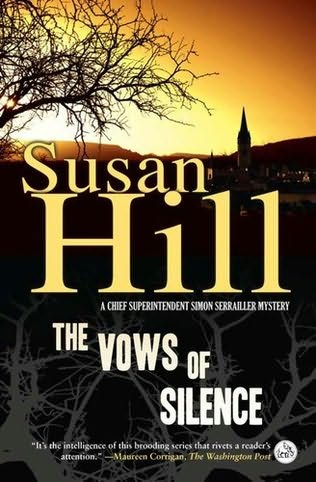
    Review: THE VOWS OF SILENCE, Susan Hill

    Chattow & Windus, 2008, ISBN 978-0-701-17999-1, 328 pages

    Now that their honeymoon is over Craig Drew has had to return to work. But his new wife Melanie has a couple more days off, unwrapping the wedding presents, writing the thankyou letters, clearing the spare room of boxes, and setting their house up. Tonight she's making a Thai chicken recipe that she knows Craig will love. But Craig never gets to eat it. When Melanie returns to the house after shopping for ingredients someone follows her.

    When the death of young Melanie Drew is followed by the shooting of two girls attending a hen's night, it occurs to Detective Chief Inspector Simon Serrailler that the events may be connected, but just what is the thread?

    THE VOWS OF SILENCE is #4 in Susan Hill's Simon Serrailler series, and will not disappoint those who are already fans. If you've not read any of the series before, by all means go ahead and find this one, but I warn you, you will be adding the other three to your "wanted" list.

    As with the earlier books in the series there is plenty going on in THE VOWS OF SILENCE apart from the murder mystery thread. Throughout the book we on occasion see the world through the mind and eyes of the murderer, but I really didn't pick up on clues about who he was. Perhaps a more discerning reader would. I'm sure Hercules Poirot would have known!

    Then there's another thread that weaves it's way and holds the novel together. A lonely woman looking for a soulmate finds just what she is looking for through an internet dating agency. This story is counterbalanced by that of Richard Serrailler. Simon's father, whose wife died only a year ago, has found a new woman. In both cases the "children" have mixed reactions to these burgeoning romances. There's more, but you'll have to read them for yourself! Enjoy the sens of family and community that Susan Hill has created around her central character, Simon Serrailler.

    Last week I struggled my way through the book I was reading. But there was no struggle with THE VOWS OF SILENCE. Susan Hill has a style that flows, so easy to read, my reading "soul" felt it had come home! I haven't yet tried any of her non crime novels (see the list at Fantastic Fiction). Perhaps I should, but then if I'm not reading crime fiction, a little voice keeps saying why are you doing this when there are so many good crime fiction books waiting?

    The Simon Serrailler series in order:
    THE VARIOUS HAUNTS OF MEN (2004), my rating: 4.6
    THE PURE IN HEART (2005), my rating: 4.7
    THE RISK OF DARKNESS (2006), my rating: 4.7
    THE VOWS OF SILENCE (2008), my rating 4.7

    Her website is at http://www.susan-hill.com/ but sadly her blog has disappeared. The website is looking rather neglected too which is a pity.
    Below is a promo for The Man in The Picture, a ghost story.

    12 September 2008

    Review: DEAD MAN'S FOOTSTEPS, Peter James

    Pan Macmillan, 2008, hb, 466 pages, ISBN 978-1-4050-9204-3.

    Sometimes it pays to be in the wrong place at the wrong time. Dodgy British businessman Ronnie Wilson can't believe what he is witnessing. It is nearly 9 am on September 11, 2001. He is seriously late for his meeting with Donald Hatcook on the 87th floor of New York World Trade Center's South Tower. And the South Tower is disintegrating before his eyes. But he doesn't see tragedy. He sees opportunity.

    Six years on, October 2007, in Brighton, England, a female body has turned up in a storm drain on Detective Superintendent Roy Grace's patch. It bears an uncanny resemblance to Grace's missing wife Sandy. Almost simultaneously, half way across the world, a second female body is discovered in a lake near Melbourne, Australia.

    In an echo of what must have happened ever so briefly on 9/11, Abby Dawson is trapped in a malfunctioning lift in Brighton. The lift feels as if it is dangling by a single cable and her cries for help are going unheeded.

    Before long Roy Grace, newly promoted to head up Major crimes finds himself managing an investigation that spans three continents. This is #4 in the series that focuses on the English seaside town of Brighton, although in DEAD MAN'S FOOTSTEPS, the town merely provides the background. These four books really are a series with continuing characters, and narrative threads that bind them together. James is truly creating a world about DS Grace: the threats to his authority, the people he has to work with, his personal life. I'm the sort of reader who likes to read a developing series in order, but this novel could also be read and enjoyed as a stand alone.

    My rating 4.7

    Earlier in the series:
    DEAD SIMPLE (2005). My rating 4.8
    Four bodies, one suspect, no trace. The first case for Detective superintendent Roy Grace. It was meant to be a harmless stag night prank. A few hours later four of his best friends are dead and Michael Harrison has disappeared. With only three days to the wedding, Detective Superintendent Grace - a man haunted by the shadow of his own missing wife - is contacted by Michael's beautiful, distraught fiancée, Ashley Harper. Grace discovers that the one man who ought to know Michael Harrison's whereabouts is saying nothing. But then he has a lot to gain - more than anyone realizes. For one man's disaster is another man's fortune...Dead simple...

    LOOKING GOOD DEAD (2006) My rating 4.8
    The second in the D.S. Roy Grace series. Tom Bryce picks up a CD left behind on the train by a fellow passenger. Later at home he investigates the CD on his laptop and finds himself on the internet viewing a snuff murder. Meanwhile Roy Grace is called to the discovery of a decapitated female corpse near the seaside resort of Brighton which he lives near. In viewing the snuff movie Tom Bryce has put himself and his family in danger. And Roy Grace is in hot water too - already in trouble for taking a piece of evidence to a medium, he needs "a result" quickly. There are plenty of threads that connect LOOKING GOOD DEAD to the earlier book in the series, but readers should not find it difficult to start with this novel if they haven't read the earlier one. Excellently crafted.

    My review of NOT DEAD ENOUGH (2007) which I read earlier this year and also gave 4.8 to.

    Peter James' own website is at http://www.peterjames.com/ and contains many of the interviews he has given, articles he has written, his blog, a newsletters, blurbs about all of his books, and extracts from Roy Grace novels.

    Will there be #5 in the Roy Grace series? You will find there is an unanswered question right at the end of DEAD MAN'S FOOTSTEPS. And according to this, the answer is YES.

    Write an opening line/paragraph

    Are you up to a challenge?
    I came across this wonderful illustration on Stephen Gardner's Sketch of the Day. Stephen has some other remarkable drawings on his blog - do pop over and have a look.

    What about writing the opening line or paragraph for a book?

    Either put it in your own blog, and come and tell us where it is, or do it as a comment on mine.

    Here is mine - I'm sure you can do better:

    Margaret never did finish the dusting, or the vacuuming, or hang the washing out that day. When Alan came whistling through the front door in the late afternoon, he found her duster where she had dropped it, alongside the half-eaten donut, his first edition Robinson Crusoe spoilt beyond belief, bleeding into the carpet.

    21 June 2008

    Watching You, Watching Me

    Just a few jottings about how I watch the rest of the crime/murder/mystery fiction genre.
    • I have already identified a number of interesting blogs that relate to the genre and monitor these through an RSS reader, a piece of software available free at http://www.rssreader.com
      After installing it on your computer all you do is add the URLs of the RSS feeds that you want to monitor. If you are generally on your computer frequently then it works pretty well. The RSS reader checks for new items once you are online.
      I've included my own blogs on this so I can see what others are getting. Helps with picking up mistakes, problems and typos.
      My installed version of RSS reader is getting a bit long in the tooth and perhaps I should look at upgrading it. I'm a bit put off by the fact that the instructions say I have to remove the old version first and I don't want to lose the content I currently have.

    • Recently I have added 50 or so of those blog URLs to the widget you can see running in the side bar currently called 51 blogs I am watching. If the RSS feed from the blog I've linked to is working properly (and in 90% of the cases it does) what you should see is the name of the blog (sometimes altered in my list for clarity) and the title of the latest posting there. As something new is posted so that link gravitates to the top of the list. I'm actually finding it a useful tool myself because I can see at a glance what is new, pop over to the person's blog (it opens in a new window) without having to look at my RSS reader. This widget is supplied by blogger.

    • I also have a number of Google Alerts coming in, that I've set up at Google. They scour new internet and blog pages for set terms like crime fiction, murder mystery and "mysteries in paradise", and new alerts arrive in my email on a daily basis. You'd think that perhaps I'd find few blogs that I don't know about but in fact in only the last week I've found another 4 like minds to monitor.
    My guess is that there is a critical mass to the number of ways in which I can keep this "watching" going. I was away from home recently and when I finally got to run it my RSS reader was bulging at the seams with unread items, but I eventually got through them.

    I like to let people know that I have seen postings of interest and so I try to leave comments, but with the number of blogs that I monitor, this is obviously not always possible. However I do enjoy getting comments myself and so if you've read this posting and have found it interesting/useful or just downright appalling, please comment.

    Never visit Midsomer during a Festival!

    The British Television series Midsomer Murders to which I am incurably addicted is based on characters and settings created by Caroline Graham in a relatively short series begun in 1987 with the publication of THE KILLINGS AT BADGER'S DRIFT.
    1. The Killings at Badger's Drift (1987)
    2. Death of a Hollow Man (1989)
    3. Death in Disguise (1992)
    4. Written in Blood (1994)
    5. Faithful Unto Death (1996)
    6. A Place of Safety (1999)
    7. A Ghost in the Machine (2004)

    The central character is Detective Chief Inspector Tom Barnaby played throughout the TV series which began in 1997 by John Nettles. Other characters such as his wife Joyce, his daughter Cully, the forensic pathologist George have all been played by the same actors, while Barnaby has had 3 DSs. See the following from Wikipedia.
    Wikipedia tells me also that sixty episodes have been aired on TV so far, the 11th series is currently being aired and that there is a series 12 to come. I have no idea which ones I have watched, and I find that even if I have seen an episode before, I can easily watch it again- which I take as a sign of true addiction.

    My database contains only one record of a book that I have read in the last 3 or so years and that is for THE GHOST IN THE MACHINE. And it seems from my rating of 3.5 that I wasn't all that impressed.
    I think the bit in italics probably came from the blurb of the book (which used to be what I did in my database before I became more confident about writing my own abstracts)
    In the village of Forbes Abbot, Dennis Brinkley is the subject of much local gossip as he collects replicas of old war-weapons and torture devices of varying sizes. Paradoxically, one of the collector's war machines crushes him to death. The villagers believe that a freak accident occurred, but his best friend Benny thinks someone is getting away with a homicide. The locals believe that Benny's contention is substantiated when psychic Ava Garrett insists she will ask Dennis to identify his killer at a séance she is hosting. However, before she can call on Dennis, an unknown assailant kills the psychic. Chief Inspector Tom Barnaby and Detective Sergeant Gavin Troy investigate the two homicides.
    This took too long to get to the bit where Barnaby and Troy were involved (nearly half the book) and there were too many side plots. Barnaby is getting ready for retirement in 6 months, is Graham too? As usual with Graham, the last chapter gives you a future view, and this gave the impression of having been written in a hurry. I think the editor should have got ruthless with the first half of the book and made her work harder in the second half.

    Anyway, review aside, my advice is never to visit the area of Midsomer during a festival! Because that is when murders occur. The probability of being caught up somehow in a murder as victim, witness, or even perpetrator is incredibly high. Besides all they seem to do in Midsomer villages is have festivals. It must be a positive mecca for tourism although sometimes the attendees seem to be very sparse. Just recently I watched one where there was a Literary Festival (Sins of Commission), and it was not really something you or I, dear reader, would have attended. A few rag taggle stalls, the occasional speaker, some fireworks, and of course a murder!

    The other thing I have enjoyed about this series is the panoply of actors, some very new to the game, but others well known, very recognisable, who make appearances. The listing at Wikipedia gives lots of lovely detail. The first screen writer was Anthony Horowitz, then Caroline Graham had a dabble herself, and then there have been a variety of them.

    There is a Midsomer News page run by a fan too.

    13 June 2008

    Locked-Off Murders

    Inspired by fellow blogger Petrona whose latest posting is about "island novels", I decided to investigate my mini-reviews for different sorts of isolation. I've come up with 11 murder mysteries that I've read in the last 3 years or so, that are really variations on the "locked-room" scenario.

    On an island

    THE LIGHTHOUSE, P.D. James, my rating 5.0
    Combe Island off the Cornish coast has a bloodstained history of piracy and cruelty but now, privately owned, it offers respite to over-stressed men and women in positions of high authority who require privacy and guaranteed security. But the peace of Combe is violated when one of the distinguished visitors is bizarrely murdered.

    PIG ISLAND, Mo Hayder, my rating 4.8
    Journalist Joe Oakes makes his living exposing supernatural hoaxes. The video of the 'the devil of Pig Island' has been around for a couple of years and Joe is absolutely sure that it is a hoax. Rumours of Satanic rituals taking place on Pig Island still proliferate, particularly among the mainland locals who resent the fact that the island is no longer open to them. The secretive religious group that lives on the island invites Joe to stay with them on the island for a week to see how the community lives. That dreadful events occur on Pig Island seems confirmed by two pieces of evidence that Joe can check for himself: a dreadful smell apparent when the wind blows from that quarter, and decaying chunks of flesh that constantly drift from the island to the mainland.

    RAVEN BLACK, Ann Cleeves, my rating 4.6
    Set on Shetland. Magnus Tait, an elderly man living on his own, mentally slow, and once dominated by his mother, was thought by the islanders to have been responsible when a little girl disappeared a few years ago. Her body was never found. But now when Magnus's teenage neighbour Catherine Ross is found strangled, there are those who say that Tait must be the prime suspect, and that the police need look no further. The detective is Jimmy Perez, an islander himself, now living on Fair Isle, but he went to school on Shetland. A carefully constructed satisfying read. 4.6

    THE RECKONING, Sue Walker, my rating 4.4
    They buried three girls. They buried the killer. But did they bury the truth? In June 1973 the bodies of three missing teenagers were found on the tiny Scottish island of Fidra. And when his father was arrested for the murders, 11-year-old Miller McAllister's life fell apart.

    Isolated by snow

    RENDEZVOUS AT KAMAKURA INN, Marshall Browne, my rating 4.3
    Just when things really can't get any worse, Aoki is sent by his superintendent to the Kamakura Inn, a ryokan in Hokkaido, to recuperate.The detective in Aoki is revived as he realises that the other guests at the ryokan have secrets to hide, and he wonders if he has been sent there intentionally. He remembers an unsolved mystery of the disappearance of a woman 7 years earlier, and realises that at least two of the other guests have connections to that case. When the ryokan is cut off from the world in a snow storm, this tale becomes a classic locked room mystery. The ryokan is a house of many secrets, built to hide as well as accommodate, and the tension grows as first of all the telephone, and then the lights fail.

    THE SACRED CUT, David Hewson, my rating 4.8
    For the first time in two decades, Rome is paralysed by a blizzard. And a gruesome discovery is made in the Pantheon, one of the city's most ancient and revered architectural treasures. Covered by soft snow is the body of an American tourist - her back horribly mutilated.

    DISTURBED EARTH, Reggie Nadelsen, my rating 4.2
    Winter 2003. War is looming and New York is paralysed by the worst blizzard in years. Artie Cohen is called in to investigate a case: a pile of blood-soaked children's clothes have been found on the beach in Brooklyn. Almost against his will, Artie finds himself drawn into a case that involves the death of a child and the unaccountable disappearance of another, all against the background of a city already stricken by fear.

    On a train

    THE MYSTERY OF THE BLUE TRAIN, Agatha Christie, my rating 4.5
    When Ruth Van Aldin Kettering is found murdered on the Blue Train en route to her annual winter trip to the French Riviera, it is up to Hercule Poirot to discover if she was murdered because the famous jewel was in her possession or was she murdered by her husband or his mistress or was there yet another sinister motive.

    THE EXCURSION TRAIN, Edward Marston, my rating 4.0
    London 1852. A trainful of excited fans are delivered to the illegal prize fight between Mad Isaac and the Bargeman near Twyford. But one second class passenger does not leave the train. He has been garrotted en route. Inspector Robert Colbeck of the Detective Department of the Metropolitan Police at Scotland Yard, now known as the Railway Detective, after his success in the previous year, takes up the case.

    THE VICTIM IN VICTORIA STATION, Jeanne M. Dams, my rating 3.9
    American Dorothy Martin broke her ankle shortly after her second marriage. Her British husband is ex-policeman Alan Nesbitt much in demand by police forces around the world as a consultant, and in this book he is only a voice at the other end of the phone. Dorothy has to travel to London by train to see her specialist, and during the journey she talks to the young man in the opposite seat, who is the CEO of a software company. When they arrive at Victoria Station he appears to have fallen asleep, and when Dorothy tries to wake him she finds that he is very dead.

    NEVER GO BACK, Robert Goddard, my rating 4.5
    An old mate from Harry Barnett's RAF days is organising a 50th anniversary reunion in Scotland at Kilveen Castle where as young men they had taken part in a psychological experiment. But even before they arrive at the castle one of their group has disappeared and soon after they arrive another dies in strange circumstances.

    LinkWithin

    Blog Widget by LinkWithin