Showing posts with label John Lawton. Show all posts

27 September 2012

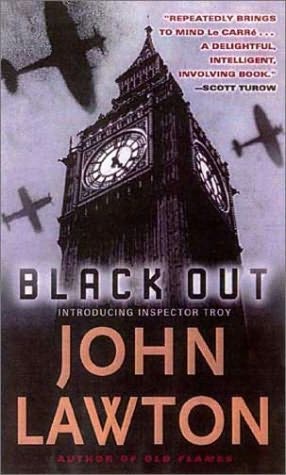
Review: BLACK OUT, John Lawton

  • first published 1995
  • this edition, Large Print, Chivers Press 1996
  • 442 pages
  • ISBN 0-7451-7963
  • source: my local library
Synopsis (Fantastic Fiction)

BLACK OUT is an outstanding debut thriller from a major new talent, featuring an original new detective, Sgt Frederick Troy, the son of a distinguished Russian emigre.

Children playing on an East End bombsite during the Blitz find a severed arm. This is no ordinary murder and Troy is soon on the trail of a German espionage network leading through a labyrinth of conspiracy and betrayal. 

My Take

This is the first in Lawton's Frederick Troy series (see the list below), and yet it creates the impression that there is quite a bit of Troy back-story. Recently I read A LILY OF THE FIELD the beginning of which pre-dates BLACKOUT. I remembered a lot of Sergeant Troy's back story from that book, his  Russian emigre background in particular. Troy appears to have emerged in BLACK OUT a bit Venus like, fully formed. His boss regards him as Scotland Yard's "most intuitive detective", and he has certainly had a meteoric rise due to his ability to read and interpret a crime scene.

London in 1944 is a dangerous place. It is under heavy German bombardment and Troy is hit by bombs more than once. He is also shot, stabbed and coshed. He is a bit bulldog like in his sleuthing efforts. What matters to him is finally getting his man and he pursues that goal at all costs. There is a scene towards the end of BLACK OUT where Troy asks another character what she believes in. She responds that he doesn't have the right to ask anyone that question because his own beliefs are suspect. She says that he is unprincipled and will do anything to get to his final quarry.

I think what I didn't like about this book is that it is difficult to predict the chain of events. There are things that the reader can't possibly know and in fact the finally denouement really comes out of left field. I found it rather slow going in places, but some of the visual pictures were stunning.

What I liked about it too is the meticulous attention to historical detail and the feeling of authenticity of setting.  Having read only two in the series, as well as the synopses for the other five, I suspect that to get the full picture of Freddie Troy you do need to read them all, but I am not sure the order matters. Historically speaking RIPTIDE is set earlier in 1941, but A LILY OF THE FIELD begins even earlier in 1934. To me the overall impression is a bit like hopping about a patchwork quilt. There's a post at It’s a crime! (Or a mystery…) which gives a useful overview.

My rating: 4.3

Other reviews to check
The Game's Afoot
Crime Scraps

The View from the Blue House


Frederick Troy (courtesy Fantastic Fiction)
1. Black Out (1995)
2. Old Flames (1996)
3. A Little White Death (1998)
4. Riptide (2001)
     aka Bluffing Mr. Churchill
5. Blue Rondo (2005)
     aka Flesh Wounds
6. Second Violin (2007)
7. A Lily of the Field (2010)

15 March 2012

Review: A LILY OF THE FIELD, John Lawton

  • published Atlantic Monthly press, 2010
  • ISBN 978-0-8021-1956-8
  • 380 pages
  • source: my local library
  • #7 in published order of the Frederick Troy series, but #4 in chronological order.
Synopsis (from Fantastic Fiction)

Vienna 1934. Ten-year-old Meret Voytek becomes a pupil of esteemed musician professor Viktor Rosen, a Jew in exile from Germany. Three years later, aware that the Nazis are advancing, Rosen tells his promising pupil that he must leave Vienna for London.

When Vienna quietly comes under Nazi rule, Meret witnesses the repercussions for the city's Jews, but when her orchestra becomes a division of the Hitler Youth, she complies and wears the uniform.

Meanwhile, across Europe, Dr. Karel Szabo, a Hungarian physicist, has been interned in a camp on the Isle of Man. Shortly thereafter, Szabo is transported to Canada and rescued by the Americans, who recruit him to join the team in New Mexico building an atomic bomb.

In his ninth book, Lawton moves seamlessly from Vienna and Auschwitz to the deserts of New Mexico to London, illustrating the fascinating parallels of the enemy alien, Szabo and gentile Voytek, as fate carries each across the distinct and untraditional battlefields of the destructive war to an unexpected intersection at the novel's close. The result, A Lily of the Field, is Lawton's best book yet, an historically accurate and remarkably written novel that explores the diaspora of two Europeans from the rise of Hitler to the postatomic age.

My take

"Consider the lilies of the field how they grow; they toil not, neither do they spin"
Matthew 6:28
I think perhaps my reading of this book suffered from the fact that the series this is part of is already well underway. I definitely didn't enjoy it as much as my friend and fellow blogger at CRIME SCRAPS REVIEW.

In the first half of the book Lawton introduces us to a rich cavalcade of characters all affected by the rise of the Third Reich and the advance of Hitler's troops into Poland and Austria. Some, Jews, Gentiles, Viennese, Poles, flee to England as early as 1935 ahead of the advance. Others are snatched off the streets and put onto trains taking them to Auschwitz.

Some meet again in England when they are rounded up into internment camps and then shipped off to Canada. Others meet in Auschwitz. Some survive because of their talents, others because they sell their souls to the devil, some because they do both.

And then the war ends and we are back in England and the crime fiction part of the novel begins with the murder on a tube station platform of one of the refugees and the subsequent involvement of Freddie Troy of Scotland Yard, his own family Russian refugees just thirty years before.

I think the richness of the information in the first half of the novel made it hard for the reader to decide what was important and what wasn't, what did I need to remember for later reference? Looking at the two halves of the novel, I think perhaps the author had a problem in deciding what he was writing: a historical fiction about the dreadful events of the Holocaust, or a murder mystery set in a Britain still under rationing and full of very confused,damaged, and often eccentric people.

But where I am torn is that this is a novel that makes you think, and, as readers of this blog will know, this is something that I value highly in my reading. A LILY OF THE FIELD presents scenarios that were new to me, and situations that I have not given much thought to before. The historical detail is rich and authentic. I think perhaps it was because there was so much detail that I had a problem in achieving focus and I found myself wondering in the first half of the novel when the crime fiction was going to kick in. It seemed that in the face of such inhumanity an "ordinary" murder would be very low key.

Freddie Troy is an interesting and quirky character who really operates by his own rules and his own sense of justice. He's a maverick in a world that is trying to establish order.

My rating: 4.3

Tell me, have you read this book or any in the series? What would you recommend? Shall I read another? Do I have to start at the beginning?

Another review to check on Euro Crime

    LinkWithin

    Blog Widget by LinkWithin