4 October 2010

Is leaving a comment just BSP?

Technorati's State of the Blogosphere in 2010 survey raised among other things the topic of why "we" blog, what we enjoy about blogging, and suggested that one of the enjoyable things was getting comments from other bloggers.

Zen Leaf wrote a Sunday Salon post about what someone said to her about leaving comments and I've been watching the vibrant conversation there, after throwing my own comment into the ring (of course). The gist of the original statement made to her was that commenting is a form of self-advertising.

When I talk to people just starting out on blogging, I do suggest that one of the ways to bring your blog to the notice of others is to begin leaving comments on their blogs. So I guess in that sense it is advertising, BSP, or whatever you like to call it. For me, commenting in this way has been the beginning of good cyber-friendships.  Here's a post (where the image comes from actually) that has some sensible things to say about commenting being an important part of social networking.

The other thing that I suggest people do is reply to the comments that others leave. I do believe that blogging can be the beginnings of a conversation. Sadly, despite my own belief in the practice, I don't always get around to doing it.

I monitor well over 100 blogs through my RSS reader and through Blogs I'm watching, and through Crime and mystery fiction on FriendFeed and I don't always get around to leaving comments on people's blogs.
But I know how much I enjoy comments, and the conversations that can flow, not just between me and the commenter,but between fellow commenters. This blog post talks about the role of commenting in building relationships.

One of the things I hate are spam comments - you know the sort I mean - the ones that make you put commenting into moderation from time to time until the "person" gets tired of visiting. But I certainly don't object to friends who leave comments that just indicate they've read and enjoyed (or hated) the post. BTW you don't always have to agree with me.

So what is your attitude to comments and commenting? What practices do you recommend?

BSP="blatant self promotion"

3 October 2010

Sunday Salon - 3 October - taking stock

This week Technorati sent me a link to its State of the Blogosphere in 2010 survey that, among other things made me think about why I blog. They seemed keen to find out whether I regard my blog as a potential source of income, but of course I don't.
[They reminded me also of the US FTC ruling with regard to declaring any goods received (books from publishers) in relation to my blog. I reminded them as an Australian citizen that I was not bound by US taxation laws. Surprisingly, we have our own]

Anyway I do however spend huge amounts of time on my blog.
In September I published 70 posts, so that just gives you some indication of the amount of time I devote to it.
To be quite honest though that was too many blog posts, and I definitely aim to cut back this month, although this is the sixth post for October in only 3 days.

The survey asked me what I enjoyed about blogging, and I selected the options that said the contact with other bloggers, and the comments that people leave - today the comments received total 5100.

The other thing I've been taking stock of is where in particular I am with the challenges I have undertaken for 2010.
I have actually completed a number of challenges already:
Of the remaining challenges:
  • I am currently reading book 100 for the year, so that challenge is done and dusted. From now on the challenge will be to see how many I can total for the whole year.
  • This week I will start listening to my 20th audio book, which was the total I was aiming at, so there is no doubt I'll complete that challenge either.
  • In the Agatha Christie Reading Challenge, I aim to read a book amonth, and this year I have read only 8, so I am a little behind. I need to read 4 more titles this year.  I have scheduled 3: MURDER IN MESOPOTAMIA, THE LABOURS OF HERCULES, WHILE THE LIGHT LASTS, so I think I'll be ok there.
  • I need to take things in hand for the 2010 Global Reading Challenge, where I have 5 books to go. So I have made a list.
    To finish the Global Reading Challenge:
    * CITY OF VEILS, Zoe Ferraris (Saudi Arabia) Kindle
    * HAVANA BLACK, Leonardo Padura (Cuba)
    * BEAT NOT THE BONES, Charlotte Jay (New Guinea)
    * BAIT, Nick Brownlee (Kenya) - Kindle
    * ANARCHY AND OLD DOGS, Colin Cotterill (Laos)
    Hopefully that will get me over the line
  • I've also decided to participate in the Canadian Book Challenge, where I should be reading a book a month, and have fallen a bit behind even though I have books on hand. I can see I'm going to have to resort to a Canadian binge to get back in line.
So now I feel organised.

TBRN (To Be Read Next)
  • now - WYATT, Garry Disher
  • now (on Kindle) - BLACKLANDS, Belinda Bauer
  • then on Kindle - THE LABOURS OF HERCULES, Agatha Christie
  • CITY OF VEILS, Zoe Ferraris (Saudi Arabia, Kindle)
  • next Audio - WHILE THE LIGHT LASTS, Agatha Christie
  • then on Audio - THE SKULL BENEATH THE SKIN, PD James
This week's new headlines
Posts in the last week

2 October 2010

ACRC: Short Stories, Update #9

In ACRC: Short Stories, I explained how I'm going to keep records of the reading of Agatha Christie's short stories.

As I read another collection, I'll add the stories to the list that I've created and publish a new posting headed ACRC: Short Stories, Update #x.

Short Story Collections read so far
Collections to be read

The updates will show the short stories read, listed in the order in which they were written, and the collection(s) in which they were published.

  1. 1923, The Adventure of the Western Star - Hercule Poirot - Poirot Investigates publ. 1924
  2. 1923, Tragedy at Marsdon Manor - Hercule Poirot - Poirot Investigates publ. 1924
  3. 1923, The Adventure of the Cheap Flat - Hercule Poirot - Poirot Investigates publ. 1924
  4. 1923, The Mystery of Hunters Lodge - Hercule Poirot - Poirot Investigates publ. 1924
  5. 1923, The Million Dollar Bond Robbery - Hercule Poirot - Poirot Investigates publ. 1924
  6. 1923, The Adventure of the Egyptian Tomb - Hercule Poirot - Poirot Investigates publ. 1924
  7. 1923, The Jewel Robbery at the Grand Metropolitan - Hercule Poirot - Poirot Investigates publ. 1924
  8. 1923, The Kidnapped Prime Minister - Hercule Poirot - Poirot Investigates publ. 1924
  9. 1923, The Disappearance of Davenheim - Hercule Poirot - Poirot Investigates publ. 1924
  10. 1923, The Adventure of the Italian Nobleman - Hercule Poirot - Poirot Investigates publ.1924
  11. 1923, The Case of the Missing Will - Hercule Poirot - Poirot Investigates publ. 1924
  12. 1923, The First Wish - Tommy and Tuppence, became The Clergyman's Daughter / The Red House in Partners in Crime publ. 1929
  13. 1924, Publicity - Tommy and Tuppence, became A Fairy in the Flat / A Pot of Tea in Partners in Crime publ. 1929
  14. 1924, The Affair of the Pink Pearl - Tommy and Tuppence - Partners in Crime publ. 1929
  15. 1924, Finessing the King - Tommy and Tuppence - became Finessing the King / The Gentleman Dressed in Newspaper in Partners in Crime publ. 1929
  16. 1924, The Case of the Missing Lady - Tommy and Tuppence - Partners in Crime publ. 1929
  17. 1924, The Case of the Sinister Stranger - Tommy and Tuppence - became The Adventure of the Sinister Stranger in Partners in Crime publ. 1929
  18. 1924, The Sunninghall Mystery - Tommy and Tuppence - became The Sunningdale Mystery in Partners in Crime publ. 1929
  19. 1924, The House of Lurking Death - Tommy and Tuppence - Partners in Crime publ. 1929
  20. 1924, The Matter of the Ambassador's Boots - Tommy and Tuppence - became The Ambassador's Boots in Partners in Crime publ. 1929 
  21. 1924, The Girl on the Train - The Listerdale Mystery, publ.1934
  22. 1924, The Affair of the Forged Notes - Tommy and Tuppence - became The Crackler inPartners in Crime publ. 1929
  23. 1924, Blindman's Buff - Tommy and Tuppence - Partners in Crime publ. 1929
  24. 1924, The Man in the Mist - Tommy and Tuppence - Partners in Crime publ. 1929
  25. 1924, The Man who was Number Sixteen - Tommy and Tuppence - Partners in Crime publ. 1929
  26. 1924,  The Red Signal - The Hound of Death publ. 1933 
  27. 1924, The Mystery of the Blue Jar - The Hound of Death publ. 1933 
  28. 1924, Philomel Cottage - The Listerdale Mystery, publ.1934
  29. 1924, Jane in Search of a Job - The Listerdale Mystery, publ.1934
  30. 1924, The Manhood of Edward Robinson -  The Listerdale Mystery, publ.1934
  31. 1924, Mr Eastwood's Advenure - aka The mystery of the Second Cucumber - The Listerdale Mystery, publ.1934
  32. 1925, The Fourth Man - The Hound of Death publ. 1933
  33. 1925, The Witness for the Prosecution - The Hound of Death publ. 1933
  34.  1925, The Listerdale Mystery - The Listerdale Mystery, publ.1934
  35. 1926, Magnolia Blossom - romance - Problem at Pollensa Bay publ. 1991
  36. 1926, SOS - The Hound of Death publ. 1933
  37. 1926, The Love Detectives - Mr Satterthwaite & Harley Quin - Problem at Pollensa Bay publ. 1991
  38. 1926, Wireless - The Hound of Death publ. 1933 
  39. 1926, The Rajah's Emerald - The Listerdale Mystery, publ.1934
  40. 1926, Swan Song - The Listerdale Mystery, publ.1934
  41. 1926, The Edge, published in While the Light Lasts and Other Stories and also in The Harlequin Tea Set and Other Stories in the US
  42. 1927, The Tuesday Night Club - Miss Marple - The Thirteen Problems publ. 1932  Miss Marple: complete short stories publ. 1997
  43. 1927, The Last Seance - The Hound of Death publ. 1933
  44. 1928, The Idol House of Astarte - Miss Marple - The Thirteen Problems publ. 1932  Miss Marple: complete short stories publ. 1997
  45. 1928, Ingots of Gold - Miss Marple - The Thirteen Problems publ. 1932  Miss Marple: complete short stories publ. 1997
  46. 1928, The Bloodstained Pavement - Miss Marple - The Thirteen Problems publ. 1932  Miss Marple: complete short stories publ. 1997
  47. 1928, Motive & Opportunity - Miss Marple - The Thirteen Problems publ. 1932  Miss Marple: complete short stories publ. 1997
  48. 1928, A Fruitful Sunday -  The Listerdale Mystery, publ.1934
  49. 1928, The Unbreakable Alibi - Tommy and Tuppence - Partners in Crime publ. 1929
  50. 1929, The Thumb Mark of St. Peter - Miss Marple - The Thirteen Problems publ. 1932  Miss Marple: complete short stories publ. 1997
  51. 1929, Next to a Dog - romance - Problem at Pollensa Bay publ. 1991
  52. 1929, Sing a Song of Sixpence -  The Listerdale Mystery, publ.1934
  53. 1929, Accident - The Listerdale Mystery, publ.1934
  54. 1929, The Golden Ball - aka Playing the Innocent - The Listerdale Mystery, publ.1934
  55. 1929, The Blue Geranium - Miss Marple - The Thirteen Problems publ. 1932  Miss Marple: complete short stories publ. 1997
  56. 1930, The Companion - Miss Marple - The Thirteen Problems publ. 1932  Miss Marple: complete short stories publ. 1997
  57. 1930, The Four Suspects - Miss Marple - The Thirteen Problems publ. 1932  Miss Marple: complete short stories publ. 1997
  58. 1930, A Christmas Tragedy - Miss Marple - The Thirteen Problems publ. 1932  Miss Marple: complete short stories publ. 1997
  59. 1930, The Herb of Death - Miss Marple - The Thirteen Problems publ. 1932  Miss Marple: complete short stories publ. 1997
  60. 1930, The Affair of the Bungalow - Miss Marple - The Thirteen Problems publ. 1932  Miss Marple: complete short stories publ. 1997
  61. 1930, The Coming of Mr. Quin - Mr Satterthwaite & Harley Quin - The Mysterious Mr Quin
  62. 1930, The Shadow on the Glass - Mr Satterthwaite & Harley Quin - The Mysterious Mr Quin
  63. 1930, At the "Bells and Motley" - Mr Satterthwaite & Harley Quin - The Mysterious Mr Quin
  64. 1930, The Sign in the Sky - Mr Satterthwaite & Harley Quin - The Mysterious Mr Quin
  65. 1930, The Soul of the Croupier - Mr Satterthwaite & Harley Quin - The Mysterious Mr Quin
  66. 1930, The Man from the Sea - Mr Satterthwaite & Harley Quin - The Mysterious Mr Quin
  67. 1930, The Voice in the Dark - Mr Satterthwaite & Harley Quin - The Mysterious Mr Quin
  68. 1930, The Face of Helen - Mr Satterthwaite & Harley Quin - The Mysterious Mr Quin
  69. 1930, The Dead Harlequin - Mr Satterthwaite & Harley Quin - The Mysterious Mr Quin
  70. 1930, The Bird with the Broken Wing - Mr Satterthwaite & Harley Quin - The Mysterious Mr Quin
  71. 1930, The World's End - Mr Satterthwaite & Harley Quin - The Mysterious Mr Quin
  72. 1930, Harlequin's Lane - Mr Satterthwaite & Harley Quin - The Mysterious Mr Quin
  73. 1931, Death by Drowning - Miss Marple - The Thirteen Problems publ. 1932
  74. 1932, The Second Gong - Hercule Poirot - Problem at Pollensa Bay publ. 1991
  75. 1932, The Case of the Discontented Soldier - Mr Parker Pyne - Parker Pyne Investigates publ.1934
  76. 1932, The Case of the Distressed Lady - Mr Parker Pyne - Parker Pyne Investigates publ.1934 
  77. 1932, The Case of the Discontented Husband - Mr Parker Pyne - Parker Pyne Investigates publ.1934 
  78. 1932, The Case of the City Clerk  - Mr Parker Pyne - Parker Pyne Investigates publ.1934 
  79. 1932, The Case of the Rich Woman - Mr Parker Pyne - Parker Pyne Investigates publ.1934
  80. 1933, Have You Got Everything You want?  - Mr Parker Pyne - Parker Pyne Investigates publ.1934
  81. 1933, The Gate of Baghdad - - Mr Parker Pyne - Parker Pyne Investigates publ.1934 
  82. 1933, The House at Shiraz  - Mr Parker Pyne - Parker Pyne Investigates publ.1934 
  83. 1933, The Pearl of Price - - Mr Parker Pyne - Parker Pyne Investigates publ.1934
  84. 1933, Death on the Nile  - Mr Parker Pyne - Parker Pyne Investigates publ.1934 
  85. 1933, The Oracle of Delphi - Mr Parker Pyne - Parker Pyne Investigates publ.1934
  86. 1933, The Hound of Death - The Hound of Death publ. 1933  
  87. 1933, The Gypsy - The Hound of Death publ. 1933 
  88. 1933, The Lamp - The Hound of Death publ. 1933  
  89. 1933, The Strange Case of Sir Arthur Carmichael - The Hound of Death publ. 1933  
  90. 1933, The Call of Wings - The Hound of Death publ. 1933
  91. 1934, The Case of the Middle-Aged Wife -  - Mr Parker Pyne - Parker Pyne Investigates publ.1934
  92. 1935, Problem at Pollensa Bay - Parker Pyne - Problem at Pollensa Bay publ. 1991
  93. 1935, Miss Marple Tells a Story - Miss Marple - Miss Marple: complete short stories publ. 1997
  94. 1936, The Regatta Mystery - Parker Pyne - Problem at Pollensa Bay publ. 1991
  95. 1937, Yellow Iris - Hercule Poirot - Problem at Pollensa Bay publ. 1991
  96. 1941, Strange Jest - Miss Marple - Miss Marple: complete short stories publ. 1997   
  97. 1941, Tape-Measure Murder - Miss Marple - Miss Marple: complete short stories publ. 1997 
  98. 1941, The Case of the Caretaker - Miss Marple - Miss Marple: complete short stories publ. 1997
  99. 1942, The Case of the Perfect Maid - Miss Marple - Miss Marple: complete short stories publ. 1997
  100. 1954, Sanctuary - Miss Marple - Miss Marple: complete short stories publ. 1997
  101. 1956, Greenshaw's Folly - Miss Marple - Miss Marple: complete short stories publ. 1997
  102. 1971, The Harlequin Tea Set - Mr Satterthwaite & Harley Quin - Problem at Pollensa Bay publ. 1991

Review: MISS MARPLE: complete short stories, Agatha Christie

Harper Collins 1997
359 pages
ISBN 9-780006-499626

Publisher's Blurb
Fans of the amiable, omniscient Miss Marple will be delighted by the first publication in one volume of all 20 short stories that Christie centered on the elderly sleuth. Wearing her black lace mittens, Miss Marple sits in her chair, knitting and digesting details of murders of all descriptions (from poisonings to a drowning to a shooting by bow and arrow). She manages, of course, to see through all false identities and bogus alibis, and neatly solves each puzzle, no matter how obscure or far-fetched. The bulk of the stories are gathered from The Tuesday Club murders, chronicling the meetings of a group formed by Miss Marple and a handful of her friends. The members take turns recounting mysteries to which they know the answers, while the others take a stab at cracking the cases. Readers will have fun playing along, but beware: Miss Marple is fierce competition.

I cheated a little once I discovered that the 20 short stories actually come from only 3 collections, one of which I had read. I didn't re-read The Thirteen Problems.
Here are the summaries of the stories in The Thirteen Problems
  • The Tuesday Night Club - Sir Henry Clithering, until recently Commissioner of Scotland Yard, tells a tale about tinned lobster that caused a fatal case of food poisoning. December 1927.
  • The Idol House of Astarte - Dr. Pender is an elderly clergyman. He tells the story of paganism and the time when he saw a man "stricken to death by apparently no mortal agency". January 1928.
  • Ingots of Gold - this story is recounted by Raymond West and is about a Cornish village called Rathole (a sly dig at the real village of Mousehole?) and treasure from the Spanish Armada. February 1928.
  • The Bloodstained Pavement - Joyce Lempriere, the artist, also tells a tale from the village of Rathole, of a husband and wife playing the cruellest trick of all, the duping and eventual murder of another woman. March 1928.
  • Motive & Opportunity - Mr Petherick is a solicitor, "a dried-up little man with eyeglasses which he looked over and not through." His tale is of spiritualism and of a will that is eventually found to be a blank sheet of paper. April 1928.
  • The Thumb Mark of St. Peter - this is Miss Marple's story, about her niece Mabel who married a man with a violent temper, and who is suspected by the locals of causing his death. May 1928.
  • The Blue Geranium - This is Colonel Arthur Bantry's tale. He is a red-faced, broad shouldered man who tells his "ghost story" at his wife Dolly's prompting. It is about a "dreadful" woman who had a weakness for fortune tellers, palmists and clairvoyantes, until the latest warns her against blue flowers, and the flowers on her bedroom wallpaper begin to change colour. December 1929.
  • The Companion - Dr. Lloyd is the grizzled elderly doctor who for the past 5 years has administered to the ailments of the village of St. Mary Mead. His tale is from time he spent practsing on the Canary Islands. Tragedy struck when two English ladies, one the paid companion of the other, came to stay, went swimming, and the companion drowned. February 1930.
  • The Four Suspects - Sir Henry Clithering tells the story of a marked man, hiding from a secret society, to whom he assigns a protector. Unfortunately the man is still killed, in an apparent accident falling down the stairs, but Clithering suspects the very man he sent in as the protector. January 1930.
  • A Christmas Tragedy - Mrs Bantry, Dolly, protests she doesn't have a tale to tell, so Miss Marple tells the story of the murder of a young wife, she had been convinced would happen, and failed to prevent. January 1930.
  • The Herb of Death - Mrs Bantry can't get out of telling a tale, and so she tells a tale of what had appeared to be a case of accidental poisoning when foxglove leaves were picked with sage, and roast duck stuffed with the mixture. But even she doesn't see what really happened, but Miss Marple works it out. March 1930.
  • The Affair of the Bungalow - Jane Helier, a beautiful young actress, tells the story of a "close friend" but Miss Marple sees through it and gives her some timely advice. May 1930.
  • Death by Drowning - a local St. Mary Mead girl has been drowned. At first it is thought to be suicide but Miss Marple is convinced it is murder. She asks Sir Henry to intervene in the local investigation to ensure that the true murderer is apprehended. She gives Sir Henry a slip of paper with the name of the murderer on it. November 1931.
I rated the above collection at 4.5.
To be quite honest, I thought the remaining 7 tales in MISS MARPLE: COMPLETE SHORT STORIES were a bit patchy, and a couple of them were downright improbable. All the stories tended to suffer a bit from the need to write sparingly, to keep the plot to short story length. Sometimes the story was finished off, and tidied up, a little too quickly for my liking. For example I would have liked this to be a little more expanded:
    Miss Marple had stalked out before Inspector Slack had recovered. 'Whew?' he muttered. 'I wonder if she's right?' He soon found out Miss Marple was right again.
Miss Marple's Final Cases (from the Christie site: Despite the title, the six Marple stories recount cases from the middle of her career, rather than her final adventures, and all are reprinted from earlier collections.)
  • Miss Marple Tells a Story: Miss Marple is staying with her nephew Raymond and his wife Joan. Her solicitor Mr Petherick brings to see her a young man Mr. Rhodes. Rhodes and his wife were staying in a hotel in a nearby town when his wife was stabbed to death. Rhodes is likely to be accused of the murder because access to his wife's room was only through the room he was sitting in. Mr Petherick believes Rhodes is innocent. aka Behind Closed Doors, 1935
  • Strange Jest: Charmian and Edward were expecting a great-great-uncle to have left them his fortune, but he appears to have left them nothing. Miss Marple believes he was playing a joke on them. aka A Case of Buried Treasure, 1941
  • Tape-Measure Murder: Miss Politt calls on Mrs Spenlow to do a dress fitting, and when she breaks into the house with a neighbour, they find her dead on the floor. Mr Spenlow's alibi for the time the murder took place includes Miss Marple. aka The Case of the Retired Jeweller, 1941
  • The Case of the Caretaker: Miss Marple is not feeling herself. She has the flu, feels depressed, old, and useless so Doctor Haydock brings her a murder to puzzle over. 1941
  • The Case of the Perfect Maid: Miss Marple's maid Edna asks her advice. Her friend Gladys has been unfairly accused by her employers and been given her notice. Miss Marple soon discovers that all is not above board with the Misses Skinner. aka The Perfect Maid, or The Maid Who Disappeared, 1942
  • Sanctuary: The vicar's wife Bunch, Miss Marple's god-daughter, discovers a man dying, shot, in the church. The man dies almost immediately. But why did he come to the church? Bunch visits Miss Marple who solves the puzzle. aka Murder at the Vicarage, 1954. Christie donated this story to the Fund for the Restoration of Westminster Abbey.
The Adventure of the Christmas Pudding
  • Greenshaw's Folly:Miss Marple's nephew Raymond West takes a house guest to see a local architectural monstrosity that only a true family member could love. While they are there they witness a will. After the house owner, whose will they witnessed, dies, they discover the will beneficiary is not the person they thought it was. 1956.
    This I thought was the least successful of all the stories.
My rating for this collection : 4.1
I've read this as part of the Agatha Christie Reading Challenge.

    What I read in September 2010

    One of those good solid reading months, with a couple of standouts.
    Three Australian authors for you to check out. **
    One New Zealand author (NZ), one Canadian (C), and one translated (T)
    No Agatha Christie's but I have a couple lined up for October.

    My pick of the month is Australian author Malla Nunn.
    1. 5.0, A BEAUTIFUL PLACE TO DIE, Malla Nunn (30 Sept)**
    2. 4.5, SILK CHASER, Peter Klein (25 Sept)**
    3. 4.5, TALKING ABOUT DETECTIVE FICTION, P.D. James-audio (21 Sept)
    4. 4.3, DEAD MAN'S CHEST, Kerry Greenwood (18 Sept)**
    5. 4.5, UNSPOKEN, Mari Jungsted (15 Sept ) T
    6. 3.8, MIDNIGHT IN MADRID, Noel Hynd (12 Sept)
    7. 4.6, ALL THE COLOURS OF DARKNESS, Peter Robinson (9 Sept) C
    8. 4.5, ROYAL FLUSH aka ROYAL HEIST, Lynda la Plante - audio (8 Sept)
    9. 4.2, CUT & RUN, Alix Bosco (4 Sept) NZ
    I've read 98 books so far this year, so I won't have any trouble at all in completing the 100 book challenge.
    17 of the books are by Australian authors and I'd like to get that up to at least 20 by the end of the year, perhaps 25.
    19 of this year's books so far are audio books, so there's another challenge (20 audio books) I won't have any trouble completing.

    How about you - how are your targets going?

    1 October 2010

    Review: A BEAUTIFUL PLACE TO DIE, Malla Nunn

    Macmillan 2008
    ISBN 978-1-405-03877-5
    397 pages
    Borrowed from my library.

    From Wikipedia:
    Apartheid was a system of legal racial segregation enforced by the National Party government in South Africa between 1948 and 1994, under which the rights of the majority 'non-white' inhabitants of South Africa were curtailed and minority rule by white people was maintained.
    New legislation classified inhabitants into racial groups ("black", "white", "coloured", and "Indian"), and residential areas were segregated, sometimes by means of forced removals.


    It is against this background that Malla Nunn sets A BEAUTIFUL PLACE TO DIE.
    It is September 1952. A white man's body has been found in deep country, in the river that separates South Africa from Mozambique. The body floats face down within reach of the river's edge on the South African side. Some kaffir boys found the body, and now it is being guarded by a nineteen year old Afrikaner constable. Three Afrikaner men, built like rugby players, stand a little way off, waiting for the investigating team from Johannesburg to arrive. For the dead man is their father, Captain Willem Pretorius, the local police chief. And the investigating "team" is Detective Sergeant Emmanuel Cooper, sent out solo on the murder of a white police captain.

    Cooper had been investigating another murder only an hour away and had been despatched to check the "possible" homicide. At the scene also is the man Pretorius had grown up with, Constable Shabalala, a Zulu. The opening scene gives Cooper a lesson in how the social structure works around here. The Pretorius sons think  their father has been killed by Mozambique smugglers, but Cooper is not so sure.

    Finding a doctor who can sign a death certificate leads him to meet "the Jew", Zweigman, who is an elderly  German living with his wife in a shanty town where there are no English or Afrikaners.

    Things become even more complex when Cooper's boss in Johannesburg tells him that the Security Branch has decided that the murder may be political, and that they are sending a team to take over the investigation. Cooper will be expected to co-operate.

    A BEAUTIFUL PLACE TO DIE is a fascinating exploration of relationships in an area where white supremacy is already an acknowledged way of life. However the newly passed racial segregation laws are about more than who rules. Emmanuel Cooper can't be sure that even he is going to get out alive.

    This was an impressive debut book, and I'm looking forward to reading the sequel, LET THE DEAD LIE.
    If  you'd like to read some opening pages click on the image to the right.

    My rating: 5.0

    Emmanuel Cooper has recently returned from Europe, from the war, leaving behind his English wife, but not leaving behind his sergeant major, a Scotsman, who gave soldiers advice on how to kill before they were killed, who lives on in his mind. This, his sometimes blurred vision, and the headaches, indicate a man who is still suffering from post traumatic stress. He reminded me of the central character created by Charles Todd, Ian Rutledge, who is constantly reminded of the war (in this case World War One) by the ever present voice of Hamish MacLeod, "Hamish in his head".

    Other reviews to check:
    • Petrona: "this book is more than a crime novel, and it is one that will rest in the mind for a while."
    • Reactions to Reading: "yet another book that has everything I look for in my crime fiction"
    • Reviewing the Evidence: "an extraordinarily powerful novel"
    A BEAUTIFUL PLACE TO DIE won the 2009 Sisters in Crime (Australia) Davitt Award for Best Adult Crime Novel,  and was shortlisted in 2010 for Edgar Award and is also shortlisted for Macavity Award for Best First Novel

    About Malla Nunn
    Malla Nunn grew up in Swaziland before moving with her parents to Perth in the 1970s. She attended university in WA, and then the US. In New York, she worked on film sets, wrote her first screenplay and met her American husband-to-be, before returning to Australia where she began writing and directing short films and corporate videos. Fade to White, Sweetbreeze and Servant of the Ancestors have won numerous awards and have shown at international film festivals from Zanzibar to New York. Malla and her husband live in Sydney with their two children.

    Malla Nunn & Others Talk About The Stories Behind Their Stories

    See also the Simon & Schuster site.

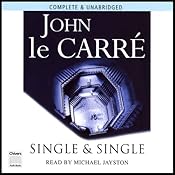
    Review: SINGLE & SINGLE, John Le Carre - audio

    Originally published 1999, Hodder & Stoughton
    ISBN: 0-340-73897-9 / 978-0-340-73897-9
    Reading time - approx 12 hrs 15 mins
    Released on audible.com Feb 2010 

    Publisher's Summary:
    A corporate lawyer from the House of Single &Single is shot dead on a Turkish hillside for crimes that he does not understand. A children’s entertainer in Devon is hauled to his local bank late at night to explain a monumental influx of cash. A Russian freighter is arrested in the Black Sea....
    The logical connection of these events and more is one of the many pleasures of this story of love, deceit, family and the triumph of humanity.

    Single & Single are a firm of financial enablers. Among their clients are the Russian capitalists, the Orlov family, out to make quick roubles. Their biggest scheme so far is the sale of "clean caucasoid" blood to the West. Money managers, the House of Single, Tiger Single, the senior partner, with his son Oliver, are set to reap a fortune. However events impair the smooth flow of cash, and the Russian partners turn to a new means of profit-making, drugs. As a lawyer in a financial management organisation, Oliver draws the line at drugs. It jeopardizes the future of the firm, and his own. He informs on his father to British government officials in the hope of cutting a deal. It takes four years for the government to act, and then their actions result in Tiger's disappearance. But it seems that Oliver was not the only one to betray Tiger.

    This was not an easy story to listen to, although narrated extremely well by Michael Jayston. The event with which the story opens, the death of Albert Wincer, really comes midway in the plot, and from that point on Le Carre feeds the reader tidbits, almost in the style of jigsaw puzzle pieces plucked randomly from the box. Sometimes the bits fit, and at other times we have to mentally set them aside for later use. If this was a held-in-the-hand paper book the reader would have the advantage of flipping backwards and forwards, re-reading bits, but you can't do that with an audio.

    One of the things that other reviewers have commented on is the fact that at the end it felt as if Le Carre could not get shut of the reader quickly enough. However I had made up my mind about my rating well before that. Perhaps I would have liked it better if I was "reading" it in another format. I may not have had the continuity problems that I referred to earlier. The story did have redeeming features: interesting characters, and good exploration of the relationships between them.

    My rating: 4.0

    In a recent Weekly Geeks post about the Overly Critical Reader I wrote about how most of my reading is the result of recommendations. However the audio books that I choose are generally the exception to that rule. To select them I browse audible.com and choose titles in a different way, often based on author. So they tend to be books that I might not otherwise read.

    LinkWithin

    Blog Widget by LinkWithin