19 February 2011

Review: BOUND, Vanda Symon

Publisher: Penguin Books 2011
ISBN 978-0-14-356527-7
314 pages
Source: I bought it. (from Wheeler Books)

Publisher's blurb
A brutal home invasion shocks the nation. A man is murdered, his wife bound, gagged and left to watch. But when Detective Sam Shephard scratches the surface, the victim, a successful businessman, is not all he seems to be.

My take:
This is #4 in the Sam Shephard series.
The story opens with a prologue, a woman bound to a chair, looking at the body of her husband, the top of his head blown off, waiting for her teenage son to arrive home.

The investigation of this horrific murder falls to D.I. Johns and his team. Sam Shephard, recently promoted to Detective, is the liaison with the wife and son of the victim.
The local newspaper instantly puts pressure on the police task force to find the perpetrators of this "Killer Home Invasion."  The description the victim's wife gives seems to tally with the idea of some sort of revenge killing, but what had John Henderson been involved in to become this sort of target?

The plot of BOUND seems to change tack at least twice. The original murder is followed by two more deaths, one of which is a murder. There is a range of candidates for the second murder, and just when the first appears to be solved, Sam throws a spanner in the works.

While I'm sure the author Vanda Symon has tried to make it possible for a new reader to meet Sam Shephard for the first time in BOUND, I find it hard to assess whether that would be realistic, as I've read them all. Elements of Sam's backstory flooded back to me as I read BOUND.
Be that as it may, if BOUND is your first Sam Shephard novel, I'm sure you will be looking for the earlier novels.
What BOUND does demonstrate is that Vanda Symon is a force to be reckoned with in Australasian, if not world, crime fiction. She is a skilled story teller, has managed the art of developing threads, at the same time as weaving peronal elements from Sam's life into the novel. And at the end, we are assured there will be another in this series - Sam has unfinished business.

My rating: 4.8

Vanda Symon's website
BOUND No. 1 Bestseller!
Of News and Reviews

CONTAINMENT was shortlisted for the inaugural Ngaio Marsh crime fiction award in 2010.
I'm adding BOUND to my list for the Australasian novels in 2011 Global Reading Challenge

18 February 2011

Review: MAIGRET AND THE HEADLESS CORPSE, Georges Simenon

First published in France 1955
Translated from French by Eileen Ellenbogen
This edition: Chivers Press Large Print 1990
238 pages
ISBN 0-7451-1079-7

Blurb from back cover
Two brothers find a grisly package clinging to the propeller of their barge in the Canal de Saint Martins, and by the time Maigret arrives most of a mysterious corpse has been assembled, except the head. The search shifts from finding the missing piece to finding a motive, as the Inspector's keen mind gathers clues from the torso which lead to a trio of suspects. A flash of intuition linking the principal suspect's sordid life to the whereabouts of the victim on his last day alive brings the case near its end but starts Maigret thinking about the reason for the crime.

My take:
This is one of the Maigret novels that demonstrates quite clearly how timeless an author Simenon was.
The discovery of body pieces without a head, thus making identification very difficult, is a scenario explored by a number of crime fiction authors since. In fact I have some books reviewed here in MiP:
    PRIME CUT, Alan Carter And then they are called to a murder scene, at HopeToun: a headless torso in the shallows on the beach. The local policewoman is Senior Sergeant Tess Maguire, recovering from sick leave after being beaten up. ... 
    SKELETON HILL, Peter Lovesey The bone discovered during the battle is re-discovered by three rescue dogs, and is found to belong to a headless corpse. Forensics tells Peter Diamond, Head of Bath CID, that not only are the bones not old, but the skeleton is female,
    THE SIMIAN CURVE, Mark Lalbeharry First of all when young Hattie Locke becomes stuck in a narrow walkway between two lockup garages in London, a headless corpse is discovered. Hundreds of kilometres away in a Frankfurt court, the charges against small time villain ...
It is a case just made for Maigret who worries tenaciously at identifying the corpse, and once he thinks he has that nailed, takes the focus to who killed him and why.
Another theme that emerges, that we tend to see frequently in more modern novels, is how the case takes over Maigret's thinking, and indeed his whole life. It serves to illustrate what a special person Madame Maigret is, in that this doesn't cause a marriage breakdown, but instead evokes a sort of sympathy from her, as she realises he is even eating without tasting.

THE HEADLESS CORPSE illustrates how, like Sherlock Holmes in many ways, Maigret can assemble minute observations and then make an intuitive leap that generates a bigger question.

My rating: 4.5

I am listing this book in my 2011 Vintage Mystery Reading Challenge and of course among my "translated" books.

17 February 2011

Forgotten Book: SCENE OF THE CRIME, John Creasey

This week's contribution to Pattinase's Friday's Forgotten Books comes from my records early in 1992.

Published in 1965.

Publisher's blurb:
Are the murders of two women and the theft of antique jewellery the work of the same criminal? If so, Superintendent Roger West may have the wrong man in custody.

What an incredible writer! Some of us have come across his creations on television (e.g.Gideon, and The Baron) without realising.
He published his first novel  SEVEN TIMES SEVEN in 1932 at the age of just 24. It is obvious if you check the lists that he was publishing up to 5 books a year.
SCENE OF THE CRIME is listed at #29 in his Inspector West series which he wrote from 1942 to 1978.

John Creasey (September 17, 1908 - June 9, 1973) was born in Southfields, Surrey, England and died in New Hall, Bodenham, Salisbury Wiltshire, England. He was the seventh of nine children in a working class home. He became an English author of crime thrillers, published in excess of 600 books under 20+ different pseudonyms.

Creasey's first published novel
He invented many famous characters who would appear in a whole series of novels. Probably the most famous of these is Gideon of Scotland Yard, the basis for the television program Gideon's Way but others include Department Z, Dr. Palfrey, The Toff, Inspector Roger West, and The Baron (which was also made into a television series).
He was awarded the MBE (Member of the Order of the British Empire) for services in the United Kingdom's National Savings Movement during World War II.

In 1962, Creasey won an Edgar Award for Best Novel, from the Mystery Writers of America, for Gideon's Fire, written under the pen name J. J. Marric. And in 1969 he was given the MWA's highest honor, the Grand Master Award.

From Wikipedia:
During 1953, John Creasey founded the Crime Writer's Association (CWA) in the UK.
The CWA New Blood Dagger is an annual award given by the British Crime Writers' Association for first books by previously unpublished writers. It is given in memory of CWA founder John Creasey and was previously known as The John Creasey Memorial Award. The award is voted on by past winners and the prize consists of an ornamental dagger and £1,000.

16 February 2011

Why do you read crime fiction?

Last week, when I ran the post When did you begin to read crime fiction? at least one commenter suggested a follow up post should ask why.

So here it is.

Now I'm a naturally squeamish person and blood, in the flesh so to speak, puts me right off.
I can't hold the cat's paw at the vet's, let alone deal with grazed knees, deep cuts (or even shallow ones) etc. And graphic TV programmes such as Silent Witness have me hiding my eyes at the worst bits.

So why does crime fiction have such a hold on me? Here are a few thoughts.
  • I love puzzles
  • I believe that events in the present often have causes in the past
  • I can escape into a world that I won't ever inhabit, or hopefully have to deal with in real life
  • There is such variety in the genre that I never get bored
  • I have discovered some really great authors
OK - I'm not going to do all the work - over to you! Why do you read crime fiction?

15 February 2011

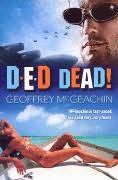
Review: D-E-D DEAD! Geoffrey McGeachin

Published by Viking (Penguin Group)2005
ISBN 0-670-02931-9
283 pages
Source: Local Library

From the back cover:
From the moment Alby drops his gun on a St. Kilda tram he knows he is in for a bad day. Then his partner Harry is gunned down in a Double Bay coffee shop. By lunchtime Alby realises someone wants him dead - and they want him dead now.

My take:

Alby Murdoch is a famous photographer working for WorldPix International, a front for an Australian ultra-secret government department  D-E-D, the Department for Extra-territorial Defence. He and his partner Harry are supposed to be doing the biannual positive vetting on US personnel at Bitter Springs, a US-Australian Joint Defence Facility out in the middle of nowhere. Harry it seems found something wrong with the CIA's list of 300 names and dates of birth of people working at the Springs.

On the surface D-E-D DEAD! has all the hallmarks of a conventional spy thriller - assassins, bombs, car chases, and the obligatory beautiful female CIA agent. But the irreverent and comedic treatment that emerges at times shows that it is a spoof. Alby and his new friend Mary Travers flee to Bali and hitch a boat ride to Broome.

An unconventional and enjoyable read if you don't mind a bit of Australian laconic humour and slang mixed into your thriller. Not entirely my cup of tea, but I still rated it at 4.4.

McGeachin's first novel, FAT, FIFTY & F***ED! won the inaugural Australian Popular Fiction Competition and was published by Penguin in August 2004.

D-E-D DEAD! introduced Alby Murdoch and was nominated for a Ned Kelly Award.
It was followed by SENSITIVE NEW AGE SPY in 2007, also nominated for a Ned Kelly Award.
In 2009 #3 DEAD AND KICKING was published.

I am including D-E-D DEAD! in my list for this year's Aussie Author Challenge

NYOR 2012 Australia


Australian libraries and library associations are behind a campaign to turn 2012 into the National Year of Reading, NYOR,  linking together all the great things that are already happening around books, reading and literacy, and giving them an extra boost, with fun programs and activities taking place across the country.

Upcoming events listed on the website Love2Read include World Book Day on 3 March, and World Read Aloud Day on 9 March.


And here at MYSTERIES in PARADISE we'll be doing our little bit throughout the year, because we all agree that reading is so important.
One of the websites associated with NYOR opens with some sobering thoughts:
    Nearly half the population struggles without the literacy skills to meet the most basic demands of everyday life and work. There are 46% of Australians who can't read newspapers; follow a recipe; make sense of timetables, or understand the instructions on a medicine bottle.
The Patron of NYOR is William McInnes, writer, actor, narrator, popular speaker at various writers' weeks. We look forward to seeing him at various events.
He doesn't write crime fiction but I really enjoyed his account of growing up in rural Australia, which seemed to have so much in common with my own experience. My review: A MAN'S GOT TO HAVE A HOBBY

14 February 2011

Crime Fiction Alphabet 2011 - Letter F - week begins 14 Feb 2011

The Alphabet in Crime Fiction - a Community Meme.

Contributors to this series of the Crime Fiction Alphabet are already stretching their brains (and mine!). In the past week we have a 3D post, a triple D posts, a post with a misleading title, some authors to look for in the D shelves of your library, as well as some D titles.
Bernadette chatted about dogs in crime fiction, while Dorte asked who your favourite detective is.
It is not too late to join in and you don't have to post each week if reading (or life) gets in the way.

Letters already covered: A B C D E 

This week's letter is the letter F:

Here are the rules

By Friday of each week you have to write a blog post about crime fiction related to the letter of the week.
[Those who intend to participate regularly have signed up here.]

Your post MUST be related to either the first letter of a book's title, the first letter of an author's first name, or the first letter of the author's surname.
So you see you have lots of choice.
You could write a review, or a bio of an author, so long as it fits the rules somehow.
(It is ok too to skip a week.)

Please link your post for the week back to this page. (a letter image is supplied that you can use in your post as well as the meme icon if you wish).

After your post is published, put a link to your actual blog post in the Mr Linky that appears below.
(leave a comment if Mr Linky has disappeared)

Then come back at the end of the week to check to see who else has posted and visit their blog (and leave a comment if you can).

Please check each Monday for the letter of the week

Letters already covered: A B C  D  E 
Thanks for participating.


LinkWithin

Blog Widget by LinkWithin