31 October 2013

People have made a start...

State by State in 2014
A number of people have already joined up to the USA Fiction Reading Challenge and quite a number of reviews have been recorded.

Ever thought you would like to read your way across America?
The USA Fiction Challenge asks you to do just that.
Read just one novel from each state - you choose whether the link is the setting or the author.
You choose whether you confine yourself to a particular genre or not.

The challenge has its own blog site:
USA Fiction Challenge - state by state in 2014
 
I decided to include books that I have read this year that are either set in the USA or the author either resides/works in an American State or was born in the USA. My books will most probably be all crime fiction, simply because I rarely read outside the genre. But yours might be a much broader selection.

I have created a page on my blog for keeping track of my reading in a state by state list, and I have also created a map showing the states I have "visited". Here is what it currently looks like.


create your own personalized map of the USA

So why not join us? No pressure to read all 50+ books and on the site there are some suggested mini-challenges with groups of states such as MidWest, Northeast or South Atlantic.

Take as long as you like too. Although the blurb says "state by state in 2014" you can start now and and continue for as long as you are still interested.

Sign up here.

29 October 2013

Review; MURDER AND MENDELSSOHN, Kerry Greenwood

Synopsis (Allen & Unwin)

The divine and fearless Miss Phryne Fisher returns in her 20th adventure in a vastly entertaining tale of murder, spies, mathematics and music.

To the accompaniment of heavenly choirs singing, the fearless Miss Phryne Fisher returns in her 20th adventure with musical score in hand.

An orchestral conductor has been found dead and Detective Inspector Jack Robinson needs the delightfully incisive and sophisticated Miss Fisher's assistance to enter a world in which he is at sea. Hugh Tregennis, not much liked by anyone, has been murdered in a most flamboyant mode by a killer with a point to prove. But how many killers is Phryne really stalking?

At the same time, the dark curls, disdainful air and the lavender eyes of mathematician and code-breaker Rupert Sheffield are taking Melbourne by storm. They've certainly taken the heart of Phryne's old friend from the trenches of WW1, John Wilson. Phryne recognises Sheffield as a man who attracts danger and is determined to protect John from harm.

Even with the faithful Dot, Mr and Mrs Butler, and all in her household ready to pull their weight, Phryne's task is complex. While Mendelssohn's Elijah, memories of the Great War, and the science of deduction ring in her head, Phryne's past must also play its part as MI6 become involved in the tangled web of murders.

A vastly entertaining tale of murder, spies, mathematics and music.

My Take

Followers of my blog will realise that it has taken me a bit longer to read this novel than is usual for me. Part of the reason is that I spent the weekend at a crime fiction convention, but it is also true to say that I found MURDER & MENDELSSOHN a little more challenging to read.

It was partly due to the setting that surrounds the murder of the orchestral conductor of the Harmony Choir. The author uses her own experiences of singing choral music to explore how the conductor and choristers feel about Mendelssohn, including some scripts in detail.

There are many possible murderers when first one conductor, then another is murdered. Neither of the conductors has many friends in the choir or the orchestra but murder seems rather extreme.

There is also a sideplot where it appears someone is trying to kill ex-code-breaker Rupert Sheffield. We learn a few never-revealed-before facts about Phryne's role in intelligence gathering, and particularly about her connections with MI6.

Greenwood also uses the novel as an opportunity to explore homosexuality and this side plot takes up quite a bit of space, detracting a little from the main murder plot. Phryne herself also seems a little more promiscuous, while her lover Lin Chung is overseas.

I did enjoy the glimpses of the splendour of Melbourne's grand old dame, the Windsor Hotel, where some of the characters are staying, and where I have also stayed a couple of times.

So this, the 20th in the Phryne Fisher series, didn't delight me as much as #19 UNNATURAL HABITS.
But I'll be still lined up for #21.

My Rating: 4.3

Also reviewed on this blog
MURDER ON A MIDSUMMER NIGHT
TRICK OR TREAT
FORBIDDEN FRUIT
4.3, DEAD MAN'S CHEST
4.4, COOKING THE BOOKS
4.3, TAMAM SHUD
4.8, UNNATURAL HABITS

26 October 2013

25 October 2013

Forgotten Book: NO MAN'S LAND, Reginald Hill

My plan this year for my contributions to Friday's Forgotten Books hosted by Pattinase is to feature books I read 20 years ago - in 1993- from the records I have in my "little green book", which I started in 1975.
In 1993 I read 111 books and was pretty well addicted to crime fiction by then.

I read NO MAN'S LAND, published in 1985, at about this time in October 1993.
It is one of Reginald Hill's historical stand-alone novels, not a Dalziel and Pascoe for which he is better known.
For me it would have had the twin marks of history and thriller.

Synopsis (Amazon)

Set in the aftermath of the Battle of Somme, 1916, this offbeat, intriguing tale is based upon the legend of armed and dangerous Allied deserters who supposedly roamed the ruined countryside, "no man's land," that existed between the British and German lines.

Known to the British as Viney's Volunteers, the deserters are commanded by Arthur Aloysius Viney, an Australian army sergeant gone mad. Viney's chief British nemesis is Captain Jack Denial, commander of the military police and peacetime Scotland Yard detective.

Viney, it seems, is responsible for the death of Denial's lover, an Army nurse. By the author of several well-received mystery novels, this present work is carefully researched and thoughtfully written. Its strengths include vivid background detail, an intricate but believable plot, and solid development of innumerable major and minor characters. 


22 October 2013

Review: THE CRY, Helen Fitzgerald

  • Published 2013, Faber & Faber UK
  • ISBN 978-0-571-28770-3
  • 307 pages
  • source: library book
Synopsis (Amazon)

He's gone. And telling the truth won't bring him back...

When a baby goes missing on a lonely roadside in Australia, it sets off a police investigation that will become a media sensation and dinner-table talk across the world.

Lies, rumours and guilt snowball, causing the parents, Joanna and Alistair, to slowly turn against each other.

Finally Joanna starts thinking the unthinkable: could the truth be even more terrible than she suspected? And what will it take to make things right?

The Cry is a dark psychological thriller with a gripping moral dilemma at its heart and characters who will keep you guessing on every page.

My Take

Anybody who has flown a long flight, say Glasgow to Dubai, in the company of a small child, or been sitting near one, can empathise with the situation when the child constantly cries. That's where we start with Joanna and Alistair and their baby Noah. For Joanna this becomes the trip from hell, although Alistair seems to be able to sleep through it all. The second leg of the journey from Dubai to Melbourne is only a little better.

The journey starts badly at departure when airport security declares that the bottles that Joanna's antibiotics and Noah's Calpol are too big. That leads Joanna into making a crucial error.

The family is on its way to Melbourne so that Alistair can claim custody of his teenage daughter from his ex-wife who brought Chloe back to Australia illegally. When Noah goes missing from the car when they are driving to Geelong, the custody of Chloe still looms large for Alistair in particular. It becomes even more crucial when Noah remains missing.

This story twists in directions the reader just couldn't predict. The general public becomes involved in the search for Noah not only through media releases but also through social networking like Facebook and Twitter. Joanna and her reactions to her baby's disappearance come under public scrutiny, with the rumour mill coming perilously close to the truth.

Although firmly set in Australia (Joanna and Alistair land in Melbourne when small towns near Geelong are threatened by bushfires) the setting could almost be anywhere and Helen Fitzgerald has the reader asking how they would have reacted in similar circumstances.

A really good read, touching issues that go well beyond the disappearance of a baby.

My rating: 4.7

See other reviews
I've also reviewed
DEAD LOVELY

Novels by Helen Fitzgerald (from Fantastic Fiction)

Dead Lovely (2007)
My Last Confession (2009)
The Devil's Staircase (2009)
Bloody Women (2009)
Amelia O'Donohue Is So Not a Virgin (2010)
Hot Flush (2011)
The Donor (2011)
Deviant (2013)
The Cry (2013)

About the author (Fantastic Fiction)

Helen FitzGerald is one of thirteen children and grew up in Victoria, Australia. She nows lives in Glasgow with her husband and two children. Helen has worked as a parole officer and social worker for over ten years. Her first novel, Dead Lovely, was published in 2007.

See the author's blog.

20 October 2013

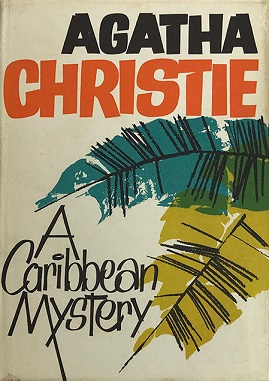
Review: A CARIBBEAN MYSTERY, Agatha Christie

  • first published 1964
  • A Miss Marple mystery
  • this edition Paul Hamlyn AC Crime Collection
  • pp7-151
  • Full plot on Wikipedia
Synopsis (Christie.com)

Jane Marple grapples with a murderous heat when a fellow hotel guest drops dead, just as he's about to share a most astonishing photograph.

Miss Marple finally takes a trip abroad, the only time she would leave her native shores to solve a murder. This novel introduced Jason Rafiel, who would strike up an unusual friendship with Miss Marple. The two couldn't be more different but develop a begrudging respect for each other. So much so that Rafiel would posthumously call on Miss Marple’s skills of detection in the novel Nemesis.

A Caribbean Mystery is dedicated to John Cruikshank Rose, "with happy memories of my visit to the West Indies". Agatha Christie and her second husband Max Mallowan's friendship with John Rose started back in 1928, at the archaeological site at Ur, the same site where they met each other.

My Take

This novel set in the late 1950s?? reflects how much things have changed in Britain since the Second World War. Not only are people travelling again, with even Miss Marple taking an overseas holiday, but young Brits are investing overseas (the Kendals have bought a boutique hotel) and business men like Mr Rafiel can conduct their businesses by telegram. [The author has been to the West Indies].

There is also some reflection on Britain's past as a leader of an Empire, as Major Palgrave refers to his experiences in both Africa and India. 

By today's standards this is also a short novel. One of the themes is the community rumopur mill. For example who was it that first said that Major Palgrave had blood pressure problems? Nobody can remember but everybody automatically thought of it when he was found dead. Another issue Miss Marple thinks about is how much we accept what people say either about themselves or those whom they are associated with. In a village like St. Mary Mead you actually know a person's history, but when you are on holiday you accept what fellow holiday makers says about themselves at face value because you have no means of checking it. So how much of what you learn is the truth?

Just as in the Hercule Poirot novels Agatha Christie began to introduce characters that he could confide in or test his ideas on, so she does the same thing in the Miss Marple novels. In St. Mary Mead Jane Marple uses someone she knows well, her friend Dolly, or the doctor, but in this novel she must assess which of her fellow holidaymakers is best. The doctor is inclined to treat her with some suspicion, the Canon's sister doesn't really have the depth of understanding, and so she uses an elderly man, Jason Rafiel, who is an invalid. Their's is an interesting relationship, after he comes to recognise Miss Marple's deductive powers.

My rating: 4.4

Check the review at Christie in a Year. (lots of depth)

I read this as the 56th novel in the Agatha Christie Reading Challenge.
My calculation is that I probably have eleven novels to go, so I will finish sometime late next year.

18 October 2013

Forgotten Book: GIRL IN WAITING, Georges Simenon

My plan this year for my contributions to Friday's Forgotten Books hosted by Pattinase is to feature books I read 20 years ago - in 1993- from the records I have in my "little green book", which I started in 1975.
In 1993 I read 111 books and was pretty well addicted to crime fiction by then.

This week Friday's Forgotten Books is being hosted by George Kelley. 

My choice is Georges Simenon's GIRL IN WAITING aka CHIT OF A GIRL, originally published in 1938?. An English version (cover to the right) was published in Pan paperback in 1957. I read this book in October 1993.

A problem I have struck before with the early Simenon novels is that it is so hard to find a synopsis. The books are often out of print and have been for some time. It seems from what I have found that the publication may have contained two stories.

How is your French? Check a listing here.

The following synopsis (gleaned from Trove) actually comes from a review in Australia's Sydney Morning Herald in 1949.

Synopsis

CHIT OF A GIRL, by Georges Simenon. Trans, by Geoffrey Sainsbury.

The title story is Richardson's "Pamela, or Virtue Re- warded," in a modern French setting. Its companion piece, "Justice," is a crime story with a satiric flavour. Both are-very satisfying examples of Simenon's peculiar talent.

The Chit is Marie Le Flem, waitress in the cafe at the fishing village of Port-eñ-Bessin. Chateard, once a fisherman, now cafe and cinema owner at Cherbourg, first saw her when he drove her elder sister, Odile, his mistress, to her father's funeral. He was strongly attracted by her

Odile "was plump, pink and tender, with a delicate skin, decile and easy-going." - Marie was "hardly formed ... lean haunches .and hardly any bust She did not bother about other people .. . . looked at them sideways, and what she thought of them she kept to herself."

Chatelard's ardour and exasperation increase as Marie's apparent aversion grows. His brusque technique, successful with other women, fails here and the snaring of Don Juan is achieved amid the smiles and admiration' of the Port.

"Justice" Petit Louis, swindler and souteneur helped Gene and the Marseilles gang in a post-office job, but offended them by blabbing to Constance Ropiquet, on whom he was living in Nice. Returning after two- days' precautionary absence from her flat he found her murdered.


LinkWithin

Blog Widget by LinkWithin