15 October 2016

Review: THE WOMAN IN BLUE, Elly Griffiths

  • this edition published 2016, Houghton Mifflin Harcourt
  • source: my local library
  • 356 pages
  • #8 in the Ruth Galloway series
  • ISBN 9-780544-417854
Synopsis (author website)

When Ruth’s friend Cathbad sees a vision of the Virgin Mary, in a white gown and blue cloak, in the graveyard next to the cottage he is house-sitting, he takes it in his stride. Walsingham has strong connections to Mary, and Cathbad is a druid after all; visions come with the job. But when the body of a woman in a blue dressing-gown is found dead the next day in a nearby ditch, it is clear Cathbad’s vision was all too human, and that a horrible crime has been committed. DCI Nelson and his team are called in for the murder investigation, and soon establish that the dead woman was a recovering addict being treated at a nearby private hospital.

Ruth, a devout atheist, has managed to avoid Walsingham during her seventeen years in Norfolk. But then an old university friend, Hilary Smithson, asks to meet her in the village, and Ruth is amazed to discover that her friend is now a priest. Hilary has been receiving vitriolic anonymous letters targeting women priests – letters containing references to local archaeology and a striking phrase about a woman ‘clad in blue, weeping for the world’.

Then another woman is murdered – a priest.

As Walsingham prepares for its annual Easter re-enactment of the Crucifixion, the race is on to unmask the killer before they strike again…

My take

I like the way the plot of this book makes use of a current contentious issue in the religious world: that of women priests in the Anglican Church.

Ruth's friend Hilary is visiting Walsingham for a conference which prepares women to become bishops. She has received a number of threatening letters related to her position as a priest and contacts Ruth to ask her advice. Ruth passes copies of the letters on to Harry Nelson.

There seemed to be less of an archaeological emphasis in the plot than usual, although Walsingham is noted for its reliquaries and Ruth does some research about them.

Threads from earlier novels are further developed, particularly Nelson's marriage and his relationship with Ruth. I really enjoyed the latest episodes in the continuing story, as well as the mystery of who the madman is who is threatening Hilary.

Highly recommended, but I also recommend that if you haven't read any in the series, that you start from the beginning.

My rating: 4.7

About the author
Elly Griffiths recently was awarded the CWA Dagger in the Library for services to the genre and for her popularity with readers.
 
I've also read
4.6, THE CROSSING PLACES
4.6, THE JANUS STONE
4.6, THE HOUSE AT SEA'S END
4.5, A ROOM FULL OF BONES
4.8, DYING FALL- audio book
4.5, THE GHOST FIELDS, Elly Griffiths - audio book
4.7, THE OUTCAST DEAD, Elly Griffiths - audio  

11 October 2016

Review: THE EXILED, Kati Hiekkapelto

  • format: Kindle (Amazon)
  • File Size: 954 KB
  • Print Length: 300 pages
  • Publisher: ORENDA BOOKS (August 19, 2016)
  • translated from Finnish by David Hackston
  • Publication Date: August 25, 2016
  • Sold by: Amazon Digital Services LLC
  • Language: English
  • ASIN: B01BOGQDI6
  • Anna Fekete #2
Synopsis  (Amazon)

Murder. Corruption. Dark secrets. A titanic wave of refugees. Can Anna solve a terrifying case that’s become personal? Anna Fekete returns to the Balkan village of her birth for a relaxing summer holiday. But when her purse is stolen and the thief is found dead on the banks of the river, Anna is pulled into a murder case. Her investigation leads straight to her own family, to closely guarded secrets concealing a horrendous travesty of justice that threatens them all. As layer after layer of corruption, deceit and guilt are revealed, Anna is caught up in the refugee crisis spreading like wildfire across Europe. How long will it take before everything explodes? Chilling, taut and relevant, The Exiled is an electrifying, unputdownable thriller from one of Finland’s most celebrated crime writers.

My Take

Anna Fekete's father was a policeman and after his murder her mother took their family to Finland which is why Anna lives in Finland, and is in part why she also joined the police force.

Her mother has returned to live in the Balkan village of Kanisza which is where Anna was born. Anna decides to go "home" to visit, to catch up with childhood and family friends. Her handbag is snatched at a local market and eventually the thief is found dead. Whele her handbag is found, her passport and credit card are missing.

The local police, including a former colleague of her father, seem very reluctant to investigate the death or to find the little girl who was with the thief. Anna's instincts tell her that there is something wrong and provoke her into undertaking her own investigation despite her mother's opposition. She makes a friend at the local police station and he helps her access files. The more she investigates the more she is convinced there is a cover-up happening. Anna feels the whole scenario has something to do with who she is.

Refugees and gypsies are flooding into Kanisza which is near the border of Hungary and Serbia, in what was once called Yugoslavia, hence the title of the book.

I did not find the book as unputdownable as the blurb suggested. In fact, just as in the first in the series, THE DEFENCELESS, I found the style strangely stilted, and Anna in particular a bit tunnel-visioned and naive. Nevertheless the story held my interestand was illuminating in terms of how people in this area are living.

My rating: 4.3

I have also read
4.7, THE DEFENCELESS

About the Author

Kati Hiekkapelto is an award-winning Finnish author, punk singer, performance artist, and former special-needs teacher. She is currently setting up an asylum for artists in danger. She is the author of The Hummingbird and The Defenceless, both of which have been translated into seven languages. The Defenceless won the prize for the best Finnish Crime Novel of the Year 2014 and was one of the top 10 bestselling books in Finland across all genres in 2015. David Hackston translated The Dedalus Book of Finnish Fantasy and has been awarded the Finnish State Prize for Translation. 

5 October 2016

Review: THE WRONG HAND, Jane Jago

  • format: Kindle (Amazon)
  • File Size: 2415 KB
  • Print Length: 368 pages
  • Publisher: Penguin (June 30, 2016)
  • Publication Date: June 30, 2016
  • Sold by: PEN UK
  • Language: English
  • ASIN: B01BG8VAG2
Synopsis (Amazon)

We all make mistakes. Moments that change us and the path we are on irrevocably.

For Rachel Allen it was the moment that she let her son's hand slip from hers. For Danny Simpson and Graham Harris it was the moment one of them took it.

Seven years ago Danny and Graham were just children themselves, angry, marginalized and unguided. That was, until they committed a crime so heinous that three families were left devastated. They were no longer just boys. They were monsters.

Released from juvenile detention, it is time for the boys, now men, to start again; new names, new people. But they can never escape who they are or what they did. And their own families, now notorious; the Allens, destroyed with grief; and the country at large have never been able to forget.
They will always be running. They will always be hiding. But are some mistakes too large, the ripples to far reaching, to outrun forever?

My take

This novel raises the question of whether there are crimes that are too heinous to ever be forgiven. Do children always understand what they are doing? Can they ever be accepted back in society?

There have been a number of this type of crime world wide and the children who have carried them out have been punished for life. It raises the question of whether both the children are as guilty as each other. Would one have done this if the other had not been present?

The plot in this book seems to closely reflect the murder of James Bulger

A very thought provoking read.

My rating: 5.0

About the author
Jane Jago was born in Sydney Australia in 1961. Originally trained as a Printmaker, she began writing whilst raising a family. She has a long standing interest in exploring the shadow aspect of human nature and in developmental psychology. Passionate about the protection of children and their right to a childhood, The Wrong Hand is her first novel. 

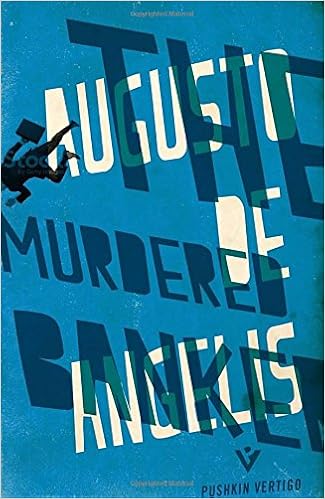
Review: THE MURDERED BANKER, Augusto de Angelis

  • Format: Kindle (Amazon)
  • Series: Pushkin Vertigo
  • Paperback: 160 pages
  • Publisher: Pushkin Vertigo (February 23, 2016)
  • Translated from Italian by Jill Foulson
  • first published 1935
  • Language: English
  • ISBN-10: 1782271708
  • ISBN-13: 978-1782271703
Synopsis (Amazon)

A body is discovered in a Milan apartment, and Inspector De Vincenzi investigates. The apartment happens to belong to and old university friend of his, Aurigi. When the body turns out to be that of Aurigi's banker, and a phial of prussic acid is discovered in the bathroom, suspicion falls on the apartment's owner, and De Vincenzi is agonisingly torn between his sense of duty and his loyalty to an old comrade...

This intensely dramatic mystery from the father of the Italian crime novel, Augusto de Angelis, is the first to feature his most famous creation--Inspector De Vincenzi.

My take

I think it may have been a combination of the translation, the author's style, and the complex plot, but I found this a very hard novel to become engaged in. I think the plot reflected the times it was set in.

My rating: 3.5

About the author
De Angelis was born in Rome. He published his first mystery, Il banchiere assassinato, in 1935. He subsequently wrote some twenty crime books, whose protagonist is Commissario Carlo De Vincenzi of the squadra mobile of Milan. Some of them were adapted for television by RAI in 1974–1977, with Paolo Stoppa playing the role of De Vincenzi.
Despite the success of the books, the Fascist government banned them. De Angelis was arrested in 1943, accused of being Anti-Fascist. After a few months he was freed but soon afterwards he was beaten up by a Fascist activist, and died at Bellagio of the wounds he had received.

New-to-me authors July to September 2016

I have still not caught up with records of my reading for the last month so this list is missing at least a couple of new to me authors.  However, I have now recorded 46 for the year (last year 53 for the whole year) and that means almost 45% of the books I read are by a new-to-me author. Most of them are on my kindle, and many are by authors who have contacted me. I have probably turned as many away.
  1. 4.4, THE SATELLITE PEOPLE, Hans Olav Lahlum
  2. 4.7, THE CHOSEN, Kristina Ohlsson  
  3. 4.5, MISSING PRESUMED, Susie Steiner 
  4. 4.3, THE LOVING HUSBAND, Christobel Kent 
  5. 4.4, I'M TRAVELLING ALONE, Samuel Bjork
  6. 4.5, ONLY DAUGHTER, Anna Snoekstra
  7. 4.3, GIRL IN THE DARK, Marion Pauw 
  8. 4.3, THE TIGER LADIES, Sudha Koul
  9. 4.6, THE DEVIL IN THE MARSHALSEA, Antonia Hodgson 
  10. 4.3, RESURRECTION BAY, Emma Viskic
 See what others have read. 

3 October 2016

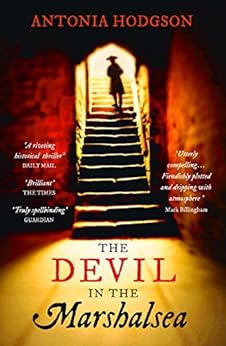
Review: THE DEVIL IN THE MARSHALSEA, Antonia Hodgson

  • Mformat: Kindle (Amazon)
  • WINNER OF THE CWA HISTORICAL DAGGER AWARD 2014.
  • File Size: 929 KB
  • Print Length: 401 pages
  • Publisher: Hodder & Stoughton (March 27, 2014)
  • Publication Date: March 27, 2014
  • Sold by: Hachette Book Group
  • Language: English
  • ASIN: B00FAT9IJK
Synopsis (Amazon)

The first thrilling historical crime novel starring Thomas Hawkins, a rakish scoundel with a heart of gold, set in the darkest debtors’ prison in Georgian London, where people fall dead as quickly as they fall in love and no one is as they seem.

London, 1727. Tom Hawkins refuses to follow in his father’s footsteps and become a country parson. His preference is for wine, women, and cards. But there’s honor there too, and Tom won’t pull family strings to get himself out of debt—not even when faced with London’s notorious debtors’ prison.

The Marshalsea Gaol is a world of its own, with simple rules: Those with family or friends who can lend them a little money may survive in relative comfort. Those with none will starve in squalor and disease. And those who try to escape will suffer a gruesome fate at the hands of its ruthless governor and his cronies. The trouble is, Tom has never been good at following rules, even simple ones. And the recent grisly murder of a debtor, Captain Roberts, has brought further terror to the gaol. While the captain's beautiful widow cries for justice, the finger of suspicion points only one way: to the sly, enigmatic figure of Samuel Fleet.

Some call Fleet a devil, a man to avoid at all costs. But Tom Hawkins is sharing his cell. Soon Tom’s choice is clear: get to the truth of the murder—or be the next to die.

A dazzling evocation of a startlingly modern era, The Devil in the Marshalsea is a thrilling debut novel full of intrigue and suspense.

My Take

Debtors' prison in 1727 is very different to what we in the 21st century might expect. Those who enter will never truly be free of debt for if they live to serve their sentence they will still have incurred debts in merely surviving. In many cases the debt to the prison will be greater than that for which they were originally imprisoned. Whether they survive or not really depends on whether they in the Common prison or not. Many of those not in the Common Side of the prison are free to leave during the day to carry on commerce, to conduct business and earn money that will enable them to pay for their prison accommodation. They must return to the prison each night. In this system those housed in the Common Side will not survive more than a few months.

It is unusual though for wealthier prisoners like Captain John Roberts to die, and the authorities announce that he has committed suicide, although his wife firmly believes he has been murdered. Rumours abound that his ghost is roaming the prison and that it requires that his murderer be exposed.  The prison authorities recognise the unrest this is causing.

Tom Hawkins finds himself charged with identifying Captain Roberts' murderer. If he does he will be released and pardoned, but if he doesn't he will die in the Common Side.

The true value of this book lies in the wealth of historical detail. Many of the characters used are based on true figures, and the situations in which they are found really happened.

My rating: 4.6

About the author
Antonia Hodgson (born 1971) is a British historical crime writer and publisher.
Hodgson was born in Derby in 1971. She attended Littleover Community School where she first studied the time of the early Georgians in A-level History. She graduated with a degree in English Literature from Leeds University in 1994 and she went to work for Harcourt, Brace.
Hodgson had spent nearly twenty years in the publishing business rising to editor-in-chief at Little, Brown before she published her own first novel. As an editor she had worked with Ozzy and Sharon Osbourne and the American novelists Nora Roberts and Elizabeth Kostova.

Hodgson's first novel, A Devil in the Marshalsea, was set in the time of the early Georgians, William Hogarth and the Southwark prison the Marshalsea. Hodgson believes that the Georgian period was more intriguing than the Victorian era which is usually considered to be more culturally important. The book was submitted anonymously to the publishers, Hodder & Stoughton, because she was known in the publishing industry. Her first book won the Crime Writers Association's Historical Dagger award and was long listed for a first novel award. It also was shortlisted in 2015 for the Theakston's Old Peculier Crime Novel of the Year Award.

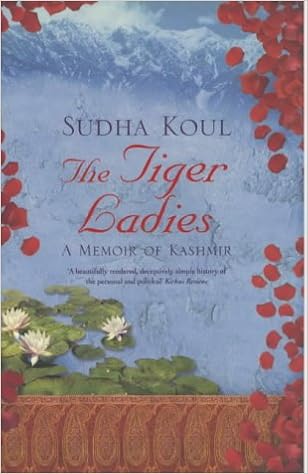
Review: THE TIGER LADIES, Sudha Koul

  • first published by Review 2002
  • ISBN 9-780755-311163
  • 218 pages
  • source: lent to me by a friend
Synopsis (Good Reads)

Sitting in her grandmother Dhanna's kitchen, surrounded by the aromas of mint and the smoke of a hookah, warmed by the kangri tucked beneath her thighs, young Sudha Koul listened to tales of She Who Fears Nothing: The Tiger Lady, stories Sudha would repeat to her own daughters in time, though in a kitchen many thousands of miles away from her beloved Kashmir. This is a magical memoir of a land now consumed by political and religious turmoil, a richly detailed story of a girl's passage into maturity, marriage, and motherhood in the midst of an exquisite and fragile world that will never be entirely the same.

My Take

Warning to followers of my blog: first of all, this is NOT crime fiction. 

I visited Kashmir in 1975, stayed in a house boat on Lake Dal, bought some lacquerware in Srinigar which I still have, visited the Mughal Gardens, and thought the place was fabulous.

But simmering under the surface were the forces that divided India during the Partition in 1947, that would eventually break Kashmir apart.

Sudha Koul tells the story of four generations of women in her family: her grandmother, her mother, herself and her daughters. Born into the Brahmin class which lay atop the social order of Kashmir, Sudha Koul was raised in a priveleged lifestyle, that contained within it the destruction of the political and social order of Kashmir. This is the story of Paradise Lost.

It is impressively told and very readable.

My rating: 4.3 

LinkWithin

Blog Widget by LinkWithin