Showing posts with label Vintage Cover Scavenger Hunt 2016. Show all posts

20 October 2016

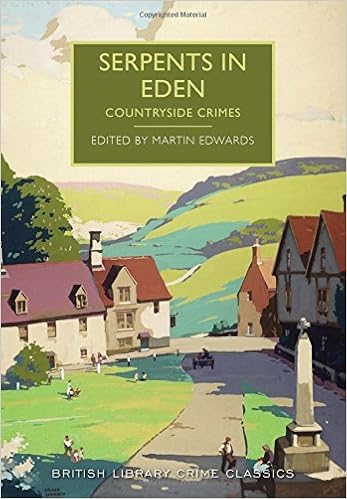
Review: SERPENTS IN EDEN: Countryside Crimes, Martin Edwards (edit)

  • this edition published in 2016 by the British Library
  • A British Library Crime Classic
  • ISBN 978-0-7123-5794-4
  • 302 pages
  • content: 13 Vintage crime fiction short stories 
Synopsis  (Amazon UK)

The lowest and vilest alleys in London do not present a more dreadful record of sin than does the smiling and beautiful countryside.... Think of the deeds of hellish cruelty, the hidden wickedness which may go on, year in, year out, in such places, and none the wiser. Sherlock Holmes Many of the greatest British crime writers have explored the possibilities of crime in the countryside in lively and ingenious short stories. Serpents in Eden celebrates the rural British mystery by bringing together an eclectic mix of crime stories written over half a century. From a tale of poison-pen letters tearing apart a village community to a macabre mystery by Arthur Conan Doyle, the stories collected here reveal the dark truths hidden in an assortment of rural paradises. Among the writers included here are such major figures as G. K. Chesterton and Margery Allingham, along with a host of lesser-known discoveries whose best stories are among the unsung riches of the golden age of British crime fiction between the two wars.

My Take

These short stories were almost all published prior to 1960, The Black Doctor by Arthur Conan Doyle as early as 1898. The authors are almost all recognised Golden Age crime fiction writers. One or two of the stories have not been easily available until their publication in this anthology. Nearly all of the writers have a connection with the Detection Club.

While some of the stories had very clever plots indeed, I found some of them rather slow and tortuous. Nearly all were "different" to what a modern short story might be like. Each story is preceded by an introduction written by Martin Edwards placing the writer in the history of British crime fiction writing.

The writers: Arthur Conan Doyle, M. McDonnell Bodkin, G.K. Chesterton, E.C. Bentley, Herbert Jenkins, H.C. Bailey, R. Austin Freeman, Margery Allingham, Anthony Berkeley, Leonora Wodehouse, Ethel Lena White, Leo Bruce, and Gladys Mitchell.
`
My rating: 4.3

5 October 2016

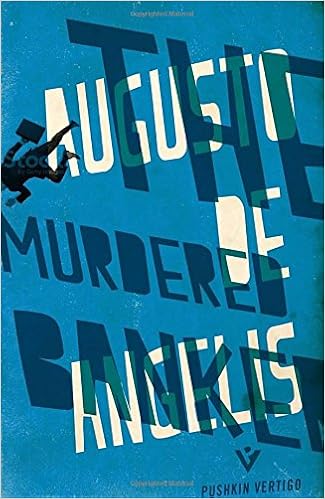
Review: THE MURDERED BANKER, Augusto de Angelis

  • Format: Kindle (Amazon)
  • Series: Pushkin Vertigo
  • Paperback: 160 pages
  • Publisher: Pushkin Vertigo (February 23, 2016)
  • Translated from Italian by Jill Foulson
  • first published 1935
  • Language: English
  • ISBN-10: 1782271708
  • ISBN-13: 978-1782271703
Synopsis (Amazon)

A body is discovered in a Milan apartment, and Inspector De Vincenzi investigates. The apartment happens to belong to and old university friend of his, Aurigi. When the body turns out to be that of Aurigi's banker, and a phial of prussic acid is discovered in the bathroom, suspicion falls on the apartment's owner, and De Vincenzi is agonisingly torn between his sense of duty and his loyalty to an old comrade...

This intensely dramatic mystery from the father of the Italian crime novel, Augusto de Angelis, is the first to feature his most famous creation--Inspector De Vincenzi.

My take

I think it may have been a combination of the translation, the author's style, and the complex plot, but I found this a very hard novel to become engaged in. I think the plot reflected the times it was set in.

My rating: 3.5

About the author
De Angelis was born in Rome. He published his first mystery, Il banchiere assassinato, in 1935. He subsequently wrote some twenty crime books, whose protagonist is Commissario Carlo De Vincenzi of the squadra mobile of Milan. Some of them were adapted for television by RAI in 1974–1977, with Paolo Stoppa playing the role of De Vincenzi.
Despite the success of the books, the Fascist government banned them. De Angelis was arrested in 1943, accused of being Anti-Fascist. After a few months he was freed but soon afterwards he was beaten up by a Fascist activist, and died at Bellagio of the wounds he had received.

4 July 2016

Review: WEEKEND WITH DEATH, Patricia Wentworth

  • format: Kindle (Amazon)
  • first published 1941, titled UNLAWFUL OCCASIONS
  • Republished 2016
  • review copy provided by Dean Street Press
  • File Size: 1194 KB
  • Print Length: 239 pages
  • Publisher: Dean Street Press (June 16, 2016)
  • Publication Date: June 16, 2016
  • Sold by: Amazon Digital Services LLC
  • Language: English
  • ASIN: B01H7J6KFU
Synopsis (Fantastic Fiction)

She held the candle steady and, stooping, touched the smeared patch with the tip of her finger.

The stain was blood.

When Sarah Marlowe, secretary to the president of the New Psychical Society, touches the cold, strange object in her hand-bag, she thinks at first it is a snake. As things turn out, it is almost as dangerous.
Her travelling acquaintance, Emily Case, has been murdered by someone who won’t hesitate to kill again to obtain the contents of Sarah’s bag. Unwilling to join the spirit world herself, Sarah enlists the aid of a handsome if not entirely trustworthy stranger, John Wickham. Together they must scrabble to solve the mystery—and outwit a murderer.

Weekend with Death was originally published in 1941. This new edition features an introduction by crime fiction historian Curtis Evans.

My Take

WEEKEND OF DEATH is a novel of it's time, set during World War II. Note it is NOT a Miss Silver novel.

It is a novel of almost Gothic overtones, set in a run down English country house that has no electricity or running water. Sarah Marlowe goes there for the weekend with her employer, Wilson Cattermole and his eccentic sister Joanna, in pursuit of ghostly emanations.

Sarah finds herself with people who are prepared to murder for the papers she is carrying. In fact she knows that at least one person, the woman who gave them to her in a train station two nights earlier, has already died and she is not sure who in the house she can trust.

Like many Golden Age stories this is a tale full of coincidences which the reader just has to accept as "normal".  Sarah Marlowe is one of those young women who don't like being told what to do, and constantly gives in to curiosity.

My Rating: 4.2

I've also read
4.1, GREY MASK
4.4, THE TRAVELLER'S RETURN

About the Author

Patricia Wentworth (1878–1961) was one of the masters of classic English mystery writing. Born in India as Dora Amy Elles, she began writing after the death of her first husband, publishing her first novel in 1910. In the 1920s, she introduced the character who would make her famous: Miss Maud Silver, the former governess whose stout figure, fondness for Tennyson, and passion for knitting served to disguise a keen intellect. Along with Agatha Christie’s Miss Marple, Miss Silver is the definitive embodiment of the English style of cozy mysteries.

26 May 2016

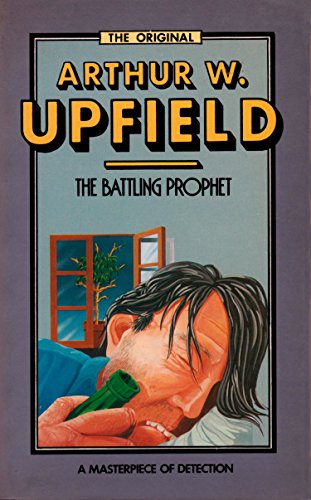
Review: THE BATTLING PROPHET, Arthur Upfield- audio book

  • Source: Audible.com
  • first published 1956
  • #22 in the Napoleon Bonaparte series
  • Narrated by: Peter Hosking
  • Length: 6 hrs and 21 mins
  • Unabridged Audiobook
Synopsis (Fantastic Fiction)

Detective-Inspector Napoleon Bonaparte is on leave, staying with an old friend near Adelaide. Ben Wickham, a meteorologist whose uncannily accurate weather forecasts had helped farmers all over Australia, lived nearby. Ben died after a three-week drinking binge and a doctor certified death as due to delirium tremens - but Bony's host insists that whatever Ben died of it wasn't alcohol...

From Audible
Ben Wickham, a famous meteorologist whose uncannily accurate forecasts have helped famers and graziers all over Australia, has died after a three-week drinking bout.

The doctor certifies that his death was cause by heart failure due to alcoholic poisoning.
But Ben's neighbour and drinking partner, John Luton, is convinced his friends didn't die from too much gin. He manages to lure Detective-Inspector Napoleon Bonaparte to his riverside cottage near the South Australian coast, on an unofficial visit for a spot of fishing.

Bony, thinking at first he's on holiday and paying a casual visit, is intrigued and decides to investigate.

My Take

Weather forecasts are extraordinarily important in the driest continent in the world. Farmers and graziers base their activities on them, but if drought is forecast then they will not re-stock their land, nor will they harrow in preparation for seeding. So lots of people stand to lose income if farming activities don't occur.

Ben Wickham tried to interest the Australian government in purchasing his weather predictions in advance and, when they rejected him, then approached overseas governments. Since Wickham died lots of people, not all Australian in origin, have become very interested in finding his will, and the books in which he wrote his predictions for future weather. They are all convinced that his best mate John Luton is hiding something. After Luton takes a beating from some outsider Bony realises that some major steps have to be taken. But someone higher up in government wants Bony off the scene and he is peremptorily recalled Queensland, and even escorted to the South Australian border.

A story with quite a bit of outback humour as well as some serious thought. There are some very quirky characters and the author has tried give us some idea of their colloquial language.

Of particular interest to me is that so many of the Bony stories have a link to South Australia. This one appears to be set somewhere near the River Murray. Ironically the year of publication, 1956, is also the year of the flooding of the Murray, in contrast with the drought conditions of the novel.

My rating: 4.4

I've also read
DEATH OF A SWAGMAN
4.4, THE BARRAKEE MYSTERY
4.0, A MAN OF TWO TRIBES 

22 May 2016

Review: MAN OF TWO TRIBES, Arthur Upfield - audio book

  • Available from Audible.com
  • first published 1956
  • Napoleon Bonaparte series #21
  • Narrated by: Peter Hosking
  • Length: 6 hrs
  • Unabridged Audiobook

Synopsis (Fantastic Fiction)

With two camels and a dog, Detective-Inspector Napoleon Bonaparte sets off across southern Australia's Nullarbor Plain in search of a missing woman. He finds much more than he bargained for. Set in some of the most mysterious and unforgiving territory in the world - the Australian desert - Man of Two Tribes is vintage Upfield.

From Audible:


Myra Thomas, accused of murdering her philandering husband, is found not guilty by a sympathetic jury. But while travelling from Adelaide to Perth on the Transcontinental Railway express, she mysteriously disappears during the overnight journey across the vast, featureless desert.

Detective-Inspector Napoleon Bonaparte takes the case and sets off to search for her over the flat wasteland of the Nullabor Plain. At first it seems that the harsh environment will give him no clues, but Bony soon finds more than he bargained for? landing himself in a bigger mystery, and a fight for survival...

My Take

The Woomera Rocket Range, a collaborative effort between a number of International groups including the British and Australia, began immediately after World War II in 1946, with a joint project running until 1960. It is located in north-west South Australia, about 500 km north west of Adelaide. British nuclear tests at Maralinga, a series of seven nuclear tests were conducted within the Woomera area between 1955 and 1963. More recently, the Woomera Immigration Reception and Processing Centre, a detention centre,  opened nearby in 1999 and operated until 2003.

The focus in the opening pages of the story is a woman, recently acquitted of murder, who has disappeared without trace from the East-West railway travelling from Adelaide to Western Australia. There is some indication that she may have connections with international espionage and Bony is sent out on an undercover mission to see if he can locate her.

There are various Aboriginal legends associated with the Australian outback but here Upfield tells one about a monster, maybe a version of the Rainbow Snake, supposedly occupying the underground limestone caverns of the Nullarbor Plain which the train line traverses. This has the effect of both deterring aboriginal trackers from looking too closely for the missing woman, and also provides an explanation of any strange noises heard at night.

Bony of course is the "man of two tribes", being a half-caste aborigine, but his Queensland tribe has little in common with the Aboriginal people living on the Nullarbor, apart from the markings on his body that show he is a warrior of some note. At the same time he is a very articulate person, highly qualified with a university degree, and a reputation for never failing to successfully conclude a case.

An interesting story but I did feel that it stretched the bounds of credibility. Basing the story around the Nullarbor Plain and Woomera does show how in touch with current events Upfield was. At the time of publication 1956, 8 years before his death, he was 66 years old and there would be another 8 Bony novels.

My rating: 4.0


I've also read
DEATH OF A SWAGMAN
4.4, THE BARRAKEE MYSTERY

7 May 2016

Review: THE BUNGALOW MYSTERY, Annie Haynes

  • format: kindle (Amazon)
  • first published 1923
  • File Size: 905 KB
  • Print Length: 232 pages
  • Publisher: Dean Street Press (March 1, 2016)
  • Publication Date: March 1, 2016
  • Sold by: Amazon Digital Services LLC
  • Language: English
  • ASIN: B01BTYR46I
Synopsis (Amazon)

“He had his tea as usual; when I knocked at the door with the tray (he always had afternoon tea), I found him—like this.”
Dr Roger Lavington is dreading his debut performance with the village amateur dramatic society. But real-world drama takes over when Lavington’s neighbour, a reclusive artist, is found murdered in his own sitting room. Also found on the scene are a lady’s glove, a diamond ring, and a mysterious young woman who begs Lavington for his protection. Her safety will depend on her ability to take a role in the forthcoming village play—but is Lavington sheltering a wronged woman or a clever murderess?

The Bungalow Mystery (1923) was the first of Annie Haynes’s golden age crime novels, and announced a major talent. This new edition, the first in over eighty years, features an introduction by crime fiction historian Curtis Evans.

My Take

I thought this novel showed many of the characteristics of a debut title: the author trying a little too hard to provide red herrings and misdirection. The plot devolved around mistaken identity and incomplete knowledge, a train crash in which the murder suspect is thought to have been killed, a policeman who works on the case long after he has been taken off it, a vindictive wife who wants a killer brought to justice, and a central character who muddies the waters by giving the wrong advice.

There is at least one change of narrative voice and so a number of points of view are presented. The original police investigation misses gathering an eye witness statement which would have tied the whole thing up in a matter of hours.

Nevertheless it is a true forerunner of the Golden Age and the convoluted plot is well worked with a number of almost Gothic elements to it.

My rating: 4.2

About the author
UK (1865 - 1929)

Annie Haynes was born in 1865, the daughter of an ironmonger.

By the first decade of the twentieth century she lived in London and moved in literary and early feminist circles. Her first crime novel, The Bungalow Mystery, appeared in 1923, and another nine mysteries were published before her untimely death in 1929. Sadly there is no known photograph of Annie Haynes still in existence.

Who Killed Charmian Karslake? appeared posthumously, and a further partially-finished work, The Crystal Beads Murder, was completed with the assistance of an unknown fellow writer, and published in 1930.

23 April 2016

Review: THE BARRAKEE MYSTERY, Arthur Upfield - audio book

  • First published in 1929, #1 in the Napoleon Bonaparte titles
  • Available from Audible
  • Narrated by: Peter Hosking
  • Length: 8 hrs and 16 mins 
  • Unabridged Audiobook
Synopsis (Audible)

Why was the redoubtable King Henry, an aborigine from Western Australia, killed during a thunderstorm in New South Wales? What was the feud that led to murder after nineteen long years had passed? And who was the woman who saw the murder and kept silent?

This first story of Inspector Napoleon Bonaparte, the half-aborigine detective, takes him to a sheep station in the Darling River bush country where he encounters those problems he understands so well... mixed blood and divided loyalties.

PLEASE NOTE: Part of the appeal of Arthur Upfield's stories lies in their authentic portrayal of many aspects of outback Australian life in the 1930s and through into the 1950s. These books reflect and depict the attitudes and ways of speech of that era particularly with regard to Aborigines and to women. In reproducing this book the publisher does not endorse the attitudes or opinions they express.

©1965 First published 1929 by Hutchinson and Company Ltd. © Bonaparte Holdings Pty Ltd, 1965. (P)2015 Bolinda Publishing Pty Ltd

My Take

It would be easy to focus in a review of  THE BARRAKEE MYSTERY on the politically incorrect (by today's standards anyway) attitudes and terminology. But as the publisher says, they reflected the attitudes of the times.

Peter Hosking does a wonderful job of the narration and that allowed me to reflect on other things: the descriptions of the outback and the toughness required of those who chose to live there. I was struck also by how the novel reflected Australia's bush heritage.

Born in England in 1890, Upfield moved to Australia in 1911 and fought with the Australian military during the First World War. Following his war service, he travelled extensively throughout Australia, obtaining a knowledge of Australian Aboriginal culture that he would later use in his written works. In addition to writing detective fiction, Upfield was a member of the Australian Geological Society and was involved in numerous scientific expeditions. (Wikipedia)

The bush heritage that I am reminded of were the works of Banjo Paterson and particularly the stories of Henry Lawson, even SUCH IS LIFE by Joseph Furphy.  In later novels Upfield wasn't as expansive in his descriptions of the country, and focussed more on detective/crime elements, but there are a lot of mini-stories in THE BARRAKEE MYSTERY. There is a mystery element in the novel too, well structured, but not really all that difficult to solve.

Bony reminds me a little of Hercules Poirot: not only does he believe in his own superior detection skills, but he also dispenses his own form of justice.

My rating: 4.4

I've also reviewed DEATH OF A SWAGMAN 

14 April 2016

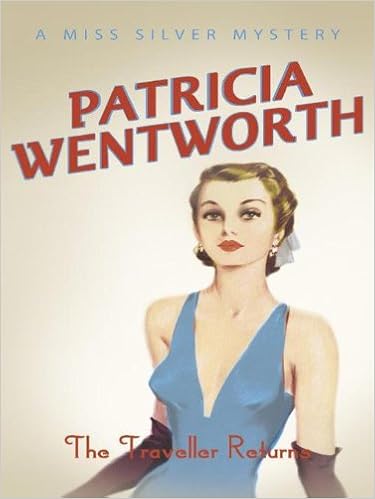
Review: THE TRAVELLER RETURNS, Patricia Wentworth

  • alternative title: SHE CAME BACK
  • first published 1945 (US publication)
  • #9 in the Miss Silver series
  • this edition from Amazon (Kindle)
  • File Size: 655 KB
  • Print Length: 320 pages
  • Publisher: Hodder & Stoughton; New Ed edition (December 13, 2007)
  • Publication Date: December 13, 2007
  • Sold by: Hachette Book Group
  • Language: English
  • ASIN: B0043VDC8E
Synopsis (Amazon)

Anne Jocelyn had been a beautiful, wealthy young woman. She had died three years ago. At least, that was what her husband Philip and the rest of the family had always thought. But then a woman calling herself Anne Jocelyn appeared and managed to convince everyone that she was the real Anne. Everyone, that is, except Miss Silver, whose suspicions are aroused by an apparently senseless murder.

My Take

I chose this for my participation in the Crime Fiction of the Year challenge for 1945 found over at Past Offences.  There is a little conflicting evidence about the date of publication so I have gone with the date on Fantastic Fiction. It seems that it was published in 1945 in USA, but not till 1948 in UK

The setting is England 1943. As far as Philip Jocelyn was concerned his wife Anne had been killed in France by a German bullet in 1940 and her body was buried in the local churchyard at Jocelyn's Holt. So when a woman claiming to be Anne turns up at the house at Jocelyn's Holt he can't believe it is her. The rest of the family are taken in by her stunning resemblance to Anne and to her detailed knowledge of the family. But if this woman is impersonating his wife, why is she doing it?

Miss Silver meets a woman on a train who is travelling to London to meet Lady Jocelyn.  She says she will know whether this is truly Anne Jocelyn or not. And then she is found dead.

While the police sergeant is a fan of Maudie Silver's, his boss doesn't come out of it too well as he is always ready to accept the easy solution to a problem. He sees Miss Silver as an interefering old biddy, always turning up where she is not really needed. Of course it is Miss Silver who eventually solves the case. 

 A nice cosy read.

My Rating: 4.3

I've also read
4.1, GREY MASK

9 April 2016

Review: MYSTERY IN WHITE, J. Jefferson Farjeon - audio book

 Synopsis (Audible)

"The horror on the train, great though it may turn out to be, will not compare with the horror that exists here, in this house." 

On Christmas Eve, heavy snowfall brings a train to a halt near the village of Hemmersby. Several passengers take shelter in a deserted country house, where the fire has been lit and the table laid for tea - but no one is at home. Trapped together for Christmas, the passengers are seeking to unravel the secrets of the empty house when a murderer strikes in their midst.  

My Take:

Subtitled A Christmas Crime Story, this novel is a variant on a classic mystery plot. Passengers on a train held up by snow drifts on an English countryside railway struggle through the the snow storm to a large  country house which they find deserted yet visitors are obviously expected: the table is laid for tea and fires are burning. The group of seven or eight people are unknown to each other and at least one of them is an unsavoury character.

The plot was fairly tangled and seemed to have the occasional change of direction. The narrator tried, reasonably successfully, to audibly differentiate between each of the characters. One of the older members of the party from the train, Mr Maltby, takes charge and searches for clues about the house owners. He is rather quirky himself, claiming that he is able to commune with the ghost of Charles I, and he makes use of the paranormal in the final denouement of what turns out to be a murder mystery. The owners of the house are discovered stranded in a car in a nearby ditch and are brought back to the house, and a story of what happened in the house twenty years before is revealed.

My rating: 3.7

About the author
Joseph Jefferson Farjeon 1883-1955 was an English crime and mystery novelist, playwright and screenwriter. 
At least two of his novels have only been recently published. He was a prolific writer with about 70 novels written from 1920 onwards. His novels were greatly admired by Dorothy L. Sayers, and The British Library reissued Mystery in White: A Christmas Crime Story in 2014, and two further novels in 2015: Thirteen Guests and The Z Murders. Mystery in White is also one of at least three of his novels to have appeared in Italian translations. Others appeared in German, French, and other languages.
He also wrote under the pseudonym of Anthony Smith. 

24 March 2016

Review: MAIGRET IN NEW YORK, Georges Simenon

  • format: Kindle (Amazon)
  • File Size: 756 KB
  • Print Length: 192 pages
  • Publisher: Penguin; Reprint edition (January 7, 2016)
    Originally published 1947
  • Publication Date: January 7, 2016
  • Sold by: Amazon Digital Services LLC
  • Language: English
  • ASIN: B015X4XSAG
  • alternative title: MAIGRET GETS ANGRY
  • This edition translated by Linda Coverdale
Synopsis (Amazon)

Maigret's first impressions of the USA colour this sparkling new translation, book twenty-seven of the new Penguin Maigret series.

What was it about him that had struck Maigret so forcefully? . . . Little John had cold eyes! . . . Four or five times in his life, he had met people with cold eyes, those eyes that can stare at you without establishing any human contact.

Persuaded to sail to New York by a fearful young law student, Maigret finds himself drawn into the city's underworld, and a wealthy businessman's closely guarded past.
Penguin is publishing the entire series of Maigret novels in new translations.

My Take

Maigret has retired to the Loire Valley but his services are still in demand. A young man is brought to see him by an elderly lawyer. Jean Maura is a law student whose father John Maura is an American millionaire living in New York.  Jean has become concerned that his father's life is in danger and he wants Maigret to accompany him to New York. They embark 10 days later.

What follows is a strange investigation, made stranger by Jean Maura's disappearance from  the boat when they arrive in New York. Maigret is frustrated in attempts to find him but arrival formalities and continues to the hotel without him. He has some difficulty in getting to see John Maura and is amazed at the father's seeming lack of concern at his son's disappearance.

Maigret finds that his English is not really adequate for the simplest of tasks and he calls up a French-speaking NYPD detective whom he met years before through an investigation in Paris. O'Brien provides his assistance and Maigret manages to piece together John Maura's history and eventually works out what is happening.

Simenon obviously wanted to write a novel about New York - he had recently arrived in 1947 - incorporating his own experiences and impressions, but also including comment on the influence of the Sicilian Mafia in economic affairs. There are some very strange characters in this novel, and from this distance some not-quite-believable plot lines.

I read this book for my participation in Crimes of the Century, on Rich Westwood’s Past Offences for 1947.  Make a stop over at Past Offences to read the suggestions of other participants.

My rating: 4.0

See a review at A Crime is Afoot.

I've also read
4.4, MAIGRET & the MAN on the BOULEVARD
4.5, MAIGRET & THE HEADLESS CORPSE
4.3, PIETR THE LATVIAN
THE LATE MONSIEUR GALLET
4.4, THE RULES OF THE GAME
4.2, THE MAN WHO WATCHED THE TRAINS GO BY
4.3, THE CARTER OF LA PROVIDENCE
4.3, LOCK NO 1. Maigret #18

4 March 2016

Review: SMALLBONE DECEASED, Michael Gilbert - audio book

  • first published1949
  • #4 in the Inspector Hazelrigg series
  •  Narrated by: Michael Mcstay
  • Length: 6 hrs and 53 mins 
  • Unabridged Audiobook
  • Release Date:01-06-10
  • Publisher: Audible Studios
 Synopsis (Audible)

Another classic Michael Gilbert thriller, set within the legal profession. The mystery begins when the body of a client is found dead in a deed-box of the impeccable legal firm of Horniman, Birley and Crane. But why? And how was the Horniman system broken? A classic English murder mystery.

Michael Francis Gilbert ( 1912- 2006) is recognized as one of the most versatile British mystery writers. He was a lawyer in London for many years and at one point had Raymond Chandler as his client. He wrote almost every sort of mystery and thriller. He wrote police procedurals, spy novels and short stories, courtroom dramas, classical mysteries, crime novels, and almost every possible combination of these, all with the same competence and dry, detached wit.

Gilbert was a founding member of the British Crime Writers Association, Named Grand Master by the Mystery Writers of America and was named Number 24 on The Telegraph's "50 crime writers to read before you die".

My take

When the senior partner of the firm Horniman, Birley and Crane, Abel Horniman dies, his son Bob, a war hero from the Navy, takes over his share of the partnership. Bob needs to find Mr Smallbone who is a co-trustee of one of the accounts his father managed. In addition there appears to be some money missing.  Everybody he contacts thinks that Smallbone, an avid collector of ancient artifacts, has gone off to Rome on a buying trip. The discovery of his body thus comes as a surprise although the reader always knows that he is dead from the title of the story.

Someone who has recently begun working at the firm becomes the amateur sleuth especially after there is a second death. Inspector Hazelrigg from the Yard pursues enquiries too and separately they come to the same conclusion.

This is a sort of "sifting the evidence" book, eliminating suspects one by one, but even so the author has a surprise in store for us. As the blurb says, a classic English murder mystery.

My rating: 4.1

About the author
(Michael Francis Gilbert)
UK (1912 - 2006)

Born in Lincolnshire in 1912, Michael Francis Gilbert was educated in Sussex before entering the University of London where he gained an LLB with honours in 1937. Gilbert was a founding member of the British Crime Writers Association, and in 1988 he was named a Grand Master by the Mystery Writers of America - an achievement many thought long overdue. He won the Life Achievement Anthony Award at the 1990 Boucheron in London, and in 1980 he was knighted as a Commander in the Order of the British Empire. Gilbert made his debut in 1947 with Close Quarters, and since then has become recognized as one of our most versatile British mystery writers.     

18 February 2016

Review: THE SANTA KLAUS MURDER, Mavis Doriel Hay - audio book

Synopsis (Audible

Aunt Mildred declared that no good could come of the Melbury family Christmas gatherings. So when Sir Osmond Melbury, the family patriarch, is discovered - by a guest dressed as Santa Klaus - with a bullet in his head on Christmas Day, the festivities are plunged into chaos.

Nearly everybody stands to reap some sort of benefit from his death excepting Santa Klaus, the one person who seems to have had every opportunity to fire the shot. Various members of the family have their private suspicions about the murderer, and the Chief Constable of Haulmshire wishes before long that he understood them better.

In the midst of mistrust, suspicion and hatred, it emerges that there was not one Santa Klaus but two.

My Take

A variant on a closed room murder mystery, the story is told from the point of view of a number of characters, but principally from that of the Chief Constable, a friend of the family, who seems determined to leave no investigative stone unturned. The result is a rather pedantic and plodding tale where this reader at least kept wondering when it was all going to finish. I'd come to my conclusion long before the Colonel had come to his, but his was no intuitive leap. He wanted every i dotted and every t crossed. He wasn't helped by the fact that very few of the family in residence for Christmas actually told the truth.

My Rating: 3.7


I've also read
4.0, MURDER UNDERGROUND

About the author
Mavis Doriel Hay (1894-1979) was a novelist of the golden age of British crime fiction. Her three detective novels were published in the 1930s and are now rare and highly collectable books. She was an expert on rural handicraft and wrote several books on the subject. 


11 February 2016

Review: LOCK NO. 1: Inspector Maigret #18

  • Vformat: Kindle (Amazon)
  • File Size: 646 KB
  • Print Length: 176 pages
  • Publisher: Penguin; Tra edition (April 2, 2015)
  • Publication Date: April 2, 2015
    originally published 1933
  • Sold by: Amazon Digital Services LLC
  • Language: English
  • ASIN: B00OZ4XGGM
  • #18 in the Maigret series
Synopsis (Amazon)

A new translation of Georges Simenon's novel set in claustraphobic provincial town, book eighteen in the new Penguin Maigret series.

Cars drove past along with the trucks and trams, but by now Maigret had realised that they were not important. Whatever roared by like this along the road was not part of the landscape. ... What really counted was the lock, the hooting of the tugs, the stone crusher, the barges and the cranes, the two pilots' bars and especially the tall house where he could make out Ducrau's red chair framed by a window.

Penguin is publishing the entire series of Maigret novels in new translations. This novel has been published in a previous translation as The Lock at Charenton.

My take

Maigret is called to investigate what has happened in this small provincial town on the outskirts of Paris. Somebody has apparently attempted to murder Ducrau, a local businessman whose business concerns are the basis of the town's economy. He has been stabbed in the back and then tossed into the canal. By chance he is rescued and seems little the worse for wear but Maigret senses that events have not run their course, so he hangs around.

Indeed Ducrau's son then commits suicide and a lock keeper is murdered, so there is a case to sort out.

Maigret has applied for and been granted early retirement (that came as a surprise to me as this is relatively early on in the series), so this will very likely be his last case. He doesn't particularly want to return home as Mrs Maigret has been packing up the house, even the bed, and they are moving to a cottage on the River Loire. Ducrau thinks he sees a kindred spirit in Maigret and offers him a job on his retirement, more or less as a security officer. But Ducrau is not a nice man and Maigret can't see himself working for him. In fact he is looking forward to his retirement, he thinks.

This is quite a heavy, dark feeling, novel. While Ducrau runs his businesses in a very hands-on way, and is well known, he is far from popular. His family and servants live in fear of him, and many people have reason to wish him harm. This is a fairly "typical" Maigret novel, with lots of psychological overtones.

My rating: 4.3

I've also read
4.4, MAIGRET & the MAN on the BOULEVARD
4.5, MAIGRET & THE HEADLESS CORPSE
4.3, PIETR THE LATVIAN
THE LATE MONSIEUR GALLET
4.4, THE RULES OF THE GAME
4.2, THE MAN WHO WATCHED THE TRAINS GO BY
4.3, THE CARTER OF LA PROVIDENCE

31 January 2016

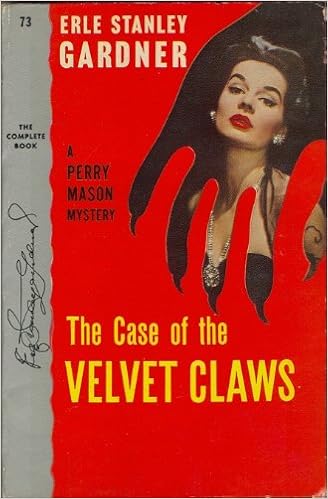
Review: THE CASE OF THE VELVET CLAWS, Erle Stanley Gardner

  • format Kindle (Amazon)
  • File Size: 544 KB
  • Print Length: 261 pages
  • Publisher: Della Street Press (September 27, 2011)
    first published 1933
  • Publication Date: September 27, 2011
  • Sold by: Amazon Digital Services LLC
  • Language: English
  • ASIN: B005QE7XPK
  • #1 in the Perry Mason series 
Synopsis  (Amazon)

Thanks to a bungled robbery at a fancy hotel, the already-married Eva Griffin has been caught in the company of a prominent congressman. To protect the politico, Eva's ready to pay the editor of a sleazy tabloid his hush money. But Perry Mason has other plans. He tracks down the phantom fat cat who secretly runs the blackmailing tabloid -- only to discover a shocking scoop.

By the time Mason's comely client finally comes clean, her husband has taken a bullet in the heart. Now Perry Mason has two choices: represent the cunning widow in her wrangle for the dead man's money -- or take the rap for murder.

My take

Unlike many others in the Perry Mason series, this novel is not centred on a court room drama, but it does introduce the characters who featured in most other novels in the series: his secretary Della Street, a young woman at this time, and obviously in love with her boss; and private eye Paul Drake who hunts down the facts to back up Perry Mason's quirky theories.

It was hard not to see, in my mind's eye, the bulky Raymond Burr who played Perry Mason in the long running television series. And yet, somehow, the central character in this novel does not quite match that tv character.

I can see why, even over 80 years on, why this novel was a winner with readers. The characters are well drawn, the action fast-paced and the plot is full of unexpected twists and turns. Perry Mason points out to his client. who constantly lies to him, that he is hardly a novice. He already has files from hundreds of previous cases in his filing cabinets, and he expects to have many more. He specialises in getting people out of holes. Most of the cases he has been involved in are murder cases, and mostly he gets people off. So here is a lawyer who takes on clients regardless of how much they can pay for his services. See more at Wikipedia.

THE CASE OF THE VELVET CLAWS was made into a film in 1936. 


A good read.

My rating:  4.4

About the author

Erle Stanley Gardner (1889-1970) is a prolific American author best known for his works centered on the lawyer-detective Perry Mason. At the time of his death in March of 1970, in Ventura, California, Gardner was "the most widely read of all American writers" and "the most widely translated author in the world," according to social historian Russell Nye. The first Perry Mason novel, The Case of The Velvet Claws, published in 1933, had sold twenty-eight million copies in its first fifteen years. In the mid-1950s, the Perry Mason novels were selling at the rate of twenty thousand copies a day. There have been six motion pictures based on his work and the hugely popular Perry Mason television series starring Raymond Burr, which aired for nine years and 271 episodes. 

23 January 2016

Review: DUCK SEASON DEATH, June Wright

  • Format: Kindle (Amazon)
  • File Size: 911 KB
  • Print Length: 192 pages
  • Publisher: Dark Passage (December 21, 2014)
    Originally written sometime in the 1950s
  • Publication Date: December 21, 2014
  • Sold by: Amazon Digital Services, Inc.
  • Language: English
  • ASIN: B00N01TQOW
Synopsis (Amazon)

June Wright wrote this lost gem in the mid-1950s, but consigned it to her bottom drawer after her publisher foolishly rejected it. Perhaps it was a little ahead of its time?

Because while it’s a tour de force of the classic ‘country house’ murder mystery, it’s also a delightful romp, poking fun at the conventions of the genre. When someone takes advantage of a duck hunt to murder publisher Athol Sefton at a remote hunting inn, it soon turns out that virtually everyone, guests and staff alike, had a good reason for shooting him. Sefton’s nephew Charles thinks he can solve the crime by applying the “rules of the game” he’s absorbed from his years as a reviewer of detective fiction – only the killer evidently isn’t playing by those rules.

Duck Season Death is a both a fiendishly clever whodunit and a marvellous entertainment.

My take:

What the blurb above does not say is that the main reason this novel was "consigned to her bottom drawer" was that the author's usual publisher rejected this offering in the 1950s because of negative reviews by three of their pre-publishing readers.

I can understand what attracted scathing comments from these readers. First of all I think Wright meant this as a spoof on the genre. The murder victim is a publisher known for his scathing comments about would-be authors and the books they gave him to read, but also an unlikeable person who tried his invective out on most of those who  came within range. The amateur sleuth who thinks the murder is not accidental is his nephew, but he didn't like Athol Sefton any more than most people. He just thinks the local doctor and policeman are bumbling idiots.

Enter an odd plot strand - the victim himself was under observation by the Victoria police for the murder of his wife, actually a cold case, with the second suspect being the nephew who used to send her boxes of chocolates.

The style in which all this is written is, at first, a bit hard to take. She writes as if she has swallowed the dictionary, a rather pompous version of English which I think was supposed to point the finger at more academic writers from the Golden Age- lots of five syllable words appear in the narrative. The style changes a little for the better in the latter half of the novel. I think it was supposed to imitate the thinking style of the voice of the narrator which did change from section to section of the novel, but was nearly always that of the nephew.

So there we have it - a country house murder set in the style of Agatha Christie (to whom there is the odd reference), located in rural Victoria in the 1950s. The location is near the Murray River at a hotel called The Duck and Dog Inn. The timing: the opening of theduck shooting season.

I spent some time considering whether I thought Wright intended this as a spoof or not, and therefore how I should rate it. I think she did, but her original readers misunderstood, or disapproved. Other bits of humour emerge, even a romantic element. So it may well have been "ahead of its time", but she doesn't quite pull it off.

My rating: 3.5


I've also reviewed 4.1, MURDER IN THE TELEPHONE EXCHANGE

See another review

4 January 2016

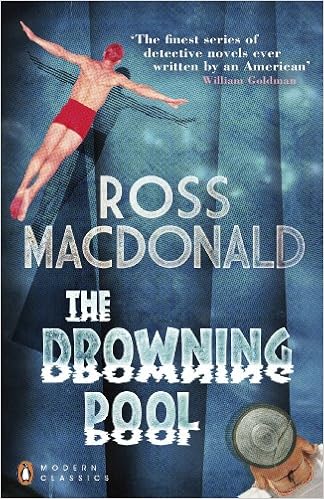
Review: THE DROWNING POOL, Ross Macdonald

  • format: Kindle (Amazon)
  • File Size: 1636 KB
  • Print Length: 272 pages
  • Publisher: Penguin (July 5, 2012)
    originally published 1950
  • Publication Date: July 5, 2012
  • Sold by: Amazon Digital Services, Inc.
  • Language: English
  • ASIN: B0082440BQ
  • #2 in the Lew Archer series 
Synopsis  (Amazon)

When Maude Slocum - beautiful, frightened and angry - comes to Lew Archer's office with a poison pen letter intended for her husband, he reluctantly agrees to help her. As he follows the Slocums around, Archer finds that Mrs Slocum might have the least of the family's troubles: her teenage daughter is desolate, her husband is in the closet and her mother-in-law has just come to an unpleasant end in the swimming pool. But why is their handsome ex-chauffeur still hanging around? And what does the sinister Pacific Refinery Company have to do with the all the bloodshed?

The Drowning Pool is Ross Macdonald's gripping tale of adultery, jealousy, murder and lies.

Ross Macdonald's Lew Archer mysteries rewrote the conventions of the detective novel with their credible, humane hero, and with Macdonald's insight and moral complexity won new literary respectability for the hardboiled genre previously pioneered by Dashiell Hammett and Raymond Chandler. They have also received praise from such celebrated writers as William Goldman, Jonathan Kellerman, Eudora Welty and Elmore Leonard.

My take

This Penguin Publisher e-book version comes with an excellent introduction by John Banville.
    "as usual with Macdonald, the mud at the bottom of today's pool is stirred up by yesterday's storms. There is hardly a character in the book without something to hide from his or her past."
All this gives the plot an incredible complexity, although, as Banville says, Macdonald was really intrigued by the motivations of plausible people in plausible circumstances.

Three deaths later, Lew Archer comes up with an explanation that I had not seen coming.

I read it for my participation in the Crime Fiction of the Year Challenge @ Past Offences for January 2016, a book published in 1950.It also fits in with the Vintage Cover Scavenger Hunt, hosted by Bev at My Reader's Block.

My rating: 4.3

About the Author
MacDonald served as president of The Mystery Writers of America in 1965, received the Silver Dagger in 1964 and the Gold Dagger in 1965 from The British Crime Writers Association, and in 1981, received The Eye, the Lifetime Achievement Award from The Private Eye Writers of America.
The Drowning Pool was made into a film starring Paul Newman in 1975.

LinkWithin

Blog Widget by LinkWithin