
Many thanks to FyreFly who mentioned on her Sunday salon post that she had created a customised Google search called Book Bloggers.
I've played around with that now and created one that points first of all to the crime fiction blogs that I follow on Crime Fiction Journeys. I've also put the search in the right hand column of MYSTERIES IN PARADISE.
You now get reasonably targetted results if you search for an author, a character, or a specific blog.
The only thing I don't like is that the search results come up in the same window - I would prefer they opened in a new window, but I'll work on that. Perhaps I can customise the code.
However, if you want to try it here it is
4 March 2009


Crime Fiction unites us all
An idea that came to me when I was reading Dorte's blog. She publishes her blog in English and Danish, and had a graph showing the language of her readers in this post.
 Unlike Dorte's, my graphic shows that my readership is almost entirely English speaking:
 I have a number of maps accessible from my blog so I captured some graphics- sorry if they are a bit fuzzy. Blogger doesn't allow you to have very large images unfortunately, so some of them I've had to stretch. If you click on the fuzzy ones, you see a clearer, larger graphic.
I was struck from the very first mapping tool that I used, Clustrmap, how wide flung my visitors are.
This is a recent ClustrMap. The red dots of course indicate where people live (according to their IP address)

Site meter gives me very nice pie charts (which is what Dorte used)

 And then this map is generated by Feedjit: once again apologies for the fuzziness but you get the idea.

So what does all this tell us? Probably what we already know: that crime fiction is a genre with wide appeal, crossing language and location boundaries. You only have to check what other languages your favourite English language author is translated into, or think yourself about the books that you read in translation. A subject for a later post I think.
Unlike Dorte's, my graphic shows that my readership is almost entirely English speaking: I have a number of maps accessible from my blog so I captured some graphics- sorry if they are a bit fuzzy. Blogger doesn't allow you to have very large images unfortunately, so some of them I've had to stretch. If you click on the fuzzy ones, you see a clearer, larger graphic.
I was struck from the very first mapping tool that I used, Clustrmap, how wide flung my visitors are.
This is a recent ClustrMap. The red dots of course indicate where people live (according to their IP address)

Site meter gives me very nice pie charts (which is what Dorte used)

 And then this map is generated by Feedjit: once again apologies for the fuzziness but you get the idea.
So what does all this tell us? Probably what we already know: that crime fiction is a genre with wide appeal, crossing language and location boundaries. You only have to check what other languages your favourite English language author is translated into, or think yourself about the books that you read in translation. A subject for a later post I think.
3 March 2009
Left Coast Crime Looms
 Left Coast Crime Looms is a rather effete way of saying we're nearly on our way.
Tomorrow we meet up with Sunnie in Sydney airport and then we board our flight to Honolulu. So today is all about the packing, taking the cat to our friend's house, cancelling the papers, arranging with a neighbour to collect the letetrs, making sure we've remembered everything.
The picture on the right shows the "little bag" crammed to the gills with giveaways for our Fair Dinkum Crime panel. Note the jars of Vegemite that are snuggled in too.
And this is the beginning of a number of automated posts so that if you are a follower of my blog, you won't feel bereft without my almost daily words of wisdom.
I have written a few posts in advance because although we will have internet access, I may not have much time to write "on the spot" posts although I hope to do a few.
Closer to 12 March I will also post the handout we are giving to those who come to our session, so that they can have it online with links, but also so you can have access to it.
Review: A ROYAL PAIN, Rhys Bowen
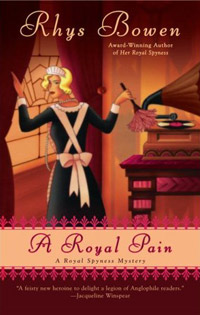 Berkley Prime Crime Mysteries, 2008, 307 pages, ISBN 978-0-425-22163-1
Georgie, Lady Victoria Georgiana Charlotte Eugenie, related to the king of England through his grandmother Queen Victoria, is 34th in line to the English throne. She belongs to a branch of the royal family rather down on its luck, and survives by cleaning houses. She is a favourite though of the Queen who asks that she play hostess to a Bavarian princess whom Queen Mary would rather like to get her son David, at present dallying with "the American woman", interested in.
From the moment that Princess Hanni, and her attendant "pain in the neck" the Baroness, arrive on Georgie's doorstep at Rannoch House, murder seems to follow them. Hanni appears to have learnt her English through watching American gangster movies and constantly displays her command of the language with inappropriate gangster speak. To keep up pretences, Georgie has to co-opt her Cockney grandfather and his lady friend Mrs 'uggins as her hired help. Their presence in the novel provides added elements of humour.
I kept changing my mind on how I would rate this. I thought at first that it was a bit more chick-lit, a bit lighter than I normally like to read, but I was struck by its historical depth, and in the end I came to like the main character Georgie. The picture Bowen draws of Queen Mary (May) whom I remember as a rather severe looking dowager, is an interesting one, and I can understand her concern with her son's romantic involvement with "the American woman". My mother's generation world wide were horrified by his eventual abdication and took almost malicious comfort in the knowledge that Wallis Simpson could never become queen.
So yes, A ROYAL PAIN is in some senses a romp, but in others a bit of serious historical fiction. I won't be alone in working out "whodunnit" fairly early on, but as always there is the quest to see if you are right.
My rating 4.3
A ROYAL PAIN is the second in the "Royal Spyness" series featuring Lady Victoria Georgiana Charlotte Eugenie.
1. Her Royal Spyness (2007)
2. A Royal Pain (2008)
3. Royal Flush (2009) - still to be published?
Rhys Bowen has a staggering number of awards and nominations under her belt.
A ROYAL PAIN has been nominated for an Agatha Award for best mystery; and Bruce Alexander Memorial Historical Mystery nominee - the latter will be decided next week at Left Coast Crime, where Rhys Bowen will be an author I want to meet.
2 March 2009
review: PERFECTLY PURE AND GOOD, Frances Fyfield
 A BBC Audiobook, unabridged, 7 hours 40 minutes, read by Rula Lenska
ISBN 978-1-4056-4791-5
Sarah Fortune goes to a small seaside town in Norfolk to straighten out inheritance issues for the Pardoe family. Three siblings and an apparently demented mother own most of Merton-on-Sea. For Sarah the job offers the opportunity to get away for a little time at least from a claustrophobic relationship with her boss's step-son. The inheritance issue isn't all that needs straightening out and tidying up. The town has its own secrets: the death by drowning two years before of a woman who bore an uncanny resemblance to Sarah and an elderly thief with a thatch of white hair whom everyone refers to as "the ghost".
This isn't simple crime fiction. Frances Fyfield brings to her story telling an embellished literary style that demands that the reader see the world through the eyes of the main characters. This will undoubtedly mean that many readers will find it heavy going. You get the impression of a carefully crafted story, when the language is every bit as important as the action.
Sarah Fortune herself is a real conundrum: "perfectly pure and good", she at times uses her own body to bring solace to men whom she likes. She does not see this as amoral behaviour, even though the reader might.
My rating: 4.3
This was the second in Frances Fyfield's Sarah Fortune series:
- Shadows On the Mirror (1989)
- Perfectly Pure and Good (1994)
- Staring At the Light (1999)
- Looking Down (2004)
- Safer Than Houses (2005)
In 2008 she won the Duncan Lawrie Gold Dagger for BLOOD FROM A STONE.
1 March 2009
Sunday Salon #8, 1 March 2009
 This week we've celebrated my father's 93rd birthday. His big worry was that he wouldn't get a renewal of his driving licence. We keep trying to tell him the day will come, but he can't imagine life without it.
February is a short month, but I've managed to read and review 12 books:
- 4.7, THE LOW ROAD, Chris Womersley (26 Feb)
4.6, THE PYRAMID, Henning Mankell (22 Feb)
4.4, AREA 7, Matthew Reilly (21 Feb)
4.6, THE MYSTERY OF THE BLUE TRAIN, Agatha Christie (15 Feb)
4.2, DEADLY WATERS, Pauline Rowson (12 Feb)
4.3, FRIEND OF THE DEVIL, Peter Robinson (8 February)
4.5, THE CHALK CIRCLE MAN, Fred Vargas (7 February)
4.8, THE CRUELLEST MONTH, Louise Penny (7 February)
4.3, VALLEY OF THE LOST, Vicki Delany (7 February)
3.6, THE SUITCASE KILLINGS, Miles Tripp (6 February)
4.4, DEAD HEAT, Dick & Felix Francis (5 February)
4.2, DISCO FOR THE DEPARTED, Colin Cotterill (4 February)
4.4, THE RINGMASTER, Vanda Symon (3 February)
Breaking News
Poll closes: How many books did you read in 2008?
45 people participated in the poll.
It appears that the majority read 2 or less books a week in 2008
 Many thanks if you were one of the participants.
New poll:
You'll find this in the sidebar of this page.
This is a relatively straightforward one. It will run for the next 3 weeks.
The question is Do you write a blog? Your choices are
- Yes- one where I am the sole author
Yes - one where I share authorship
No - I don't have a blog
- now - A ROYAL PAIN, Rhys Bowen
- next - THE SEVEN DIALS MYSTERY, Agatha Christie
- in the car - PERFECTLY PURE AND GOOD, Frances Fyfield
- Weekly Geeks 2009-08: Crime Fiction & Social Issues
Crime Fiction writers do not write in a political or social vacuum. You can see social commentary in the writing of Henning Mankell and Agatha Christie. - REVIEW: THE LOW ROAD, Chris Womersley
This book was the winner of the Ned Kelly Best first book award in 2008. - Checking the value of your website
A new tool for checking the value of your website. DEmand was so great at one stage that the site was overwhelmed - Forgotten Books: Who remembers Mary Stewart?
Another English author who wrote some great books. - Scene of the Blog
An interesting meme being run at Kitling Books. - Five Questions Interview
A set of personalised questions created for me by Dorte. Let me know if you would like me to ask you some similar questions. - Review: THE PYRAMID, Henning Mankell
Back stories about Kurt Wallander. - Your Blog is Fabulous Award
A kind award that I passed on to others.
Weekly Geeks 2009-08: Crime Fiction & Social Issues
 This week's Weekly Geek Challenge is to talk about social or political issues.
- 1. Choose a political or social issue that matters to you. If you were a Weekly Geek last May and already did this theme, pick a different theme than the one you did at that time.
2. Educate readers about your topic by telling us a little about it and any involvement you've had in this issue.
3. Find books addressing your issue; they do not necessarily have to be books you’ve read. They can be non fiction, fiction, poetry, etc...Give a little synopsis of the book or a link to the description.
4. Use images which you feel illustrate your topic.
You can be as creative as you like - have fun with the theme and show us your passion!
This was a point that Henning Mankell made in the foreword to PYR
 AMID that I reviewed recently. He says he is conscious of making Kurt Wallander his mouthpiece: talking about what is happening to Sweden, the erosion of traditional values, the rise of violence, the influx of refugee immigrants who do not share the same value systems.
In it I wrote:
As you do in the novels of Ian Rankin, Ruth Rendell and Donna Leon, the reader becomes aware of social change, as refugees flood into Sweden, and drug trafficking replaces the old ways criminals used to make money. Mankell sees himself as a social commentator, and Kurt Wallender as his mouthpiece: (this is from the Foreword to THE PYRAMID)
"... the books have always been variations on a single theme: 'What is happening to the Swedish welfare state in the 1990s?..'.....
Wallander has in a way served as a kind of mouthpiece for growing insecurity, anger and healthy insights about the relationship between the welfare state and democracy".
It is in fact something you see even in the novels of Agatha Christie.
In my review of her very first novel THE MYSTERIOUS AFFAIR AT STYLES I wrote
 This novel is set towards the end of World War One, and Christie makes a number of observations about the privations of life in England during the war, rationing, and shortages, and a style of living that is fast disappearing. The house at Styles for example once had a much larger domestic, household and garden staff, but is now "making do". The Cavendish brothers have inherited money, John lives the life of a country squire, and Lawrence, the younger brother is delicate and follows literary pursuits. Other members of the family are working in "acceptable" occupations, for war time that is, a nurse, the land army, and a companion.
Once you recognise Agatha Christie as a social and political commentator on her own times, then you recognise this role everywhere in her early novels at least.
It helps you understand that most crime fiction writeres are not writing in a social or political vacuum. They are part of the times that they live in, and can't help either reflecting that, or in some way commenting on it. They may simply be using in their novel an exploration of something they have seen in a newspaper, or an idea that has been worrying at them.
Subscribe to:
Posts (Atom)
LinkWithin
