9 July 2012

Crime Fiction Alphabet: the letter H


The Alphabet in Crime Fiction - a Community Meme.
 
This meme was run first on this blog in 2009-2010 and was re-run in 2011.


This week's letter is the letter H
Our journey so far
A   B    C    D    E    F   G


Here are the rules

By Friday of each week participants try to write a blog post about crime fiction related to the letter of the week.

Your post MUST be related to either the first letter of a book's title, the first letter of an author's first name, or the first letter of the author's surname, or even maybe a crime fiction "topic". But above all, it has to be crime fiction.
So you see you have lots of choice.
You could write a review, or a bio of an author, so long as it fits the rules somehow.
(It is ok too to skip a week.)
You probably won't have to do a lot of extra reading in order to participate, but I warn you that your TBR  may grow as a result of the suggestions other participants make.
Feel free to use either of the images provided in your blog.

Your assistance in advertising this community meme, and pointing people to this page, would be very much appreciated.

By the end of this week  post your blog post title and URL in the Mr Linky below.
Please place a link in your blog post back to this page.
Visit other blogs and leave comments.

Check the Crime Fiction Alphabet page for summaries of previous years.

Thanks for participating.

8 July 2012

New to me authors April- June 2012


 Out of the 80 books I've read this year nearly 30 are new-to-me authors.

I reported on the first 16 at the end of March and chose two Australian authors as my best for the period:

5.0,  A FEW RIGHT THINKING MEN, Sulari Gentill
5.0, THE BROTHERHOOD, Y.A. Erskine

I didn't have any 5s this time but you can see form the list below that two came close.
I am going to point you again to two Australian authors.

Longlisted for Australia's 2012 Miles Franklin Award which is a literary award, on the face of it, THE PRECIPICE by Virginia Duigan is not a crime fiction novel, although by the end you realise that more than one crime has been committed, and there are certainly plenty of puzzles to solve. Read more about the book here.

What would you remember about her if your sister, who is ten years older than you, simply walked out one night and never came back? Would you know her if she reappeared twenty years later? Would you know if the person was an imposter? What if she didn't have any evidence of her old identity? What if she had changed her name? What questions should you ask?

And what if there was more at stake? What if you had to share your mother's estate with her?

WHERE HAVE YOU BEEN?  by Wendy James is an excellent read.

And then finally, I'll direct you to THE HANGING SHED by Gordon Ferris

I liked this book in particular because of it's historical setting, the year that I was born. It is set in Scotland, I was born in Australia, I must hasten to point out. But we shared a bleak, almost poverty stricken, post-war world.

The book begins strongly with a description of Barlinnie Prison in Glasgow. Douglas Brodie is hurtling through the night to Glasgow on the Royal Scot. It is April 1946 and he has had a phone call from a friend he thought had died in the war. The friend is in desperate trouble, convicted of murdering a young boy, and scheduled for the hanging shed.
  1. 4.8, THE HANGING SHED, Gordon Ferris
  2. 4.6, WINGS OVER THE WATCHER, Priscilla Masters 
  3. 4.8, WHERE HAVE YOU BEEN? Wendy James
  4. 3.1, BICYCLE SHOP MURDER, Robert Burton Robinson
  5. 4.6, DEFENDING JACOB, William Landay
  6. 4.2, THE BROTHERS OF BAKER STREET, Michael Robertson
  7. 4.8, THE PRECIPICE, Virginia Duigan
  8. 3.2, MURDER AT THE ROCKS, Jill Paterson
  9. 4.5, THE FLATEY ENIGMA, Viktor Arnar Ingolfsson
  10. 4.7, DREGS, Jon Lier Horst
  11. 4.6, NEXT OF KIN, Elsebeth Egholm
  12. 4.2, APRIL FOOL, William Deverell
  13. 4.7, THE HOLY THIEF, William Ryan  
You are sure to find some new names and books.

7 July 2012

Best new-to-me crime fiction authors: a meme: April to June 2012

It's easy to join this meme.

Just write a post about the best new-to-you crime fiction authors (or all) you've read in the period of April to June 2012, put a link to this meme in your post, and even use the logo if you like.
The books don't necessarily need to be newly published.

After writing your post, then come back to this post and add your link to Mr Linky below. (if Mr Linky does not appear - leave your URL in a comment and I will add to Mr Linky when it comes back up, or I'll add the link to the post)
Visit the links posted by other participants in the meme to discover even more books to read.

This meme will run again at the end of September and December this year.
See the summary for March 2012 


6 July 2012

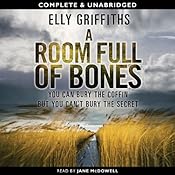
Review: A ROOM FULL OF BONES, Elly Griffiths -audio book

  • Narrated by Jane McDowell 
  • Published 2012, released by Audible
  • Length: 9 hours 44 mins
  • source: I bought it
  • #4 in the Ruth Galloway series
Blurb (from Audible) 


It is Halloween night, and the local museum in King's Lynn is preparing for an unusual event - the opening of a coffin containing the bones of a medieval bishop. But when Ruth Galloway arrives to supervise, she finds the museum's curator lying dead beside the coffin. It is only a matter of time before she and DI Nelson cross paths once more, as he is called in to investigate. Soon the museum's wealthy owner lies dead in his stables, too. These two deaths could be from natural causes - but Nelson isn't convinced.

My Take

If I wanted to be picky about this book I could say that Elly Griffiths has recently discovered Australian Aboriginal archaeology and anthropology. If you didn't know anything about 19th and early 20th century collection of indigenous artefacts and bones and their transportation to colonial "mother countries", and the consequent recent struggles to have these items returned for burial in their homelands, then you will after reading A ROOM FULL OF BONES.  For me as an Australian reader it is interesting to find this as a topic running through the book. I thought it was good too that Elly Griffiths points out for us one of the issues that archaeologists debate: the conundrum of what to do with bones once you have disinterred them.

One comment that I recently read inferred that the story line is "more of the same", i.e. that the reader didn't feel satisfied that the content of the story was sufficiently different to earlier books in the series. I think that criticism was a little unjust. I have read the series from the beginning and I think I enjoyed this one as much as each of the earlier ones.

If you are wondering, this really is a series you should read in order. There is terrific character development and persistence of quite a large number of interesting characters from one book to the next. The books peek into Ruth Galloway's life at intervals, and central to it all is Ruth's relationship to DI Harry Nelson. The sleuthing combination of a forensic archaeologist and a detective is excellent.

In previous reviews I have commented that the story was often written in the present tense which was a little disconcerting. I didn't notice that so much in A ROOM FULL OF BONES, or perhaps if it was there, it didn't not impinge on my reading in quite the same way.

This series capitalises on our interest in the past: there are passing references to Time Team and to tv shows like the Antiques Road Show.

Elly Griffiths is a terrific story teller and I am looking very much forward to #5 in the series.

My rating: 4.5

Other reviews to check

Other Elly Griffiths books reviewed on MiP


4.6, THE CROSSING PLACES (2009)
4.6, THE JANUS STONE (2010)
4.6, THE HOUSE AT SEA'S END (2011)

5 July 2012

Forgotten Book: Review: THEY CAME TO BAGHDAD, Agatha Christie

  • Format: Kindle (Amazon)
  • File Size: 595 KB
  • Print Length: 307 pages
  • Page Numbers Source ISBN: 0062073788
  • Publisher: Harper; Masterpiece ed edition (October 14, 2010) Originally published 1951.
  • Sold by: HarperCollins Publishers
  • Language: English
  • ASIN: B0046RE5HM
Synopsis (Amazon)

Agatha Christie’s international mystery thriller, reissued with a striking new cover designed to appeal to the latest generation of Agatha Christie fans and book lovers.

Baghdad is the chosen location for a secret summit of superpowers, concerned but not convinced, about the development of an, as yet, unidentified and undescribed secret weapon.

Only one man has the proof that can confirm the nature of this fantastic secret weapon – a British agent named Carmichael. Unfortunately the criminal organisation responsible for the weapon’s development will stop at nothing to prevent him entering Baghdad and presenting his proof to the assembled delegates. Can Carmichael enter the city against such odds?

Into this explosive situations appears Victoria Jones, a girl with a yearning for adventure who gets more than she bargains for when a wounded Carmichael dies in her arms in her hotel room.

Now, if only she could make sense of his last words ‘…Lucifer…Basrah…Lefarge…’

My Take

Originally published in 1951, THEY CAME TO BAGHDAD reflects popular concerns of the time about whether another World War was brewing.
    He said grumblingly, ‘All right, all right…Get back as soon as you can. I’ve never seen the market so jumpy. All this damned Communism. War may break out at any moment. It’s the only solution, I sometimes think. The whole country’s riddled with it – riddled with it. 
    And now the President’s determined to go to this fool conference at Baghdad. It’s a put-up job in my opinion. They’re out to get him. Baghdad! Of all the outlandish places!’
     ‘Oh I’m sure he’ll be very well guarded,’ Miss Scheele said soothingly. 
    ‘They got the Shah of Persia last year, didn’t they? They got Bernadotte in Palestine. It’s madness – that’s what it is – madness. ‘But then,’ added Mr Morganthal heavily, ‘all the world is mad.’
While the main protagonists appear to be the USA and Communist Russia, those engineering the war are quite a different group again:
    ‘I know everybody says there’s going to be another war sooner or later,’ said Victoria. 
    ‘Exactly,’ said Mr Dakin. ‘Why does everybody say so, Victoria?’ 
    She frowned. ‘Why, because Russia – the Communists – America –’ she stopped. 
    ‘You see,’ said Dakin. ‘Those aren’t your own opinions or words. They’re picked up from newspapers and casual talk, and the wireless. There are two divergent points of view dominating different parts of the world, that is true enough. And they are represented loosely in the public mind as “Russia and the Communists” and “America”. Now the only hope for the future, Victoria, lies in peace, in production, in constructive activities and not destructive ones. 
    Therefore everything depends on those who hold those two divergent viewpoints, either agreeing to differ and each contenting themselves with their respective spheres of activity, or else finding a mutual basis for agreement, or at least toleration. Instead of that, the opposite is happening, a wedge is being driven in the whole time to force two mutually suspicious groups farther and farther apart. Certain things led one or two people to believe that this activity comes from a third party or group working under cover and so far absolutely unsuspected by the world at large. Whenever there is a chance of agreement being reached or any sign of dispersal of suspicion, some incident occurs to plunge one side back in distrust, or the other side into definite hysterical fear.
The central character/heroine Victoria Jones, who turns out to be a superb detective, never appears in another Christie novel. In tone and theme this novel is reminiscent of those that featured Tommy and Tuppence. It also reflects a theme that appears elsewhere, the idea of an evil force that is controlling world events.

As Wikipedia says "The book was inspired by Christie's own trips to Baghdad with her second husband, archaeologist Max Mallowan, and is also one of few Christie novels belonging to the action and spy drama genres.."

It is very clear that much of the description of the journey to Baghdad and what happens on an archaeological dig comes from Christie's own experience. In this e-version of THEY CAME TO BAGHDAD we also have a segment from Christie's Autobiography, begun in 1950 when she was in Iraq.

I don't think this is one of Christie's best . The tone is probably closer to the novels of the 20s and 30s, and there was a little too much melodrama and romance in it for my taste. But it reminds us how anxious people must have been in 1950.
  • 1949 China became Communist and Russia demonstrated an Atomic Bomb
  • 1950 the Korean war began, Senator McCarthy begins the Communist Witchhunt in the USA and President Truman orders the construction of the hydrogen bomb
My rating: 4.2

Check the other Forgotten Books for this week at Pattinase's Friday's Forgotten Books

4 July 2012

Mid year stocktake - how are all those challenges going?

Quite a number of my fellow bloggers reported earlier in the year that they were reducing the number of challenges they were participating in.

I've persisted in taking on reading challenges because I believe they give me some points of comparison from year, some sense of direction, and prevent me from focussing just on one form of the genre. I do vary the challenges from year to year.

So how am I going this year? Pretty well actually, although there are some like the Global Reading Challenge, New Zealand authors, and "not crime fiction" that need a bit of specific attention.

The reading challenges I've joined
 Personal reading challenges
  • American authors: currently 11/20
  • translated, currently 13/20
  • New Zealand, currently 0/4
  • new to me: currently 29 - last year 60
  • not crime fiction: currently 0 
My detailed summary page.

So how are your reading challenges going? 

3 July 2012

How many e-books have you bought in the last 6 months?

At the top of the right hand column you'll find a poll which asks you how many e-books you have bought in the last 6 months.

The poll question is inspired by a remark made by Australian crime fiction writer PD Martin who is a keynote speaker at Salisbury Writers' Festival in late August.
    She is speaking about e-books and their potential impact on writers and readers. 
    "One in six Americans is an e-reader and about 20% in Australia have reported buying an e-book in the last 6 months."
This week I am addressing a group at a suburban library, trying to explain the e-reader offerings here in Adelaide, and unravelling the differences between Kindle books and the rest. My prezi is here.
When I was overseas recently I read books only from my Kindle. I had 40 books pre-loaded in readiness and read about half of them. (In actual fact I have over 500 books on my Kindle organised into 22 "Collections".)

In the last 2 weeks I've reverted to library books and, would you believe it, I'm having withdrawal symptoms?

A recent poll resulted in the post e-books holding steady led me to believe that in general the hype has gone out of the e-reader market, although a couple of commenters told me they have only just acquired an e-reader.

Some people however are now reading most of their books in e-format.
Indeed this year I have read 41 books on my Kindle out of a total of 80 books altogether. That is about half of all my reading.
So for people like me to say that I have bought more than 5 e-books this year is an under-statement. 
In fact my Amazon account shows 90 purchases and that is without those I have acquired through Smashwords and NetGalley. (Some have been very cheap: either free or 99 cents, and in general I baulk at paying much more than $10)

So comment if you like about your e-book spending and reading.
Are you using your e-reader regularly now or are you having difficulty in finding a use for it?
Do you feel like confessing how many e-books you've actually bought this year, or how many you've actually read? Go ahead.


LinkWithin

Blog Widget by LinkWithin