3 December 2014

Plans for December Reading

December is always a busy time and it is often hard to get some time to do some serious reading.

I did aim to read 145 books this year, but I am only on 126 currently, so that target looks a bit far away.

Specifically I am aiming to complete the Mystery Author Challenge being run at Red Headed Book Child.
I have E, X and Y to go.
E: I am reading now: THE SHADOW WOMAN by Ake Edwardson
Y will be ANTIDOTE TO MURDER by Felicity Young
X depends a bit on my local library but I have reserved DEATH OF A RED HEROINE by Qiu, Xiaolong
My full list is here.


The other meme that I am trying to complete is VINTAGE MYSTERY BINGO 2014 hosted by Bev at My Reader's Block.
My record page is here. I have actually read 25 books.

Here is what I have done so far.
Golden Vintage - books written before 1960

 To complete a double bingo I am borrowing a Maigret from the library: THE MAN WHO WATCHED TRAINS GO BY

Silver Vintage: books written 1960 - 1989

 I am not sure whether I am going to be able complete a bingo line on this one. I have plenty of books on my Kindle to use - it is just getting them to line up!

2 December 2014

1 December 2014

Crime Fiction Pick of the Month November 2014

Crime Fiction Pick of the Month 2014
Many crime fiction bloggers write a summary post at the end of each month listing what they've read, and some, like me, even go as far as naming their pick of the month.

This meme is an attempt to aggregate those summary posts.
It is an invitation to you to write your own summary post for November 2014, identify your crime fiction best read of the month, and add your post's URL to the Mr Linky below.
If Mr Linky does not appear for you, leave the URL in a comment and I will add it myself.

You can list all the books you've read in the past month on your post, even if some of them are not crime fiction, but I'd like you to nominate your crime fiction pick of the month.

That will be what you will list in Mr Linky too -
e.g.
ROSEANNA, Maj Sjowall & Per Wahloo - MiP (or Kerrie)

You are welcome to use the image on your post and it would be great if you could link your post back to this post on MYSTERIES in PARADISE.


29 November 2014

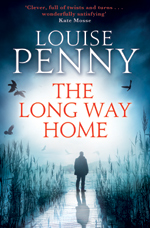
Review: THE LONG WAY HOME, Louise Penny

  • first published by Minotaur 2014
  • ISBN 978-0-7515-5364-5
  • 373 pages
  • #10 in the Armand Gamache series
  • source: my local library
Synopsis (author website)

Happily retired in the village of Three Pines, Armand Gamache, former Chief Inspector of the Homicide with the Sûreté du Québec, has found a peace he'd only imagined possible. But his peace is interrupted when his friend and neighbour, Clara Morrow tells him her artist husband Peter has failed to come home. She asks for Gamache's help in finding him. Having finally found sanctuary, Gamche feels a near revulsion at the thought of leaving Three Pines. But he must.

Together with his former second-in-command, Jean-Guy Beauvoir, and Myrna Landers, they journey deeper and deeper into Quebec. And deeper and deeper into the soul of Peter Morrow. A man so desperate to recapture his fame as an artist, he would sell that soul. And may have. The journey takes to an area so desolate, so damned, the first mariners called it The land God gave to Cain. And there they discover the terrible damage done by a sin-sick soul.

My take

To my chagrin, I discovered on reading this, the latest in the series, that I forgot that I haven't read the one just before (HOW THE LIGHT GETS IN) - I'm sure I have a copy somewhere ... now where is it? Apart from that, I have actually read all the titles in the series.

I found this title a rather odd mixture of philosophical discussion (what inspires an artist?) and an almost mystical quest ( the closest I can get is something like Tolkien's Lord of the Rings) as Armand Gamache tracks Peter Morrow's journey to find truth. Gamache's instincts tell him that there will be a murder at the end, although for most of the story that is not obvious.

The story that this novel weaves is at the same time fantastic and yet plausible. And as always, the characters are very real.

Highly recommendable.

My rating: 4.9


I've also reviewed
4.8, THE CRUELLEST MONTH
4.9, A RULE AGAINST MURDER
4.9, THE BRUTAL TELLING
5.0, BURY YOUR DEAD
5.0,  A TRICK OF THE LIGHT
4.5, THE HANGMAN - a novella
4.9, THE BEAUTIFUL MYSTERY

The order of the Gamache books, from first to most recent, is:
Still Life, A Fatal Grace/Dead Cold (same book, different title), The Cruelest Month, A Rule Against Murder/The Murder Stone (same book, different title), The Brutal Telling, Bury Your Dead, A Trick of the Light, The Beautiful Mystery, How the Light Gets In, The Long Way Home.


My earlier mini-reviews

STILL LIFE: my rating 4.6
Louise Penny's first novel was runner up in the Crime Writers' Association's Debut Dagger Award in 2004, in manuscript form.
In the early morning of Thanksgiving Sunday, 76 year old Jane Neal is found dead in the woods of the small Canadian village of Three Pines. She has been shot through the heart by a hunter's arrow - was it an accident or is it murder? There are many secrets in this village and this case gets a distinguished detective from Surete du Quebec, Chief Inspector Armand Gamache. Jane had recently entered a revealing village 'portrait' into the village art competition. Her great friend Timmer Hadley had also recently died. Were the events connected? Most enjoyable, but not for the impatient, one-more-title-to-add-to my-list, reader. Be prepared to spend some time sifting the clues.

DEAD COLD: my rating 5.0
#2 in the Armand Gamache series. In the little Canadian village of Three Pines another death has occurred. A female spectator, the hated CC de Poitiers, has been electrocuted while out on the ice watching the annual Boxing Day curling match. This has to be murder but no-one saw anything. Coincidentally the victim has been living in the house that was the centre of the last murder in Three Pines, Gamache's case a year ago, the focus of Penny's debut novel STILL LIFE. Gamache renews old acquaintances in the village and we learn more about him. Do read these books in order if you can.

28 November 2014

Agatha Christie and Reflections on the effects of World War One.

Although Agatha Christie's first novel THE MYSTERIOUS AFFAIR AT STYLES was published post war in 1920, it is true to say that nearly all of the novels set prior to the outbreak of World War Two has a plot stemming from the days of the war, or contains reflections on the impact of the war either on the sleuths, or the British economy, English society, or subsequent world politics.

When you read the early novels for their murder mysteries, these observations are often missed.
Let us look at just a few of the early titles.

For example THE MYSTERIOUS AFFAIR AT STYLES was the first featuring Hercule Poirot. He was a Belgian refugee, and had in fact already retired as the head of Belgium's police force when the Germans
invaded Belgium and he was forced to flee to Britain.
This account of the Styles Case is penned by Captain Hastings, a war hero invalided home from the Front. He is invited down to Styles Court by his friend John Cavendish to spend some of his convalescent leave. In the village Hastings runs across his old friend Hercules Poirot, an elderly Belgian, once one of the most celebrated members of the Belgian police, but now a refugee assisted by John Cavendish's mother Mrs Inglethorpe.

This novel is set towards the end of World War One, and Christie makes a number of observations about the privations of life in England during the war, rationing, and shortages, and a style of living that is fast disappearing. The house at Styles for example once had a much larger domestic, household and garden staff, but is now "making do". The Cavendish brothers have inherited money, John lives the life of a country squire, and Lawrence, the younger brother is delicate and follows literary pursuits. Other members of the family are working in "acceptable" occupations, for war time that is, a nurse, the land army, and a companion.

THE SECRET ADVERSARY was published in 1922, and saw the creation of Tommy and Tuppence.
In early May 1915 the British luxury liner Lusitania was struck by two German torpedoes and quickly sank 15km off the western coast of Ireland. The prologue of THE SECRET ADVERSARY begins with an American on the Lusitania who is carrying important papers for the American ambassador in London handing these over to a young American girl to complete his mission. Her name is Jane Finn.

The story then jumps to a chance meeting near Picadilly in London early in 1919 between Miss Prudence Cowley (Tuppence) and Major Thomas Beresford (Tommy). Both have been involved in the war effort, but the war ended in late 1918 and so did gainful employment.
Tuppence and Tommy were childhood friends and met up briefly in 1916 when Tommy was hospitalised and Tuppence was working as a nurse. Over afternoon tea they decide to form a business partnership trading under the name of the Young Adventurers.

The First World War is still very fresh in people's minds. And now in the political mix is the Russian Revolution in late 1917, the Tsar and his family executed, and the Communist Party came into power. Russia was amongst the victors of the war, and a party to the peace negotiations. The British Labour Party has a lot of sympathy with the Russian communists and is looking for anything to discredit the government. There are strikes in Britain at the end of 1918 and threats of strikes in 1919, problems with Ireland too, the period during which THE SECRET ADVERSARY is set.

In THE MAN IN THE BROWN SUIT published in1924, you can see Christie experimenting with a different style of murder mystery.

In the Prologue, in the dressing room of a Russian dancer in Paris, through a meeting she has with another Russian, we learn 3 things. Firstly neither of them are Russian. Secondly they have both been working for an arch criminal who is on the point of retirement. The "Colonel" has, even during the First World War, organised a series of "stupendous" coups including jewel robberies, forgery, espionage, assassination, and sabotage. Thirdly we learn the story of the theft of some South American diamonds before the war. The dancer knows where these diamonds are and intends to exchange them for some of the "Colonel's" accumulated wealth.

I think Agatha Christie tried to move from a murder mystery to a thriller with connections to the world of organised crime, unionism, espionage and romance. The novel introduces another sleuth in the form of Colonel Race.

So you can see where I am going with this idea. When you read the early Christie's, look for the mentions of the first World War.

Now, I'm not going to leave Miss Marple out, even though her first case is not published until 1930: THE MURDER AT THE VICARAGE.
Look for mentions of the impact of the war on village society, the inability to finance the big country houses, the difficulties in getting staff, the damage to England's social structure etc.

Somewhere in the Marple titles - you might remember where, but I can't - there is mention of the personal impact of the war on Jane Marple - she had an affair with an officer who was married, but he did not come back from the war, and so she remained a spinster all her life, like so many other young women at the time who similarly lost their men in the trenches.

24 November 2014

Review: THE ENGLISH LADY MURDERERS' SOCIETY, Jim Williams

  • first published 2011 by Quartet Books, London
  • ISBN 978-0-70437-251-1
  • 302 pages
  • Source: My local library
Synopsis (author website)

Janet Bretherton, a widow at 60, suspected of her husband's murder and involvement in the fraud which brought his company down, exiles herself to Puybrun, a small village in a picturesque corner of south-west France, where she nurses her grief and tries to rebuild her shattered world. She meets six other Englishwomen who live the expatriate life. Earthy has fled from a hippy camp in a damp corner of Wales. Carol claims to have slept with every man in the world called Dave. Belle has a husband, Charlie, who may or may not be real because no one has ever seen him. Joy is married to the appalling Arnold. And Veronica and Poppy try to discover the basis for the love they have for each other. The women form a group in which they take turns to teach each other the lessons life has taught them. At the same time, they grow more confident and gradually reveal the secrets of their pasts.

When Janet finds she has attracted the attention of Léon, thirty years younger than she is, yet seems to find her still sexually desirable as he invites her to go dancing with him, she asks herself: What are his real motives? And does she care? In the end, the process of discovery reveals a terrible secret which forces the women to decide how much they love each other: how far they can rely upon each other... even when the question is one of murder.

The English Lady Murderers' Society is a humorous and affectionate description of the solidarity of women in the face of the idiocy and unreliability of men. It celebrates the courage and beauty of older women. The author is familiar with the subject because he is married to one of them.

My Take

This is a cleverly plotted novel that brings together a group of expat English women who all have something to hide in one way or another, and who are mostly without husbands. Janet's husband has recently died, and she appears to be suspected of his murder. She left England without telling her daughter Helen where she was going and the phone calls they have are full of recriminations. It is Helen who tells Janet that the police want to talk to her, and who gives the police her phone number. Janet has a series of quite strange conversations with the detective in charge of the investigation into her husband's death.

Meanwhile the small group of expat Englishwomen in the small French village of Puybrun form a society and explore each other's company. They go bushwalking, learn painting, and play poker rather like many other retired women do.  Meanwhile the investigation into Janet's husband's death continues and Janet works out what really happened to him.

My Rating: 4.5

About the author
Jim Williams first hit the news when his early novels had the uncanny knack of coming true. The Hitler Diaries was published nine months before the celebrated forgery came out. Farewell to Russia dealt with a nuclear disaster in the Soviet Union months before the Chernobyl incident. Lara's Child, his sequel to Doctor Zhivago, provoked an international literary scandal and led to his being a guest speaker at the Cheltenham Festival. Scherzo, a witty and elegant mystery set in eighteenth century Venice, was nominated for the Booker Prize. All of his fiction has been published internationally. The English Lady Murderers' Society is his tenth novel.

21 November 2014

900 Reviews on this blog

When I began this blog in January 2008, I did so thinking it would be primarily a place to post reviews of the books I have read. I also thought it would help me remember plots and titles.

Now after 2915 posts, I have reached the 900th review. This year I have published fewer non-review posts but even so about 30 % of my posts have been reviews.

I am still maintaining an "All Reviews" page, sorted by author, and in addition I post my reviews on Library Thing (where I have 1068 books listed) and on NetGalley.
Reviews of Australian authors also appear on Fair Dinkum Crime.

LinkWithin

Blog Widget by LinkWithin