Showing posts with label 2011 nordic challenge. Show all posts

8 December 2011

Review: CELL 8, Roslund & Hellstrom

  • published by Quercus 2011
  • ISBN 978-1-84916-147-3
  • translated from Swedish by Kari Dickson
  • 460 pages
  • source: review copy sent to me by Pan Macmillan Australia
Publisher's blurb

A cheap crooner by the name of John Schwarz earns his keep on a ferry between Sweden and Finland, singing evergreens for drunken passengers. One night, he loses his temper with a man harassing women in the crowd, beating him unconscious. As drunken brawls are commonplace on the Baltic cruising ferries, no one raises an eyebrow.

No one, that is, but Detective Ewert Grens. Concerned by the details of the case report, Grens can't help but think someone capable of such violence must have a history of it. As a precaution, he orders Schwarz arrested: one that is seemingly justified when Schwarz provides such resistance that he has to be sedated.

Suspicion turns to shock when Grens discovers that John Schwarz does not exist. When he learns that the man in his custody is in fact John Meyer Frey – an American citizen from Marcusville, Ohio – he is even more astonished. John Meyer Frey cannot be sitting in front of him: John Meyer Frey died on Death Row over six years before.

This mystery will initiate the most remarkable criminal investigation of Ewert Grens' career, the reverberations of which will reach the highest tier of international politics, and blow the worldwide debate on the death penalty wide open.

My take

My research shows CELL 8 is yet another example of a translated crime fiction title released in English out of order of original publication.
Here is the list I've worked out with original Swedish publication dates:
  • THE BEAST (2004)
  • BOX 21 (2005)
  • REDEMPTION aka CELL 8 - original title Edward Finnigans upprättelse - (2006)
  • THE GIRL BELOW THE STREET (2007) 
  • THREE SECONDS (2009) - my review
Check the list for yourself on the author's website.

The method by which John Meya Frey cheats Ohio's Death Row does strain the bounds of credibility a bit but the conundrum of whether a man who has already been certified as dead can be executed again is a nice one. As is whether a country like Sweden which has abolished the death penalty, and is party to an EU agreement that states that no member country will extradite a person to face a death penalty, can carry out such an extradition.

Ewart Grens carries his own burdens which leak over into this case. Lurking in the background is his own relationship with a former colleague Anni, now a brain damaged resident in a nursing home. Grens is responsible for her condition and it affects his judgement in the case of John Schwartz. He is zealous for the apprehension of Schwartz and brings him in on a charge of attempted murder when the passenger he kicked in the face on the ferry hovers between life and death in hospital.

CELL 8 is well constructed and well paced book. 17 year old John Meya Frey always protested his innocence in the murder of his 16 year old girlfriend. It seems that because he was a minor the police were only too willing to believe in his guilt and no-one really looked for an alternative answer. The reader is given a sniff of who the real killer might have been, early on, but I misinterpreted the tip.

There is an interesting irony played out in the latter pages of the book too.

My rating: 4.5

Other reviews to check

7 December 2011

Review: ROSEANNA, Maj Sjowall & Per Wahloo - audio

  • available from Audible.com
  • Narrated by Tom Weiner and translated from Swedish by Lois Roth
  • length: 6 hours 35 mins
  • source: I bought it
  • Originally published 1965, the first of ten books in the Martin Beck series.
  • also available in Kindle edition from Amazon 
Publisher's Summary (Audible)
 
On a July afternoon, the body of a young woman is dredged from Sweden's beautiful Lake Vättern. Three months later, all that Police Inspector Martin Beck knows is that her name is Roseanna, that she came from Lincoln, Nebraska, and that she could have been strangled by any one of 85 people.

As the melancholic Beck narrows down the list of likely suspects, he is drawn increasingly to the enigma of the victim, a free-spirited traveller with a penchant for the casual sexual encounter, and to the psychopathology of a murderer with a distinctive - indeed, terrifying - sense of propriety.

With its authentically rendered settings, vividly realized characters, and command over the intricately interwoven details of police detection, Roseanna is a masterpiece of suspense and sadness.

My take

I have been promising myself to read this, the first in the Martin Beck series. I have read a number of the series (see the list below) and enjoyed them. Fifty six years on from the publication of ROSEANNA, it would be easy to dismiss the signals in the book that crime fiction was embarking on a new style of police procedural, one that not only focussed on the crime committed but also on the way the policeman felt about his job, the way the investigation gnawed at the detective's consciousness,  affected his family life, and even how well he felt.

The introduction to both the Audible and Kindle versions is the same, written by Henning Mankell who pays tribute to how the authors thought they could use "crime novels to form the framework for stories containing social criticism. ... They wanted to use crime and criminal investigations as a mirror of Swedish society... Their intent was never to write crime stories as a form of entertainment."

In ROSEANNA Maj Sjowall and Per Wahloo experimented with a number of formats. Parts of the novel are simply narrative while in other sections we have verbatim transcripts of interview.

In 2009 an article in The Guardian titled The queen of crime said
    When Maj Sjöwall and her partner Per Wahlöö started writing the Martin Beck detective series in Sweden in the 60s, they little realised that it would change the way we think about policemen for ever.
Tom Weiner does an excellent job of the audio version. (Just a personal anecdote - about two chapters before the end, my iPod ceased to work, and I was forced to read the last two chapters on my Kindle.)

My rating: 4.7

The Martin Beck series (courtesy Fantastic Fiction)
1. Roseanna (1965) - rated: 4.7
2. The Man Who Went Up in Smoke (1966) - my review: rated 4.7
3. The Man on the Balcony (1967) - mini-review: rated 4.8
4. The Laughing Policeman (1968) - mini-review : rated 4.7
     aka Investigation of Murder
5. The Fire Engine That Disappeared (1969) - review: rated 4.5
6. Murder at the Savoy (1970)
7. The Abominable Man (1971)
8. The Locked Room (1972)
9. Cop Killer (1974)
10. The Terrorists (1975)
I now have the remainder of this series on my Kindle and may set myself a mini-challenge in 2012 to complete reading it.

I am also making this post my contribution to this week's Pattinase's Friday's Forgotten Books

6 October 2011

Review: OUTRAGE, Arnaldur Indridason

  • Format: Kindle Edition
  • File Size: 411 KB
  • Print Length: 320 pages
  • Page Numbers Source ISBN: 0307359417
  • Publisher: Vintage Digital (June 23, 2011)
    Translated from Icelandic by Anna Yates
  • Sold by: Amazon Digital Services
  • Language: English
  • ASIN: B0051UTRLM
  • Source: I bought it
Product description (Amazon)

In a flat near Reykjavík city centre, a young man lies dead in a pool of blood. There is no sign of a break-in: the only clues are a woman’s purple shawl, found under the bed in the next room, and a vial of prescription drugs in the victim´s pocket.
With Detective Erlendur away in a remote part of Iceland, Detective Elínborg, who is already struggling to juggle family life and the relentless demands of her job, is assigned the case. Her investigation into the murdered man’s past soon uncovers a squalid tale of double lives, drug dealers and the unsolved disappearance of a young girl many years before.
From its explosive opening, Outrage leads down a trail of hidden violence, psychological brutality and of wrongs that will never be fully righted.

My take:

Although OUTRAGE is the 7th title in the Erlendur series to be translated  into English it could quite easily be read initially as a stand alone. Hopefully the reader will enjoy this one enough to track down some of the earlier titles.

I've referred to the books as the Erlendur series because the novels usually focus on a rather grumpy old-fashioned detective by that name. In OUTRAGE though he has recently wound up a very  demanding case and has taken an unscheduled leave. Not even those closest to him know where he has gone.

So when the dead body in the flat in the fashionable Thingholt district is called in, Detective Elinborg is on duty and she calls the team to the crime scene. We, the readers, have met Elinborg in earlier novels, and know her as hard working, meticulous, conscientious. OUTRAGE gives us a chance to get better acquainted with her. Elinborg tries to keep her home life and her work life separate, refuses to discuss the cases she is working on with her husband and children, but this does result in a form of alienation between her and her eldest son. Elinborg works incredibly long hours and leaves much of the home management of their three children to her husband Teddi who is a mechanic.

What we learn from this novel is that sometimes people, particularly women, will talk to Elinborg particularly because she is a woman. This particular case involves a man who uses a date rape drug on his victims and when they learn this it colours women's attitudes to giving information.

Indridason uses an interesting hook for this novel. In the opening chapter Runolfur, the murder victim, is off to a bar with the Rohypnol in his pocket. He picks up a woman to take back to his flat. Later he is found dead on the floor of his flat, his throat cut, wearing the t-shirt we last saw on his female victim. It sent me scurrying off to read the first part of the chapter again. And of course we now want to know what happened.

I didn't feel OUTRAGE had the flair of earlier novels in the series, but is nevertheless still a very acceptable police procedural. It does also explore a number of contemporary issues: the pain that occurs when children leave home, the growing urbanisation of Iceland and the social dislocation that can occur, and how life in Iceland has changed in the last part of the twentieth century.

My rating: 4.6

Other reviews
Indridason titles on this blog
ARCTIC CHILL
5.0, HYPOTHERMIA
4.5, OPERATION NAPOLEON

Review: THE FIRE ENGINE THAT DISAPPEARED, Maj Sjowall, Per Wahloo

  • Format: Kindle Edition
    originally published in 1969
    translated from Swedish by Joan Tate
    Introduction by Colin Dexter
  • File Size: 553 KB
  • Print Length: 288 pages
  • Publisher: Harper Perennial (August 20, 2009)
  • Sold by: HarperCollins Publishers
  • Language: English
  • ASIN: B002RI9EZ0
  • Source: I bought it
Also available from Audible.com

Product Description (Amazon)

The excellent fifth classic installment in the Martin Beck detective series from the 1960s – the novels that have inspired all crime fiction written ever since.
Widely recognised as the greatest masterpieces of crime fiction ever written, these are the original detective stories that pioneered the detective genre.

Gunvald Larsson sits carefully observing the dingy Stockholm apartment of a man under police surveillance. He looks at his watch: nine minutes past eleven in the evening. He yawns, slapping his arms to keep warm. At the same moment the house explodes, killing at least three people.
Chief Inspector Martin Beck and his men don't suspect arson or murder until they discover a peculiar circumstance and a link is established between the explosion and a suicide committed that same day, in which the dead man left a note consisting of just two words: Martin Beck.

Written in the 1960s, they are the work of Maj Sjowall and Per Wahloo – a husband and wife team from Sweden. The ten novels follow the fortunes of the detective Martin Beck, whose enigmatic, taciturn character has inspired countless other policemen in crime fiction. The novels can be read separately, but do follow a chronological order, so the reader can become familiar with the characters and develop a loyalty to the series. Each book has a new introduction in order to help bring these books to a new audience.

My take

THE FIRE ENGINE THAT DISAPPEARED is a perfect illustration of the concept that solving homicide cases is a mixture of accumulating evidence through painstaking and methodical sleuthing with flashes of intuition. In any investigative team the role of some will be the sleuthing, but it will often be the intuition that solves the case. The problem is that without the painstaking sleuthing little intuition is possible, and the accumulation of evidence is often necessary to both break the perpetrator and for for successful prosecution to take place. There is also often a problem in getting all the essential information into one brain. It takes all kinds to form a good team of detectives: plods, cynics, workaholics, as well as those who carefully compartmentalise their lives. Successful resolution requires testing theories, discarding those that don't fit, following the occasional red herring, and often, as in this case a long passage of time. The threads that make up a case often first present separately but as the plot develops they begin to converge.

One of the things that this novel clearly shows too is that each of the team has a private life. In THE FIRE ENGINE THAT DISAPPEARED Martin Beck's marriage appears to be on the point of collapse. This seems to be something so common to the modern detective that we almost take it for granted.

The Martin Beck series was written in the late 1960s and now five decades later we can still appreciate how cleverly they were constructed.

My rating: 4.5

 The Martin Beck series (courtesy Fantastic Fiction)
I have now read *
1. Roseanna (1965)
2. The Man Who Went Up in Smoke (1966) *
3. The Man on the Balcony (1967) *
4. The Laughing Policeman (1968) *
     aka Investigation of Murder
5. The Fire Engine That Disappeared (1969) *
6. Murder at the Savoy (1970)
7. The Abominable Man (1971)
8. The Locked Room (1972)
9. The Cop Killer (1974)
10. The Terrorists (1975) 

See also
THE MAN WHO WENT UP IN SMOKE

11 September 2011

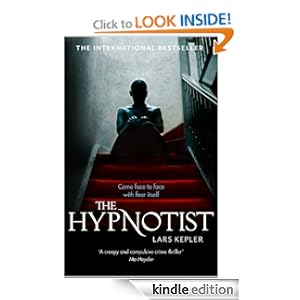
Review: THE HYPNOTIST, Lars Kepler

  • Format: Kindle Edition
  • File Size: 875 KB
  • Print Length: 512 pages
    Translated from Swedish by Ann Long
  • Page Numbers Source ISBN: 0007359101
  • Publisher: Blue Door (May 12, 2011)
  • Sold by: HarperCollins Publishers
  • Language: English
  • ASIN: B004VM6494
  • Source: I bought it
Publisher's Blurb (Amazon)

You need clues. You need time. You need a motive. You won’t have any of them.
Tumba, Sweden. A triple murder, all the same family. The killer is at large, and it looks as if the elder sister escaped the carnage. But she is missing and it seems only a matter of time until she too is murdered. Detective Inspector Joona Linna demands to investigate the grisly aftermath – against the wishes of the national police.Where can Linna begin? The only surviving witness is the boy, Josef, whose mother, father and little sister were killed before his eyes, and he’s in shutdown, comatose with shock. Obsessed and desperate, Linna turns to disgraced specialist Erik Maria Bark…

My take

By any standards THE HYPNOTIST is a long book and it poses the dilemma that always comes with long books of how much of the story outline to reveal in a review.
You are given the basics in the publisher's blurb (above).
The action of the book begins in the early hours of December 8 and rounds off on December 24.

Trauma specialist Erik Maria Bark is woken in the middle of the night by Detective Inspector Joona Linna who explains he needs to question a 15 year old boy, Josef Ek,  who has witnessed a double murder and who has been seriously injured himself. The boy has been transferred to the neurosurgical unit at the hospital where Bark works.The doctor in charge of the case has suggested Linna call Bark. When Bark arrives at the hospital, he finds that the doctor is being put under pressure to allow the police to question the victim. News comes through that the victim's father has been murdered, the older sister is missing, and Joona Linna suggests questioning the victim be done by hypnosis.

That's when we learn that Erik Maria Bark last hypnotised a patient ten years earlier and made a promise never to hypnotise anyone again. Of course under pressure from Linna he agrees to break his promise, and thus the ball begins to roll.

What makes THE HYPNOTIST such a long book, in part, is that the reader needs to learn what happened ten years before to exact the promise from Erik Maria Bark. The plot branches in many ways. In hypnotising Josef, Bark and Linna hear information that puts Bark's family in danger, and eventually leads to Bark's son Benjamin being kidnapped.

There. That's all I'm going to tell you. I found THE HYPNOTIST very readable but in places not entirely credible. Ignore labels that tell you this is the next Stieg Larsson. It isn't, but consumable Swedish crime fiction it is.

My rating: 4.5

Other reviews to check

18 August 2011

Book Review: UNTIL THY WRATH BE PAST, Asa Larsson

  • Format: Kindle Edition
  • File Size: 478 KB
  • Print Length: 288 pages
  • Publisher: Quercus (August 4, 2011)
    Originally published in Swedish 2008, translated from Swedish by Laurie Thompson
  • Sold by: Amazon Digital Services
  • Language: English
  • ASIN: B005DKRPQO
  • Source: I bought Kindle version, but a review hard copy was provided by Pan Macmillan Australia
Product description (Amazon)

In the first thaw of spring the body of a young woman surfaces in the River Thorne. Rebecka Martinsson is working as a prosecutor in nearby Kiruna. Her sleep has been disturbed by haunting visions of a shadowy, accusing figure. Could the body belong to the ghost in her dreams?
Joining forces once again with Police Inspector Anna-Maria Mella, Martinsson is drawn into an investigation that focuses on old rumours about the disappearance of a plane carrying supplies for the Wehrmacht in 1943. Shame and secrecy shroud the locals' memories of the war, with Sweden's early collaboration with the Germans still a raw wound. And on the windswept shore of a frozen lake lurks a killer who will kill again to keep the past buried for ever beneath half a century's silent ice and snow.

My take

I'm really regretful that I have read only 2 of Asa Larsson's four novels, and in particular have missed reading THE BLACK PATH (see Euro crime review by Maxine Clarke), because the impact of the events of the third novel are frequently referred to in UNTIL THY WRATH BE PAST.

The hook that gets the reader into the novel is a powerful one.
    I remember how we died. I remember and I know. That's the way it is now.
17-year-old Wilma Persson and her boyfriend are trapped while diving beneath the ice of Lake Vittangijärvi, looking for the wreck of a Nazi transport airplane that crashed there during the War. The story opens with Wilma as the narrator and she continues to make frequent appearances throughout.
When Wilma's body is first discovered in a nearby river, it is assumed her death was an accident. No-one had known where the young couple were diving. When forensic evidence shows that Wilma did not die where her body was found, Rebecka Martinsson decides to take over the investigation herself.

I was never very clear about what the transport plane contained but it was enough to push locals, who are ironically relatives of Wilma's, to make sure it was not discovered.

Wilma ensures Rebekah Martinsson's involvement in the investigation by appearing to her in what seems to be a dream.
    I go to visit the prosecutor. She’s the first person to see me since I died. She’s wide awake. Sees me clearly when I sit down on her bed. Her farmor is standing in the bedroom as well. She is the first dead person I’ve seen since I died myself. The first dead person I’ve ever seen, in fact. The grandmother eyes me up and down. You can’t just come and go as you like here, stirring up trouble. The prosecutor has a stern protector. I ask permission to speak to her granddaughter. 

UNTIL THY WRATH BE PAST is about a lot more than a murder mystery. It is also about how local people had behaved 60 years before during the war; about relationships within a particular family; about how Inspector Anna-Maria Mella, mother of four, is coping with her job; and about Rebecka Martinsson trying to maintain her independence in Kiruna when her lover has gone back to Stockholm.

Allowing Wilma to narrate events, and even at times to go back into the past as a character remembers, does feel a little odd, and requires a degree of tolerance from the reader. It introduces a paranormal element into the book which perhaps we could have done without.
    Hjalmar is skiing through the forest. The afternoon sun is warming everything. There are big balls of new snow in the trees, but it has started to melt and drip. I’m sitting in the birch trees among all the watery pearls, watching him. Moving from tree to tree. Being weightless, I can perch on the thinnest of twigs. In winter they are black and the frost makes them straggly.
My rating: 4.7

Other reviews
Also reviewed on this blog: THE SAVAGE ALTAR

29 June 2011

Review: THE KILLER'S ART, Mari Jungstedt

Publisher: Transworld Publishers (Random House) 2010
Translated from Swedish into English by Tiina Nunnally
Length: 305 pages
ISBN: 978-0-385-61707-9
Source: my local library

Read an extract here

This is #4 in Mari Jungstedt's Anders Knutas series set in Gotland, Sweden.

Publisher's Blurb
It is a cold wintry morning in the picturesque port town of Visby when art dealer Egon Wallin’s battered and naked body is found hanging from a gate in the town’s old city walls. His was a very public death, but who killed him and why?

As Inspector Knutas begins his investigation, Egon’s secrets quickly begin to come to the surface. He died on the eve of leaving his wife. Is his death a spurned lover’s revenge? And when a painting by a new cause-célèbre artist is stolen from his gallery, more questions are raised.

Another theft and another death, this time in Stockholm, widens the search for the killer. As the police piece together the clues, one scandal is followed by another and Inspector Knutas will discover that beneath the patina of glamour, the high-society world of art collecting hides many secrets – some worth killing for.

My take:

I found THE KILLER'S ART just a little "flatter" than previous titles in the series, although I will still keep Mari Jungstedt on my list of Swedish authors to follow, and Gotland on my list of places to avoid.

What made it seem "flatter"? To start with, Detective Anders Knutas didn't seem as sharp as he should have been. He has a rather ambivalent attitude to journalists - on the one hand he regards them as a threat to his investigation and on the other hand he wants to maintain a good relationship with Johan Berg from Swedish television in particular. Knutas regards himself as a good judge of character and at least twice in THE KILLER'S ART his judgements receive a bit of a knocking

I thought perhaps Jungstedt tried to incorporate too many story lines in the plot. There is the main murder of Egon Wallin and the spider's threads branching out from there. Then there are the developments in the relationship between Johan Berg and Emma, the mother of his child. This is a relationship that began in the first of the series UNSEEN.The third main story line is the relationship between Knutas and one of his detectives Karen Jacobsson, who is ambitious and wants a more authoritative position. This was in many ways the weakest part of the plot and I felt it detracted from the main story. The decision that Knutas makes is a divisive one that deflects his team from their main focus on the murder for a while.

The resolution of the puzzle of who killed Egon Waller and why takes a long time and a lot of police resources because the original crime scene held so few clues. If the murderer hadn't been so obsessed by the idea of "unfinished business" then the original crime may have gone unsolved.

My rating: 4.4

Other Jungstedt titles reviewed on this blog:
4.7, UNSEEN
4.5, UNSPOKEN
4.5, UNKNOWN

Other reviews of THE KILLER'S ART to check:
Crime Scraps,
DJ'sKrimiblog,
International Noir Fiction
EuroCrime

Inspector Anders Knutas, Gotland, Sweden (courtesy EuroCrime)
• Unseen20061
• Unspoken20072
• The Inner Circle (apa Unknown)20083
• The Killer's Art20104
• The Dead of Summer20115

6 May 2011

Review: THE KEEPER OF LOST CAUSES, Jussi Adler-Olsen

Translated by Tiina Nunnally
Published Penguin Group (USA Aug 2011)
My copy: an Advance Uncorrected Proof from NetGalley

Marketing copy provided by the publisher
Jussi Adler-Olsen is Denmark's premier crime writer. His books routinely top the bestseller lists in northern Europe, and he's won just about every Nordic crime-writing award, including the prestigious Glass Key Award-also won by Henning Mankell, Stieg Larsson, and Jo Nesbo. Now, Dutton is thrilled to introduce him to America.

The Keeper of Lost Causes, the first installment of Adler-Olsen's Department Q series, features the deeply flawed chief detective Carl MØrck, who used to be a good homicide detective-one of Copenhagen's best. Then a bullet almost took his life. Two of his colleagues weren't so lucky, and Carl, who didn't draw his weapon, blames himself.

So a promotion is the last thing Carl expects.

But it all becomes clear when he sees his new office in the basement. Carl's been selected to run Department Q, a new special investigations division that turns out to be a department of one. With a stack of Copenhagen's coldest cases to keep him company, Carl's been put out to pasture. So he's as surprised as anyone when a case actually captures his interest. A missing politician vanished without a trace five years earlier. The world assumes she's dead. His colleagues snicker about the time he's wasting. But Carl may have the last laugh, and redeem himself in the process.

My take

By 2007 Carl Morck had been in the Danish police force for 25 years. He was once an experienced criminal investigator who lived and breathed for his work. He used to be an elegant man whom people noticed. But all that changed the day he and his team were sent to a murder investigation where hidden snipers killed one them, paralysed a second, and took away Morck's fire.

Six months on, Morck is back at work but a bit of an embarrassment that his superiors don't how to handle. The answer comes in the shape of a new section, Department Q, that Morck will head, that will deal only with unsolved crimes designated as cases "deserving special scrutiny."

The first case Morck decides to deal with is a high profile one of popular politician Merete Lynggaard who vanished from a ferry from Germany docking in Copenhagen Harbour in 2002. Successfully solving this case will be a big feather in the cap for Department Q.

Department Q consists of Carl Morck and his assistant, a political refugee from Syria, a civilian called Hafez el-Assad. Assad is primarily meant to do clerical and cleaning duties but as Morck increasingly involves him in the investigation, it becomes obvious that Assad has experience and talents no-one knows about. They make an unlikely but strangely complementary detective duo.

Their investigation into Merete Lynggaard's disappearance reveals elementary pathways that the original team missed and sloppy methodology. As they begin to make progress, the investigation into the shooting of Morck's team six months before ramps up, and Morck himself has panic attacks over what it will reveal.

Book website

This was a great read. My rating 4.8

I certainly hope to read a sequel.

I am counting THE KEEPER OF LOST CAUSES in e-book challenge, Nordic Challenge 2011, translated, and new-to-me authors.

26 April 2011

Review: THE LEOPARD, Jo Nesbo


  • Format: Kindle Edition
  • File Size: 926 KB
  • Print Length: 624 pages
  • Page Numbers Source ISBN: 1846554004
  • Publisher: CCV Digital (January 20, 2011)
  • Sold by: Amazon Digital Services
  • Language: English
  • ASIN: B004FV4XBC
  • Source: I bought it
Hardback: 611 pages (Jan. 2011) Publisher: Harvill Secker
Translated into English by Don Bartlett

#6 of Nesbo's books to become available in English
Previously reviewed here:
NEMESIS
THE REDEEMER
5.0, THE SNOWMAN

Publisher's blurb
In the depths of winter, a killer stalks the city streets. His victims are two young women, both found with twenty-four inexplicable puncture wounds, both drowned in their own blood. The crime scenes offer no clues, the media is reaching fever pitch, and the police are running out of options. There is only one man who can help them, and he doesn’t want to be found. Deeply traumatised by The Snowman investigation, which threatened the lives of those he holds most dear, Inspector Harry Hole has lost himself in the squalor of Hong Kong’s opium dens. But with his father seriously ill in hospital, Harry reluctantly agrees to return to Oslo. He has no intention of working on the case, but his instinct takes over when a third victim is found brutally murdered in a city park. The victims appear completely unconnected to one another, but it’s not long before Harry makes a discovery: the women all spent the night in an isolated mountain hostel. And someone is picking off the guests one by one. A heart-stopping thriller from the bestselling author of the The Snowman, The Leopard is an international phenomenon that will grip you until the final page.

My take

I've spent a bit of time worrying about how I can review THE LEOPARD without spoilers, because, although you could read it as your first taste of Nesbo, it is really not a stand-alone. However, if you've got it's fat pages in your hands then don't let me prevent you from reading it. But it will make you want to read earlier novels particularly THE SNOWMAN and REDBREAST.

At the end of THE SNOWMAN, as the blurb says, Harry Hole, deeply traumatised, resigned from the Crime Squad, and took off for Hong Kong where he attempted to lose himself. The only detective in Norway who has any experience in dealing with serial killers is Harry Hole, and that is why Politioverbetjent Gunnar Hagen wants him back. He sends an officer to Hong Kong to find Harry and bring him back. But it is the news that his father is dying that puts Harry on that plane.

But solving this case is more urgent than just stopping a serial killer. A long standing battle has re-surfaced, not just good versus evil. The Minister of Justice is wondering yet again why he is paying for two criminal investigation units.
    It’s all about cuts and rationalisation in the force. About jurisdiction. The old fight, Crime Squad versus Kripos. Whether there are enough resources for two specialist branches with parallel expertise in a small country. The discussion flared up when Kripos got a new second in command, one Mikael Bellman.
It's a battle that Gunnar Hagen wants to win, and finding and stopping a serial killer will do it.

THE LEOPARD is seriously noir, not for the faint-hearted. There are descriptions of torture that will take your breath away. Things that Harry does to himself that will nearly make your heart stop. But you'll keep reading because you'll want to know how it all turns out.

I thought I got a better vision of Harry Hole, saw him in a clearer light in THE LEOPARD. He felt a bit more human too.
    ..... the man who was a living legend not just at Oslo Police HQ but in every police station across Norway, for good or ill. .......He liked Harry Hole, had liked him from the first moment he had clapped eyes on the tall, athletic, but obviously alcoholic Norwegian stepping into Happy Valley to put his last money on the wrong horse. There was something about the aggressive expression, the arrogant bearing, the alert body language that reminded him of himself ..
    A driven man. A junkie. A man who does what he must to have what he wants, who walks over dead bodies if need be.
    He couldn’t care less about personal prestige, he only wants to catch the bad boys. All the bad boys.
The other thing that seems to emerge more for me in THE LEOPARD was Jo Nesbo, through his characters, considering criminological and philiosophical issues.
    What is it, where is it, whatever it is that makes a murderer? Is it innate, is it in a gene, inherited potential that some have and others do not? Or is it shaped by need, developed in a confrontation with the world, a survival strategy, a life-saving sickness, rational insanity? For just as sickness is a fevered bombardment of the body, insanity is a vital retreat to a place where one can entrench oneself anew. For my part, I believe that the ability to kill is fundamental to any healthy person.
and again
    That was what life was: a process of destruction, a disintegration from what at the outset was perfect. The only suspense involved was whether we would be destroyed in one sudden act or slowly.
Perhaps it has always been there in previous novels, but I've just missed seeing it.

A great read, if just a bit long. By the end, I really did want it to finish.
My rating: 4.8

Other reviews to check:
Where I'm "counting" this book:

15 March 2011

Review: FROZEN MOMENT, Camilla Ceder

first published in Sweden 2009
published in Great Britain 2010 by Weidenfeld & Nicolson
translated from Swedish by Marlaine Delargy
ISBN: 978-0-297-85947-5
378 pages
source: my local library

Publisher's Blurb
One cold morning, in the wind-lashed Swedish countryside, a man's body is found in an isolated garage. The victim has been shot in the head, and run over repeatedly by a car. Inspector Christian Tell, a world-weary detective with a chequered past, is called to the scene. But there are few clues to go by, and no one seems to be telling the truth.

Then, a second brutal murder. The method is the same, but this victim has no apparent connection with the first. Tell's team is baffled.

Seja, a reporter and witness, thinks a long-unsolved mystery may hold the key to the killings. Tell is drawn to Seja, but her prescence at the crime scene doesn't add up, and a relationship could jeopardise everything. For the inquiry to succeed, the community must yield the dark secrets of its past.

My take:
The opening pages struck an immediate chord with me - Ake Melkersson is on his way to his last day at work, thinking about what retirement will be like, when his car breaks down. He pulls into a garage just off the highway and discovers a body. At first he panics and drives away but then realises he must go back and alert the police. Not wanting to disturb his wife he phones his neighbour Seja to come and collect him. Seja is a free-lance journalist and the name over the garage door rings a bell with her.

Inspector Christian Tell and his team are (I think) at the Goteborg police station. They are a very mixed bunch, men of a variety of ages from near retiring to newly recruited, with one woman, Karin Beckman, who is rather sensitive about her role and status in the team. The author explores the team dynamics, showing how they work together, even though relationships are not always harmonious.

The structure of the book is interesting, with the "modern" action taking place from just before Christmas in 2006 to early January 2007.  The secondary timeline begins in 1993 when Maya, who is nearly eighteen, leaves home to enrol for three years in a folk high school. Maya's teenage years have been full of rebellion and she is looking forward to making a new start. Two years later Maya comes home to visit her mother..
It is inevitable that the two timelines will intersect.

FROZEN MOMENT is far from being just another police procedural. The plot is well developed and there is a lrage cast of charcaters. For both timelines there is quite a bit of back story, and it did come as a surprise to me to realise that this is Camilla Ceder's debut novel.  I had even thought at one stage that maybe FROZEN MOMENT was the second in a series.

My rating: 4.5

Other reviews to check:
  • Reactions to Reading: There are memorable and interesting characters among Tell’s team who I’m sure I will enjoy getting to know further in future installments of the series.
  • EuroCrime: Maxine Clarke's review: a substantial, rounded novel and a welcome newcomer to Scandinavian crime fiction.
  • Material Witness: Another week, another Scandinavian crime fiction author. Another strong, well-structured, terrifically readable novel and yet another strong, introspective leading man.
Camilla Ceder's second novel, BABYLON, was published in Swedish in 2010.

I am listing FROZEN MOMENT in my books for the Nordic Challenge 2011

19 February 2011

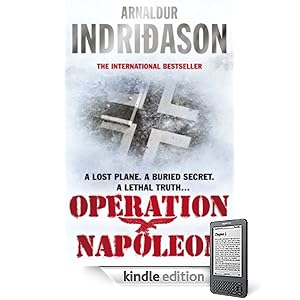
Review: OPERATION NAPOLEON, Arnaldur Indridason

  • Format: Kindle Edition
  • File Size: 711 KB
  • Print Length: 336 pages
  • Publisher: CCV Digital (October 7, 2010)
  • Source: I bought it.
First published with the title Napóleonsskjölin by Vaka Helgafell, Reykjavík in 1999
English translation copyright © Victoria Cribb 2010

Blurb
1945: a German bomber flies over Iceland in a blizzard; the crew have lost their way and eventually crash on the Vatnajökull glacier, the largest in Europe. Inexplicably, there are both German and American officers on board. One of the senior German officers claims that their best chance of survival is to try to walk to the nearest farm and sets off, a briefcase handcuffed to his wrist. He soon disappears into the white vastness.
1999, mid-winter, and the US Army is secretively trying to remove an aeroplane from the Vatnajökull glacier. By coincidence two young Icelanders become involved – but will pay with their lives. Before they are captured, one of the two contacts his sister, Kristin, who will not rest until she discovers the truth of her brother’s fate. Her pursuit puts her in great danger, leading her on a long and hazardous journey in search of the key to the riddle about Operation Napoleon.

My take:
I didn't enjoy this as much as Indridason's Erlendur novels. I kept wondering if Erlendur would make even a cameo appearance. There was a detective (There have been some funny goings on here,’ observed the scruffily dressed detective in his early fifties ) but his appearances really came to nothing.

OPERATION NAPOLEON reminded me of thrillers that I used to read back in the 70s by writers like Jeffrey Jenkins, Alistair MacLean and Clive Cussler. The difference between those and OPERATION NAPOLEON is the character of Kristin. Those earlier thrillers rarely had capable women.
It reminded me also of another novel I reviewed: THE MASK OF ATREUS by A.J. Hartley, mainly I think because of the idea of a secret cargo.

One interesting element was the discussion of Icelandic dependency on US funding and assistance.
Kristin is talking about why her friendship with the American Steve collapsed:
    It’s partly political. I oppose the presence of the American army on Midnesheidi. I could understand its strategic significance during the Cold War, but that didn’t mean I agreed with its presence. I’ve always regarded it as a blot on the landscape. It’s as simple as that. The Icelanders shouldn’t have an army and they certainly shouldn’t get into bed with one. Far too many people have prostituted themselves to the Defense Force already – businessmen, particularly. I should never have allowed things to go so far between us but . . .’
My rating: 4.5

My other Indridason reviews on MiP
ARCTIC CHILL
5.0, HYPOTHERMIA

Other reviews to check
EuroCrime review by Maxine
Review on From the Blue House by Rob Kitchin

I am listing this book in the e-book challenge and Nordic Challenge 2011

13 February 2011

Review: FROZEN TRACKS, Ake Edwardson

Published at Vintage 2008
originally published in Swedish 2007
#3 in the Erik Winter series
English translation by Laurie Thompson
ISBN 978-0-099-47207-0
538 pages
Source: I bought it.

Publisher's blurb
The autumn gloom comes quickly on the Swedish city of Gothenburg, and for Detective Inspector Erik Winter the days seem even shorter, the nights bleaker, when he is faced with two seemingly unrelated sets of perplexing crimes. The investigation of a series of assaults and a string of child abductions take Winter to "the flats," the barren prairies of rural Sweden whose wastelands conceal crimes as sinister as the land itself. Winter must deduce the labyrinthine connections between the cases before it is too late and his own family comes into danger.

My take:
    They never worked on one isolated case at a time. That might have been the situation in the best of all worlds, but that wasn't where they were living. In the best of all worlds they wouldn't have existed at all as a profession. In the best of all worlds there was no such thing as CID detectives, no uniformed police officers. Law and order took care of itself. Everybody lived in a land of milk and honey.
In FROZEN TRACKS Edwardson brings together two seemingly separate threads: assaults on young male university students, and child abductions. The Gothenburg CID knows about the first because a couple of the students sustain life threatening injuries and end up in hospital. Knowledge about the child abductions accumulates only slowly, pointing up a hole in Sweden's decentralised policing system. Parents report severally to their local police station stories their 4 year olds are relating about being taken for a ride in a car, a "mister" who has offered them sweeties. But no-one connects the dots until it is nearly too late, and the stories remain just that, local reports that are never passed on to a central office.

Christmas is approaching, and the various members of DCI Erik Winter's team have their own personal problems, one recovering from recent bereavement, one a wife leaves home unexpectedly, and Winter's own family wants to visit his mother on Costa del Sol. As Christmas gets closer the pressure rises, and in neither investigation are there any reliable witnesses, although the reader sees some of the abduction thread through the eyes of the abductor.
    'This is the country we have built, the new Jerusalem,' said Winter.
Like his more famous country man, Henning Mankell, for whom this is often a theme, Ake Edwardson asks how life in Sweden has come to this.

I'm not sure however that I found the final tying off of the threads particularly credible.
It also seemed to me that Edwardson used the idea that police investigators are routinely, because of economic pressures, required to deal with more than one case at once, as a justification for writing a complex novel in which the same team was required to handle two "serial" threads. I suspect also that it provided for him, as the author, a technically difficult writing challenge - or am I just being a little too cynical?

My rating: 4.4

I'll be counting FROZEN TRACKS as a title in the Nordic Challenge 2011 and also for the letter F in Crime Fiction Alphabet.

Another review to check: Fiona Walker on EuroCrime

11 February 2011

Review: THREE SECONDS, Roslund & Hellstrom


Publisher: Silver Oak, January 2011
Translated from Swedish by Kari Dickson
485 pages
ISBN: 978-1-4027-8592-4
Source: my copy was supplied by the publicist and I participated in a giveaway promo in December 2010.

Check my earlier post for the publisher's blurb. In this one I'm going to focus on "my take".

THREE SECONDS is about a sting set up at the highest level in the Swedish police system to eradicate a Polish drug mafia operating in Sweden. Central to the sting is Paula alias Piet Hoffmann, recruited in gaol some 10 years earlier, a criminal who has been infiltrating the company set up by the Polish mafia.

A botched drug deal that results in the death of a Danish police officer  is designed to put Paula inside prison, to begin infiltration at the highest level. As with all such covert operations there are those who know what is going on and those who don't. There is always the danger that one of those who is "not in the know" will stumble across information that does not add up. One of those excluded from the insider information is Detective Inspector Ewert Grens of the Stockholm City Police. Grens is a dangerous man to leave out of any secret, and he begins in his bulldog fashion to sniff deeper when the facts simply don't tally.

THREE SECONDS wasn't easy reading. The plot seems to be heading in one direction, and then darts off in another. More than once I consulted the Cast of Characters page at the beginning of the novel, and more than once I was glad that the chapters were broken up into digestible bits. But by the middle of what is really quite a long book, I was hooked. I couldn't work out for the life of me how the plot was going to devolve. In the long run it was all very clever. In addition it felt very authentic and credible.

My rating: 4.6

Other reviews to check:
In 2009, THREE SECONDS was awarded the Swedish Academy of Crime Writers' Award for Swedish Crime Novel of the Year.
It was a top 10 best-seller in Sweden for 8 months.
It has been shortlisted in the Best British Novel category (this refers to where it was published) for a 2011 Barry Award.

I am going to list THREE SECONDS in my books for the Nordic Challenge 2011

13 January 2011

Review: BAD INTENTIONS, Karin Fossum

  • Paperback: 192 pages
  • Publisher: Harvill Secker (1 July 2010)
  • Language English (translated from Norwegian by Charlotte Barslund)
  • ISBN-10: 1846552923
  • ISBN-13: 978-1846552922
I read BAD INTENTIONS on my Kindle, a review  e-copy supplied by the publishers Houghton Mifflin Harcourt through NetGalley

Publisher's Blurb
In this chilling return to the Inspector Konrad Sejer series, the detective and his partner investigate the deaths of two teenagers in rural Norway. One victim was a lonely Vietnamese boy, the other a psychiatric patient let out for a weekend in the woods with friends. Grief devastates their two mothers. Sejer can’t help himself and, overcome by sympathy, he promises to deliver an explanation for what has befallen them. The pursuit will bring him face-to-face with pure evil . . .

My take
Once they were just little kids with skinny legs and pointy knees. How did they become so evil?
    Any second now Axel’s green Mercedes will appear around the bend. While he waits, he chews his nails. He has bitten them right down. The tips of his fingers are red and sore. He thinks about everything that has happened and about how he is going to move on. He knows he has to make a choice…. But sometimes we need to face reality. And perhaps that is not fair, but nothing about this situation is fair. It’s best to keep my mouth shut, he thinks, I’m protecting Axel and Reilly. They are my friends, and we’re in this together for ever.
Despite the fact that it is #7 in Fossum's Inspector Sejer series this is not a police procedural. It is rather a melancholic exploration of the way guilt can tunnel its way through the minds of those who feel it. Jon is the first to break and from then on the slippery slide is inevitable for the others. Who will crack next? And did they actually commit a crime?

Sejer and his colleague Skarre seem almost to take a backseat in this novel, observers and prompters to the final undoing:
    He sat listening to the hum of the police station. He liked being a part of a big engine. He liked interrogating people, he liked spotting the lie when it came. A lie had its own pitch, and over many years he had learned to recognize it. He liked the moment when the confession finally spilled out, when all the cards were on the table and the course of events could be mapped and filed.
The story is an exploration too of how sometimes the victims of crime can unexpectedly become allies who force the truth to come out.
There is so much to think about in BAD INTENTIONS and it really came up to my expectations.

My rating: 4.9

Other reviews of Karin Fossum titles on this blog:
 Other reviews of BAD INTENTIONS
I'm going to "use" BAD INTENTIONS in

3 January 2011

Review; THE MAN WHO WENT UP IN SMOKE, Maj Sjowall & Per Wahloo

  • Format: Kindle Edition
  • File Size: 434 KB
  • Print Length: 288 pages
  • Publisher: HarperPerennial (January 16, 2010)
  • Sold by: Amazon Digital Services 
  • Source: I bought it
Originally published 1966.
Translated from Swedish.

Product Description (Amazon)

Martin Beck has just begun his holiday: an August spent with his family on a small island off the coast of Sweden. But when a neighbour gets a phone call, Beck finds himself packed off to Budapest, where a boorish journalist has vanished without a trace. Instead of passing leisurely sun-filled days with his children, Beck must troll about in the Eastern Europe underworld for a man nobody knows, with the aid of the coolly efficient local police, who do business while soaking at the public baths - and at the risk of vanishing along with his quarry.

My take:

Martin Beck could not remember ever being given such a hopeless, meaningless assignment and there are several times after he arrives in Budapest when he feels useless, directionless, as if there is something he ought to be doing, but has no idea what. He contrasts it with his previous case where his involvement in solving a murder had become a personal need.
    Inwardly he cursed the strange impulse that had made him take on this pointless assignment. The possibilities of his solving the case became more and more remote. He was alone and without an idea in his head. And if, on the other hand, he had had any ideas, he would have lacked resources to implement them.
He knows of course why he has taken this case on - "a kind of occupational disease that forced him to take on all assignments and do his best to solve them."
 
And then he realises he is being followed and the followers make the mistake of attacking him. Beck realises he is on the track of something even though at that point he is not sure what. What he refers to as his "policeman's soul" kicks in, and he begins to see connections, and ideas begin to generate.

This is a fascinating read. At about the same time as Martin Beck comes alive with this case, the author tricks the reader into seeing what Beck sees, coming to a similar conclusion. It is hard to explain how this happens, but the story proceeds with pace from that point. And then it all comes together!

My rating: 4.7

 The Martin Beck series (courtesy Fantastic Fiction)
1. Roseanna (1965)
2. The Man Who Went Up in Smoke (1966)
3. The Man on the Balcony (1967)
4. The Laughing Policeman (1968)
     aka Investigation of Murder
5. The Fire Engine That Disappeared (1969)
6. Murder at the Savoy (1970)
7. The Abominable Man (1971)
8. The Locked Room (1972)
9. The Cop Killer (1974)
10. The Terrorists (1975)

Mini-reviews from my records

THE MAN ON THE BALCONY (1967), my rating 4.8
Written with Per Wahloo and set in Stockholm. The introduction in THE MAN ON THE BALCONY, written by Andrew Taylor, comments on the fact that the Martin Beck series has stood the test of time, as fresh now as when this one was written 40 years ago. The man on the balcony is observed, as he constantly watches children in the street, by a neighbour who decides to report him to the police. But he hasn't done anything and the report disappears in the swamp of more pressing cases - a mugger who attacks elderly women in the dark and steals their money, and a series of murders of young girls. The mugger is caught and it is discovered that he probably saw the killer.  Andrew Taylor points out how Sjowall and Wahloo pioneered a new trend in crime fiction veering away from the whodunnit towards the whydunnit. For me what was also interesting was how their Communist/Marxist background coloured their view of what was causing the breakdown of society and the resultant crime.

THE LAUGHING POLICEMAN (1968), my rating 4.8
One blustery November evening someone guns down eight occupants of a Stockholm bus - one of whom was a detective. Eight people together purely by coincidence - perhaps. But, above all, why was that policeman - a solitary and ambitious man - on that bus? An intriguing many stranded mystery, written with co-author (husband) Per Wahloo. A very unexpected ending. Police procedural which takes a very candid look at how organised detection in Sweden actually works. But their procedures do seem very different. The Laughing Policeman won the Edgar in 1971 - the only translated novel ever to do so. Maj Sjöwall (1935--) and Per Wahlöö (1926-75) were husband and wife. They were both committed Marxists and, between 1965 and 1975, they collaborated on ten mysteries featuring Martin Beck. Four of the books have been made into films, most famously The Laughing Policeman, which starred Walter Matthau Worth looking out for.

LinkWithin

Blog Widget by LinkWithin